Where Wonder Carries a Warning
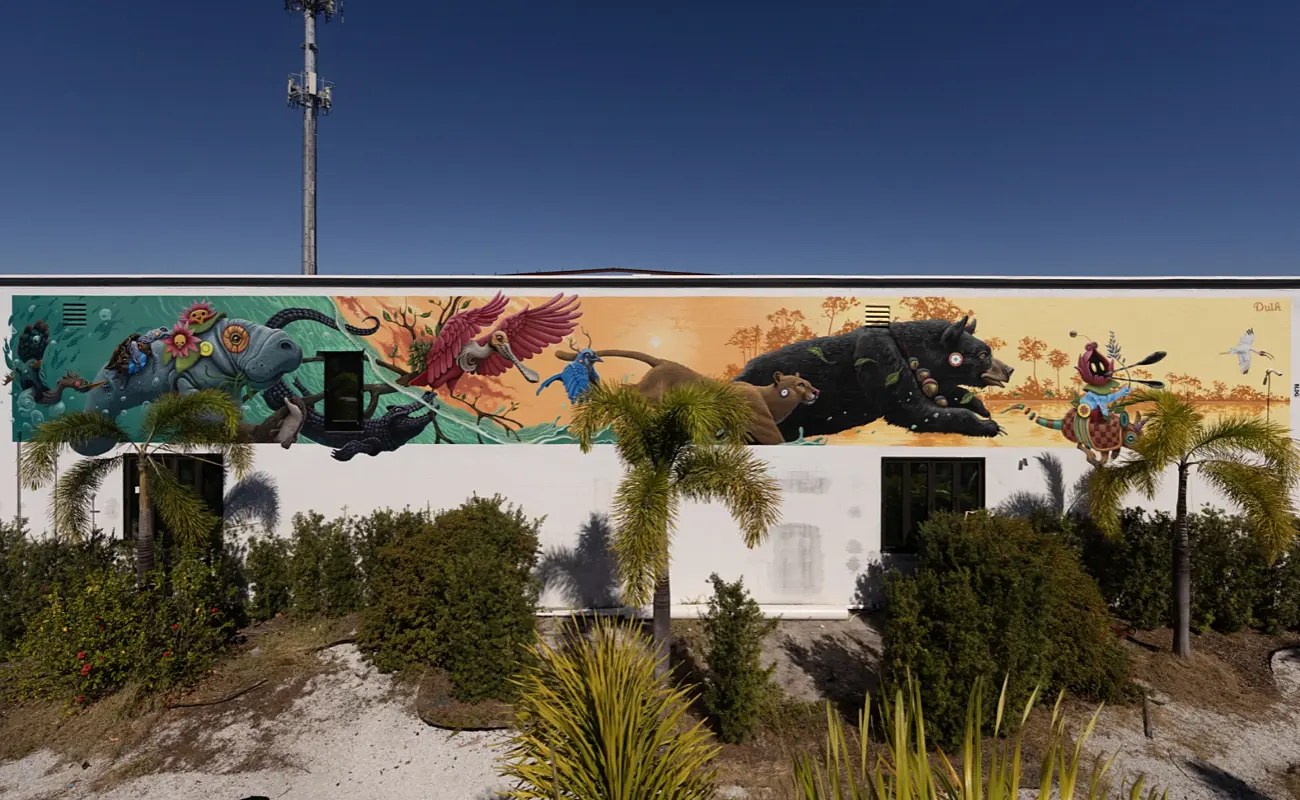
Dulk builds worlds that appear abundant at first glance. Wildlife fills intensely colored compositions where animals merge with plants, architecture, mechanical fragments, ceremonial objects, and pieces of other species. Doors interrupt bodies, whales emerge from unexpected forms, and entire environments seem to grow from living creatures. Yet the Spanish artist, born Antonio Segura Donat in Ontinyent in 1983, uses this visual richness to address something far less idyllic. Endangered species, disappearing habitats, climate change, and human interference sit beneath the seductive surfaces of his paintings, murals, drawings, sculptures, and photographic research.
Animals entered his imagination long before ecological vulnerability became an explicit subject. Childhood books and old natural history encyclopedias inherited from his grandfather introduced him to rhinoceroses, tigers, toucans, and other creatures far removed from his immediate surroundings. His father also maintained an aviary, giving the young artist opportunities to closely observe canaries, goldfinches, and other birds. Afterward, Dulk would draw what he remembered, often allowing recognizable anatomy to shift into something invented. Observation and transformation became intertwined almost from the beginning.
That childhood habit still underpins his practice. Nature is not simply material to depict but something connected to family, memory, curiosity, and the pleasure of discovery. The hybrids populating his mature work extend those early drawings while carrying a more urgent ecological consciousness. Bright color and improbable anatomy may offer an immediate invitation into the image, but danger is rarely far away. The apparent paradise is unstable, and its beauty becomes more affecting precisely because it may not last.

Dulk: From Graffiti Walls to Imagined Species
Graffiti introduced another decisive language when Dulk was around eighteen. Encouraged by a friend, he began painting walls under the name that would eventually become his professional identity. Initially, Antonio Segura and Dulk occupied separate creative territories, with his given name attached to illustration and his alias reserved for street work. Those identities gradually converged. His education developed alongside this period, including illustration studies at the School of Art and Design in Alcoy from 2002 to 2005, graphic design in Valencia from 2006 to 2009, and further study at St Lukas School of Art in Brussels in 2010.
Work in illustration, animation, fashion, advertising, and graphic design broadened his technical foundation. That background remains visible in the controlled compositions and strong graphic readability of his images, even as his approach has moved toward greater naturalism. Dulk describes his earlier work as more cartoon-like, while later paintings and murals rely increasingly on detailed animal anatomy. The shift toward realism has not reduced the strangeness. Instead, believable creatures make the impossible transformations surrounding them feel more immediate.
René Magritte, Salvador Dalí, and Hieronymus Bosch are among the artists Dulk admires, providing useful context for his combination of precision and irrationality. His own symbolic vocabulary includes skulls, hearts, bells, circus tents, bullseyes, and doors. A target placed on an animal communicates threat with stark economy, while a doorway can suggest access to another imagined world. The circus carries greater ambiguity. It recalls childhood spectacle and magic while pointing toward the troubling history of animals turned into entertainment. Such contradictions are central to his work, where innocence can sit beside violence and visual pleasure can conceal approaching loss.

From Field Observation to Ecological Fiction
Research has become increasingly important as Dulk has brought greater specificity to his subjects. Before developing a painting or mural, he studies species, behavior, landscapes, and environmental conditions, gathers photographic references, and constructs compositions digitally before translating them through drawing and paint. Acrylic is a principal studio medium because its rapid drying time accommodates the pace at which he prefers to work while supporting saturated color and detailed modeling. Photography has become equally important, particularly when the images originate from his own encounters with wildlife.
A pivotal experience came in Churchill, Manitoba, in 2018 while he was producing The Last Winter, a mural examining the uncertain future of polar bears and beluga whales under climate change. Observing the wildlife of Hudson Bay while working changed his understanding of what artistic research could involve. Previously, much of his information had come through books and online imagery. Direct contact with animals, their behavior, and the landscapes they inhabit gave him another kind of knowledge. Travel and firsthand observation subsequently became fundamental parts of his process.
That approach has produced works anchored to identifiable animals and ecosystems. The 2019 mural Fragile in Jacó, Costa Rica, drew upon the story of Grecia, a toucan that survived severe damage to its upper beak and received a prosthetic replacement. Dulk later visited the bird, strengthening the connection between a fantastic image and a specific case of animal welfare. In Valencia, Rondalla del Fang transformed concern for the Albufera wetland into an immersive installation at the Centre del Carme Cultura Contemporània in 2021. Fantastic flora and fauna, aquatic imagery, shifting light, mural painting, and large-scale spatial elements allowed visitors to physically enter an environment inspired by the ecological survival of a place closely connected to Valencian identity.

Dulk: Protecting What Remains
Public space gives Dulk a different relationship with both scale and audience. Murals retain the freedom associated with his graffiti beginnings while introducing architecture, weather, speed, and unpredictability into the process. A painting or sculpture permits sustained control and fine detail, whereas a wall becomes part of a neighborhood and can be encountered repeatedly by people who never intended to visit an exhibition. He sees these modes as complementary. That movement between controlled studio environments and unpredictable public settings also echoes his subject matter, which repeatedly confronts natural systems whose stability can no longer be assumed.
His 2022 municipal falla for Valencia, Protegeix allò que estimes (Protect What You Love), gave that instability a particularly striking physical form. The monumental sculpture centered on threatened habitats and vulnerable species while participating in a tradition that culminates with the artwork being consumed by fire. Destruction was therefore not merely represented but embedded in the work’s fate. Around the same period, Procés Natural at the Centre del Carme exposed the labor behind Dulk’s finished imagery through preparatory drawings, documentation, sculpture, original works, and materials associated with murals and animation. Together, the projects revealed how extensively his seemingly spontaneous fantasy depends upon research, organization, experimentation, and translation between media.
More recent collaborations have brought scientific conservation knowledge directly into this visual system. The Giant Change, a monumental mixed-media flamingo inspired by the Albufera and the global vulnerability of wetlands, entered the permanent collection of Amsterdam’s STRAAT Museum. For Mediterraneus, created with the Oceanogràfic de València and its foundation, Dulk worked with biologists and veterinarians on a mural involving more than twenty Mediterranean species. Its spiral composition incorporates invasive species, coral bleaching, plastic pollution, ghost nets, overfishing, and habitat degradation without surrendering the imaginative character of his work. His role with Lindblad Expeditions and National Geographic as an expedition expert further connects wildlife photography, field observation, conservation research, and art. The creatures may remain impossible, but the dangers surrounding them are increasingly specific, transforming the childhood wonder that first led Dulk toward animals into a visual argument for paying closer attention to what could disappear.