“Art is the fundamental pillar of civilisation and my own idiosyncratic way of navigating the world.”
Finding Freedom Through Art and Experience
Kasia Turajczyk has built an artistic practice shaped by movement across cultures, intellectual curiosity, and an unwavering commitment to creative freedom. Born in Poland with both Polish and German heritage, she has lived in several European countries before settling in England in 2010. Her early years unfolded within the restrictive atmosphere of communist Poland, where grey urban landscapes, socialist realist architecture, and political hardship contrasted sharply with the vibrant inner world she cultivated through books, drawing, music, theatre, cinema, visits to historic buildings, and the love of her grandparents and relatives. These experiences established art not simply as a pastime but as an essential refuge that allowed her imagination to flourish despite difficult surroundings.
From childhood, creativity became inseparable from everyday life. While other children collected toys, Turajczyk found lasting companionship in pencils, paper, and books devoted to great painters from across Europe. Reading biographies of celebrated artists sparked an enduring fascination with artistic achievement while reinforcing the belief that imagination could overcome even the bleakest environments. Ancient and historical buildings, opera, ballet, literature, and museums, which expanded her visual vocabulary long before she considered a professional artistic career. These formative influences continue to echo throughout her paintings, where memory, symbolism, and emotional honesty remain central concerns that connect personal history with universal human experience.
Painting has always been a natural extension of Turajczyk’s personality rather than a career choice that emerged later in life. One of her earliest artistic memories involved covering the white wall of her parents’ living room with fruit painted directly onto its surface after gathering produce from the kitchen. That playful act captured the fearless experimentation that still defines her practice today. She approaches each canvas as an opportunity for discovery, allowing structured ideas to coexist with spontaneous decisions. Her work moves fluidly between surreal narratives and abstract expression, driven by a desire to tell stories while remaining open to unexpected visual transformations that emerge during the creative process.

Kasia Turajczyk: Between Intellectual Curiosity and Emotional Expression
Turajczyk’s artistic philosophy reflects an unusually broad intellectual foundation that extends well beyond visual art. Alongside studies in history, the humanities, literature, and philosophy, she explored mathematics, quantum physics, astronomy, and finance, embracing knowledge with the same curiosity that first attracted her to Leonardo da Vinci. She admires the Renaissance master not only for extraordinary artistic ability but also for his relentless pursuit of understanding across disciplines. That multidisciplinary mindset continues to inform her paintings, where visual storytelling frequently intersects with scientific curiosity, philosophical reflection, and questions surrounding human existence. Rather than separating emotion from intellect, she consistently seeks moments where both can enrich one another on the canvas.
The diversity of her artistic influences reflects both historical depth and remarkable openness. Salvador Dalí introduced her to the possibilities of surreal imagination during her youth, while Albrecht Dürer’s technical brilliance initially inspired admiration mixed with self doubt. Discovering abstraction eventually released her from the pressure of pursuing perfection through traditional mastery alone. Medieval Sienese and Florentine painting remains a lasting source of inspiration because of its sincerity, luminous colour, and emotional conviction, qualities she values regardless of her own secular worldview. She also credits Remedios Varo, Francisco Goya, Paul Cézanne, Japanese Ukiyo-e masters such as Hiroshige, Polish painter Witold Wojtkiewicz, and Anselm Kiefer with shaping different aspects of her evolving artistic language.
Life itself remains her richest source of inspiration. Nature, literature, politics, travel, music, architecture, and everyday encounters continually generate new ideas that later develop into paintings. Her experiences as an immigrant have heightened her sensitivity toward injustice, prejudice, and unequal treatment, making empathy a defining characteristic of both her personality and creative vision. Rather than isolating herself within the studio, she absorbs impressions from cities, landscapes, conversations, books, and cultural events, allowing these experiences to accumulate before they emerge visually. Colour, atmosphere, memory, and emotion become interconnected, creating paintings that invite viewers to reflect on society while also exploring deeply personal psychological landscapes.

Stories, Symbols, and the Architecture of Imagination
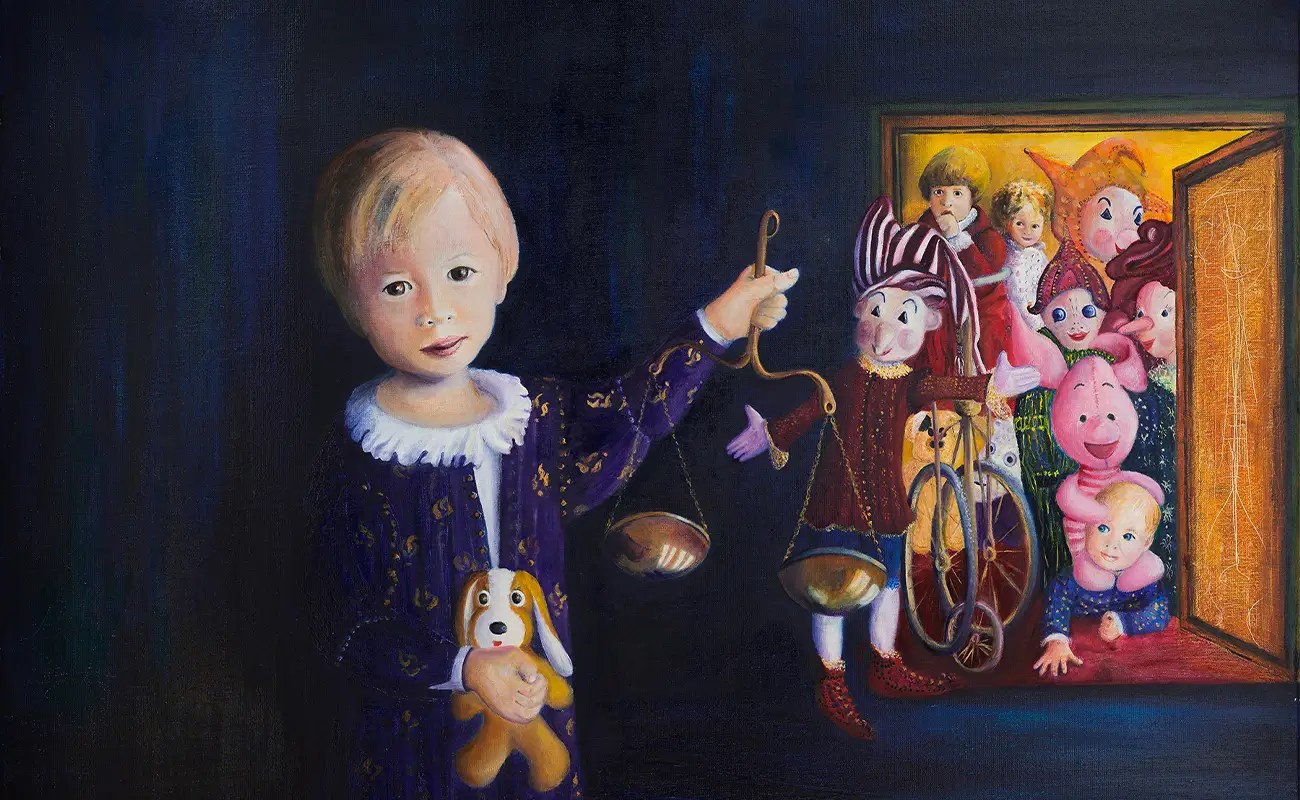
Among Turajczyk’s many works, The Loony Bin of Life occupies a particularly meaningful place. Created in oil on canvas, this symbolic surreal painting expresses profound disappointment with the failures of adulthood and the consequences those failures impose upon younger generations. Pinocchio, a recurring figure throughout her artistic practice, becomes the central character in this imaginative narrative. Initially envisioned as a monumental figure on a large canvas, the concept evolved after an earlier sketch featuring children, fantastical creatures, banners, and protests against the absurdities of adult society. That first composition sparked a more ambitious vision that transformed overnight into a richer symbolic landscape filled with movement and emotional urgency.
The finished concept centres on a giant Pinocchio within a carousel populated by children, toys, and beautifully crafted wooden horses. The merry go round becomes a metaphorical institution representing the chaos and irrationality of modern life, while its young occupants long to escape the systems imposed upon them. Pinocchio occupies a unique position between puppet and human, making him an ideal guide capable of helping others find freedom. Through fantasy, Turajczyk addresses serious social concerns without abandoning the visual wonder that defines her surreal imagery. The painting demonstrates her ability to combine storytelling, symbolism, and emotional critique while preserving a sense of imagination that encourages viewers to engage with its layered meanings.
Another deeply personal work, My Brain: The Conversation with My Cosmos, explores imagination through abstraction and mixed media. Constructed using acrylic paint alongside discarded compact discs, wires, wood, plastic, seeds, screws, nails, nuts, and other found materials, the piece emerged through an unusually intuitive process completed outdoors on the grass near her studio. Turajczyk describes the painting as a conversation between her mind and the wider universe, with the brain functioning as both storyteller and creator of an imagined world. The work reflects her empathy toward social inequality, environmental destruction, and the disappearance of animal and plant species. Its unconventional materials, energetic construction, and emotionally charged symbolism reveal an artist committed to expressing both intellectual inquiry and deeply felt compassion through innovative visual language.

Kasia Turajczyk: A Practice Guided by Curiosity and Constant Discovery
Daily life in Turajczyk’s studio follows no rigid schedule because each painting develops according to its own rhythm. Some days begin with painting at sunrise, while others continue long into the night. Travel frequently interrupts studio routines, yet these journeys become productive extensions of her practice because she always carries sketchbooks to record observations and develop new concepts. Reading occupies as much importance as painting itself, with an extensive personal library offering continual access to historical movements, artistic techniques, and fresh perspectives. Long walks often become moments of reflection during which she mentally examines unfinished works before returning to them with renewed clarity and purpose.
Her creative process depends upon patience as much as action. Turajczyk often spends considerable time simply observing a canvas, walking around it, making another espresso, and thinking through possibilities before applying another brushstroke. Multiple paintings usually develop simultaneously, allowing her to shift between surreal compositions, abstract works, and drawings whenever one project requires distance before reaching completion. She openly acknowledges that artists inevitably absorb ideas from earlier generations, viewing this dialogue with history as an essential part of artistic development rather than something to avoid. For her, the greatest satisfaction arrives when complete concentration takes over and external concerns disappear, leaving only the evolving relationship between artist and painting.
Looking ahead, Turajczyk is developing an ambitious body of work titled Chromatic Counterpoint: The Polyphonic Canvas. This series seeks to transform her lifelong relationship with music into a visual language that extends beyond simple illustration. Combining figurative imagery with structural abstraction, the project layers semi abstract portraits of influential composers alongside musical notation and multilingual texts. Through this approach, she investigates the meeting point between emotion and intellect while acknowledging the cultural and historical importance of music itself. After beginning with three abstract studies, she is now expanding the concept into its principal works, treating each canvas as a complex system of visual signs that unites academic research, artistic experimentation, and personal emotional response.