“Then, when he was gone, they shattered into stardust.”
Painting the Invisible Between Night and Memory
Silvia Righetti approaches painting as a language for experiences that resist ordinary description. Working through abstraction, fragments of landscape, textured colour, and intimate forms of storytelling, she gives visual presence to silence, memory, dreams, and emotional states that often remain concealed. Her practice moves between painting and writing, two linear disciplines that allow her to express thoughts beyond the restrictions of social convention. Although her professional background extends across architecture, design, and creative direction, the canvas and the page remain her most personal territories. Nocturnal atmospheres frequently shape her visual vocabulary, partly because she often paints at night, when dark tones, shadows, and concentrated stillness naturally enter the work. Science, psychology, folklore, and the movement of the natural world provide further points of connection. Rather than illustrating these subjects literally, Righetti uses them to investigate uncertainty, vulnerability, transformation, and the invisible forces that influence human perception.
Her relationship with art began beside Lake Garda in Italy, where she discovered writing and painting during childhood. At eight years old, she started attending the studio of a local painter, gaining early experience through artistic projects and exhibitions. Those formative encounters presented art not simply as a technical pursuit, but as a sustained way of observing and responding to the world. Righetti later moved to Venice to study Architecture at IUAV, specialising in immersive theatre. The city offered an environment in which architecture, performance, visual art, and public space continuously intersected. Exposure to the Venice Art and Architecture Biennale brought her into contact with international artists and multidisciplinary production, strengthening her interest in sculpture, photography, set design, and multimedia installation. During this period, she recognised that creating art was not an occasional activity but a personal necessity. Artistic life became inseparable from continual movement, intellectual curiosity, collaboration, spiritual inquiry, and the freedom to change direction without abandoning a central emotional purpose.
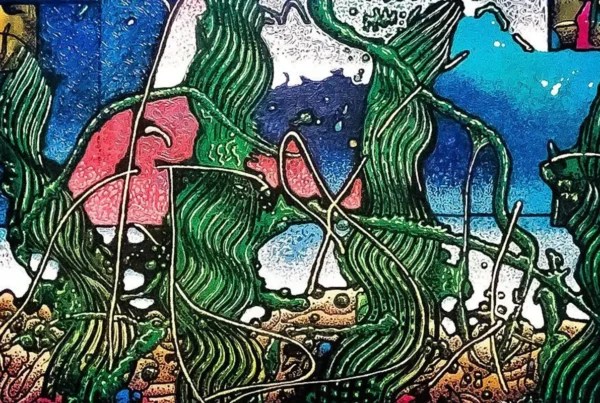
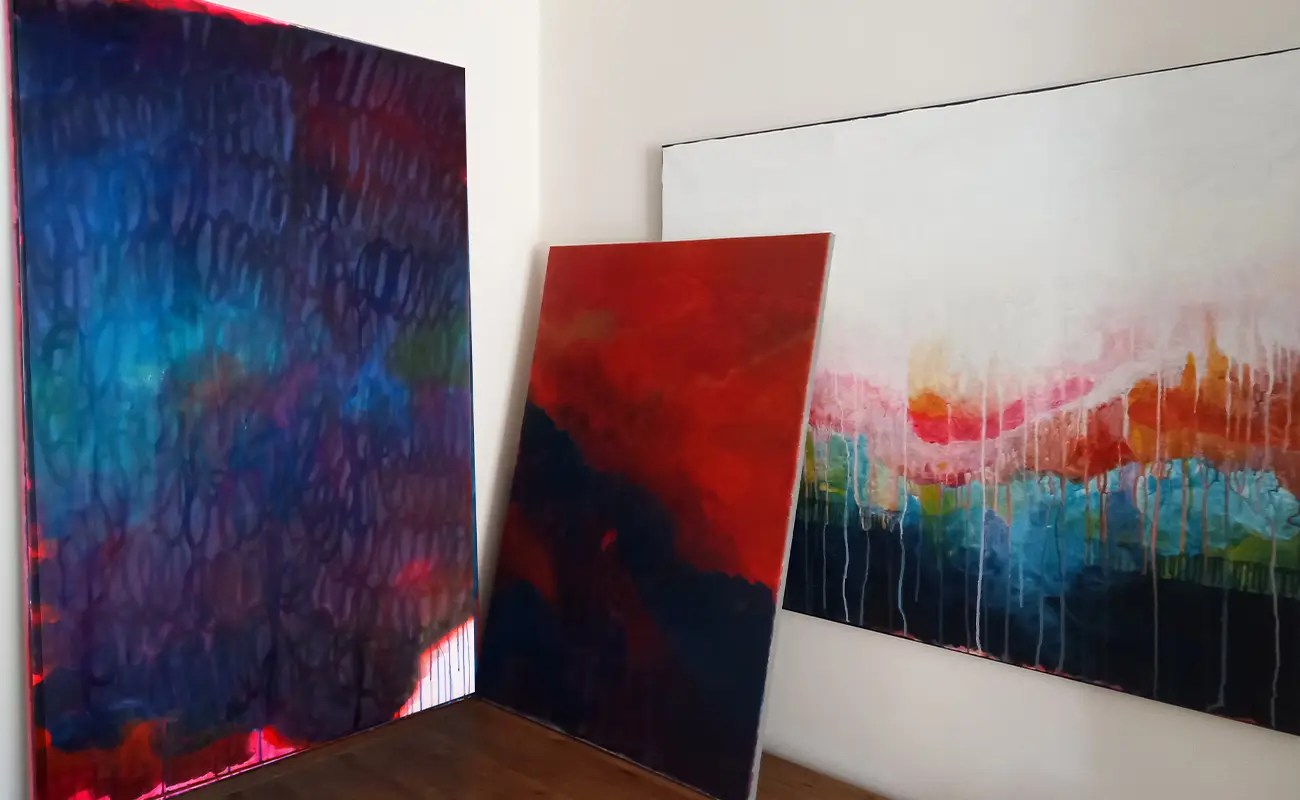
Painting remains the foundation of Righetti’s practice because it allows physical gesture, thought, and emotion to operate simultaneously. She understands the act as a bodily exercise in which the hand moves across the surface with the responsiveness of a dancer following, altering, or discovering a choreography. Lines can become sinuous or controlled according to a mood, memory, dream, or passing thought. Her images frequently balance geometry with disorder, combining recognisable traces of the natural world with forms that remain unresolved. She seeks ways to suggest silence through visual intensity, music through flowing colour, and darkness through dense layers of paint. Landscape is present, but seldom as conventional scenery. It becomes psychological, unstable, and open to transformation. Water, celestial movement, fog, gardens, meadows, and changing light enter the work as emotional structures. This approach places Righetti between representation and abstraction, where a familiar place can dissolve into atmosphere and a private sensation can gradually acquire a material, spatial, or symbolic form.

Silvia Righetti: A Practice Formed by Movement and Exchange
Righetti’s architectural education gave her a lasting awareness of how bodies, objects, light, and stories interact within space. Her specialisation in immersive theatre encouraged her to consider artworks as experiences rather than isolated objects. While studying in Venice, she participated in projects that crossed sculpture, performance, video, painting, and installation, developing a sensitivity to materials and to the theatrical relationship between an artwork and its surroundings. A scholarship later took her to Paris, where she collaborated with French artist and set designer Gérard Cholot on a multimedia installation involving light, glass, and video at the Perrier factory in Nîmes. Back in Venice, she wrote, directed, and performed in Egg O for Social Sculpture No. 2, organised by the Peggy Guggenheim Foundation for a symposium at Teatro Fondamenta Nuove. Conceived as a food based action concerning love and identity, the performance demonstrated her early interest in transforming personal and social questions into shared sensory experiences.
Further projects continued this movement across disciplines. Righetti developed a video mapping work focused on the island of Giudecca and presented it at the Academy of Fine Arts. She also took part in the Linea D’Acqua Art Festival with Iotu Dance, a digital installation examining movement, sensuality, the self, and the other within relational space. These experiences strengthened her understanding of storytelling as something that can unfold through images, materials, architecture, sound, and physical presence. Her subsequent work with artists and organisations connected to the Venice Biennale exposed her to varied approaches to site specific production and creative strategy. She collaborated with Creative New Zealand, the Australian Art Council, and independent institutions while encountering the practices of artists including Et Al, Bill Culbert, Simon Denny, and Fiona Hall. Such exchanges expanded her technical knowledge, but their deeper influence came from witnessing how artistic ideas evolve through dialogue, practical constraints, institutional settings, and the unpredictable conditions of public presentation.
Two women have held particular importance as mentors within Righetti’s development. Her long collaboration with sculptor and light artist Federica Marangoni introduced her to new technologies, materials, exhibition production, publications, and spatial approaches to sculpture. Their professional relationship has continued across many years, most recently through the 2024 exhibition of Marangoni at the Murano Glass Museum, for which Righetti co-curated the installation and accompanying Electa publication. Angiola Churchill also offered a powerful model through her work as an artist, educator, and former leader within the New York University Studio Art Program in Venice. Righetti collaborated with Churchill on the exhibition and publication White Space at Palazzo Reale in Naples. During a period in New York, she also worked with Finnish artist Kaarina Kaikkonen and later co-curated a proposal for a floating installation associated with the 2015 Venice Art Biennale. These relationships reinforced her belief that artistic identity grows through sustained exchange, generosity, experimentation, and contact with other creative lives.

When Grief Becomes Weather
Beneath Righetti’s collaborative and interdisciplinary career lies a private practice concerned with emotional exposure. For several years, she has incorporated hypnotherapy into her painting process, using it to interpret dreams, fears, personal limitations, and experiences connected to her identity as a woman. The subconscious is not treated as a source of fixed symbols. Instead, it becomes an uncertain guide toward sensations and images she does not yet understand. This method allows fragility and delicacy to emerge without being forced into conventional explanations. Everyday scenes can release streams of memory, while apparently simple objects can acquire psychological or spiritual weight. Music also plays an essential role, affecting rhythm, gesture, and the internal energy of a composition. Righetti describes its influence in cellular terms, suggesting a transformation so intense that the body itself seems to change. Painting therefore operates as both discovery and confrontation, opening access to experiences that can feel exhilarating, disorienting, or difficult to communicate through direct language.
The ongoing series Cells of Time emerged from one of the most painful periods of her life. Righetti cared for her father during his terminal illness, and the final six months were shaped by suffering, suspended expectation, and the repeated awareness of time passing. In July 2023, enormous hailstones unexpectedly struck the family home. Their violent impact on the roof merged in her memory with her father’s heartbeat, the family’s held breath, and the emotional pressure of waiting. The sound became a discordant composition, comparable to confused musicians playing somewhere beyond reach. Those white spheres of ice eventually became visual units through which she could imagine the hours spent between hope and uncertainty. After her father died, the remembered forms changed again, breaking apart in her imagination like stardust. The series began as a means of processing grief, but it also gave material form to the strange convergence of private loss, natural violence, bodily vulnerability, and altered perceptions of duration.
Cells of Time has developed through acrylic and ink on canvas, including works made in Berlin and near Lake Garda between 2023 and 2026. In Small Cells of Time, in the series of smaller works, she transforms remembered hailstones into suspended forms charged with grief and endurance, while in the larger canvases she connects the extreme weather event more directly with the silence of her father’s final condition. Moon Tears similarly presents illuminated ice beneath an observant blue moon, drawing together celestial imagery, environmental disruption, and intimate sorrow. What began as an attempt to turn tragedy into beauty has gradually widened into an investigation of climate change and increasingly excessive natural phenomena. The work does not separate personal mourning from ecological instability. Instead, it considers how a single event can hold several realities at once, functioning as a memory, a weather pattern, a visual rhythm, a record of helplessness, and a warning about planetary change.

Silvia Righetti: Expanding the Canvas into Space
After spending two years moving between Berlin, Italy, and the United Kingdom, Righetti chose to establish herself in a small town in Buckinghamshire, outside London. There, she is reorganising her studio in the hope of dedicating more sustained time to her artistic practice. Her daily process remains intimate and fluid, connecting painting with the movement of writing and music. She trains her hands and attention through repeated making, allowing different media to meet as naturally as pigments blend on a palette. Acrylic and ink continue to play central roles, while collage and fabric are becoming increasingly important within new paintings. These additions are not simply decorative experiments. They extend her interest in instability, layering, memory, and changing identity. Night remains a productive working environment, bringing dark tones and concentrated attention into the studio. The resulting surfaces often feel caught between emergence and disappearance, as though forms are becoming visible only briefly before shifting into another emotional or material condition.
Righetti now plans to transform Cells of Time into an installation incorporating sculpture and sound, developed in collaboration with a musician. This expansion grows directly from the original experience, in which noise, architecture, weather, bodily tension, and memory were inseparable. A spatial version can give the remembered hailstorm a physical and acoustic presence, allowing viewers to encounter the work through movement as well as sight. Concepts involving fabric and wood have already extended the project beyond the canvas, showing how its circular forms might inhabit a room rather than remain contained within a painted surface. Her earlier installations provide a strong foundation for this direction. Authenticity, created from printed cotton during the Covid period, reconstructed the experience of viewing an empty external world through domestic curtains. Silent Mermaid and Fog used metal prints on aluminium to connect narrative fragments with darkness, water, waiting, and unexpected human arrival. Across these works, material choice consistently serves emotional and spatial meaning.
Borders remain one of the central concerns guiding Righetti’s future work. She is interested in divisions between people, nations, languages, life and death, time and space, as well as the uncertain zones where those distinctions begin to weaken. Places that lose their original identity and become fluid, hybrid, or difficult to name hold particular fascination. Architecture taught her to read space structurally, while immersive theatre showed how narrative can alter the way a place is experienced. Painting gives her another route into the same questions, permitting visible and invisible elements to coexist without requiring resolution. Works such as Misty / Mystical Giudecca transform Venice into a location that is known yet visually elusive, suspended between fog, water, history, and imagination. Lavarone layers personal familiarity with the presence of Sigmund Freud, wartime history, mountain landscape, and the propagation of memory. Through future paintings and installations, Righetti continues to follow such unstable edges, allowing materials, stories, and subconscious images to reveal realities that remain in motion.