
Garments, Traces, and the Architecture of Absence
A dress without a wearer can become more psychologically charged than a represented body, and Yulya Pakalina’s work repeatedly draws power from this contradiction. Her garments, bodily fragments, stitched figures, and suspended structures function as containers whose occupants have withdrawn, dissolved, or become difficult to locate. Trained in fashion and now working across textiles, printmaking, clay, and installation, Pakalina retains an acute understanding of how clothing organizes the human figure. She no longer treats the garment primarily as a functional or commercial design object. Instead, she uses it to register emotional pressure, social expectation, vulnerability, and the unstable boundary between visibility and disappearance. The submitted works reveal a practice in which material and subject are closely aligned. Fabric carries memory through folds, seams, abrasions, and repairs, while printmaking produces the ghostly impressions and imperfect repetitions appropriate to a body of work concerned with diminished presence. Pakalina’s significance lies in this transformation of familiar feminine forms into uncertain psychological structures. Her dresses do not simply symbolize women; they examine how identity is shaped, displayed, disciplined, protected, and sometimes emptied out.
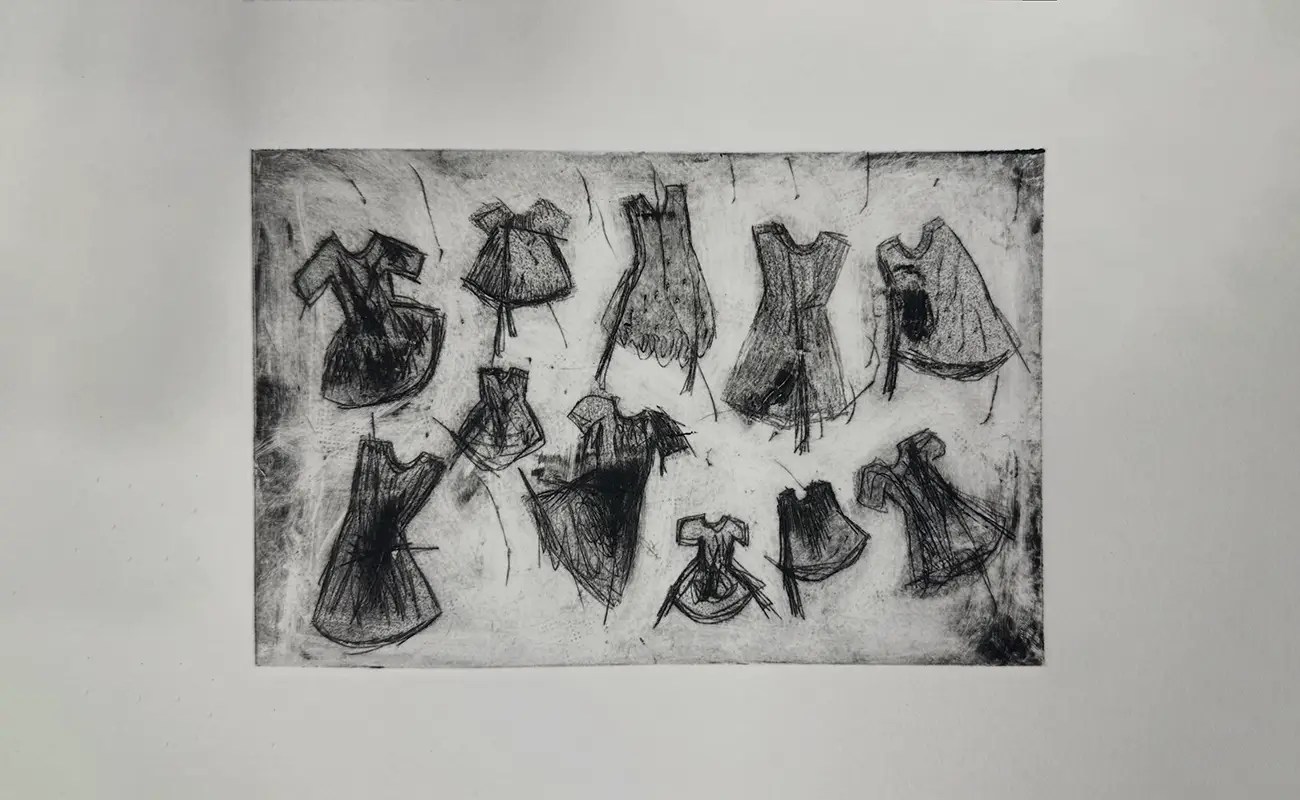
This approach is particularly concentrated in Dress for a Diminished Self, the 2024 series of small-scale etchings, monoprints, and drypoints. One submitted print presents a single dress suspended from a hanger, its bodice and skirt surrounded by knots, bows, lace-like networks, and dark accumulations. The garment appears decorative at first, yet the dense monochrome surface gradually turns ornament into pressure. Curled lines gather around the lower hem like tangled thought, while irregular fields of ink make the surrounding space feel stained, weathered, or psychologically saturated. Another print arranges multiple dresses across a pale rectangular field, creating an unstable archive of silhouettes. The forms vary in size, weight, and tonal density, but none is inhabited. Some resemble preliminary fashion sketches, while others appear damaged, crossed out, or partially erased. This oscillation between design vocabulary and expressive mark-making is central to the series. Fashion drawing traditionally anticipates a finished object and an idealized wearer, but Pakalina reverses that logic. Her printed dresses look backward, carrying the residue of bodies and identities that cannot be fully recovered.
The strongest images in this group make absence active rather than merely melancholic. A pale bodysuit or childlike garment floats against a dense black ground, carrying a handwritten statement about looking within and contemplating the self. The form is visually exposed, but the text complicates that exposure by redirecting attention toward interiority. Loose threads extend beyond the printed rectangle, allowing the work to exceed the clean boundary traditionally associated with works on paper. These interruptions are important because they prevent the garment from becoming a closed emblem. It remains connected to unfinished processes, unstable attachments, and the physical act of making. Elsewhere, photographic or printed fragments of legs, lace, straps, and undergarments are distributed across white space, producing a composition that feels both intimate and estranged. The body is present through cropped evidence rather than complete representation. Pakalina’s images therefore resist the certainty of portraiture. They ask viewers to reconstruct a subject from clothing, gesture, and residue, while also making that reconstruction impossible. Such refusal gives the work its emotional tension and protects it from becoming a straightforward narrative of disappearance.

Yulya Pakalina: The Female Body Between Protection and Exposure
Threads of Worry, created in 2026, advances Pakalina’s concerns by shifting emphasis from the empty garment toward the vulnerable figure. The series consists of fifteen-centimetre-square embroideries grouped under the titles The Unbearable Lightness of Being, A Quiet Armouring, and Swamped. Their small scale requires physical proximity, making viewing feel private and almost confidential. Within the submitted examples, women kneel, curl inward, float, or cover themselves. Black thread creates spare bodily contours, while clear faceted beads and crystals accumulate into burdens, coverings, droplets, or surrounding particles. The contrast between dark stitched lines and reflective embellishment is especially effective. Materials associated with adornment and luxury become visual equivalents for emotional weight. In one embroidery, a kneeling figure appears submerged beneath a dense rectangular field of translucent beads, with only parts of the body and a concentrated red area remaining visible. In another, the figure’s outline is surrounded by isolated bead clusters that suggest drifting matter, tears, or thoughts without resolving into a single symbol. The works transform anxiety into a physical relationship between line, surface, repetition, and weight.
The three groups within Threads of Worry establish distinct emotional registers while remaining materially coherent. The Unbearable Lightness of Being can be read through figures that seem suspended or insufficiently anchored, their outlines vulnerable within expansive fields of unworked cloth. A Quiet Armouring is suggested by accumulations of beads that shield the body while simultaneously burdening it. Protection here is never neutral. A covering can offer safety, yet it can also restrict movement or make the concealed wound more conspicuous. Swamped intensifies this ambiguity through compositions in which the figure is visually overtaken by shining material. The patient repetition of embroidery gives these images conceptual credibility because the process itself enacts the artist’s attempt to manage inward pressure. Each stitch fixes a small point in place, but the completed images continue to convey drift and emotional instability. Pakalina’s challenge is to preserve this balance between personal specificity and broader resonance. The series succeeds when beads function structurally rather than decoratively, altering the body’s visibility and redistributing visual weight across the cloth. The most compelling pieces allow beauty to attract attention before revealing its connection to concealment, exhaustion, and psychic strain.
Related submitted works expand this language beyond the embroidery hoop. Two pale garment-shaped fabric panels mounted directly on a wall include an isolated eye and descending dark droplets, linking clothing, surveillance, grief, and bodily fragmentation. Their rough edges, seams, folds, and small abrasions resist the refinement expected of tailored fabric. The material appears vulnerable because it has been handled, opened, and incompletely repaired. A suspended brassiere-like structure made from fine dark filament or wire offers another interpretation of exposure. Positioned against a frosted window, it is simultaneously intimate object, linear drawing, and unstable sculpture. Clear droplets hang beneath its open cups, turning an item associated with bodily support into a fragile vessel that cannot contain what passes through it. Light entering from behind makes the form seem nearly weightless, although its tangled construction communicates tension. These works demonstrate Pakalina’s ability to convert garments into emotional anatomies. The female body is not represented as a stable object for viewing; it is dispersed across supports, apertures, traces, tears, seams, and structures that alternately hold and fail to hold.

Domestic Space, Material Memory, and Public Visibility
The 2025 solo exhibition Right to Dry places Pakalina’s intimate vocabulary within a wider social and architectural context. Inspired by the freedom to hang laundry openly in shared or visible spaces, the project examines how an ordinary domestic action can reveal systems of judgement, respectability, permission, and control. One submitted installation image shows pale fabric descending from a small opening in a worn white wall. The cloth is layered, semi-transparent, irregularly cut, and marked with faint text, while darker strips hang toward the floor. Cracks, stains, exposed plaster, and peeling surfaces become active participants in the work. Rather than using a neutral gallery wall as passive background, Pakalina allows the architecture to echo the fabric’s vulnerability. Both wall and garment-like form carry evidence of age, pressure, and exposure. The resulting image is quiet but politically alert. Laundry becomes more than a domestic object; it becomes a sign of who is permitted to occupy visible space and which forms of private life may be publicly acknowledged. The work’s restraint allows these questions to emerge without being reduced to a slogan.
The exhibition also clarifies the continuity between Pakalina’s personal and social concerns. Her inward-looking works address diminished selfhood, anxiety, and emotional burden, while Right to Dry considers the external conditions that influence how a self is presented. These are not separate subjects. Clothing mediates between the body and its surroundings, and laundry makes that mediation publicly legible. A garment on a body participates in identity, protection, and social performance. The same garment hanging to dry becomes evidence of domestic routine, economic circumstance, cultural convention, and physical habitation. Pakalina’s fashion background gives her a precise understanding of this transition from worn object to exposed object. Her installation practice extends the logic of the empty dresses in Dress for a Diminished Self: the absent wearer remains implied, but the surrounding space now carries greater authority. Windows, damaged walls, hooks, lines, and hanging points determine how the work is read. This spatial sensitivity offers an important direction for her practice because it moves the garment beyond symbolic illustration and places it within structures that regulate visibility, privacy, and belonging.
Pakalina’s use of textiles enters a substantial history of feminist artists reclaiming sewing, embroidery, and domestic materials as serious conceptual languages. Her practice also shares concerns with artists who have used clothing and bodily fragments to address memory, gendered labour, trauma, and absence. Connections can be drawn to Louise Bourgeois’s sewn bodies and fabric constructions, Annette Messager’s accumulations of intimate objects and images, and Mona Hatoum’s transformations of domestic forms into psychologically charged structures. These comparisons should not be treated as claims of direct influence. They help identify the field in which Pakalina’s work operates and the standards against which it can be assessed. Her distinctive contribution lies in the movement between fashion literacy, printmaking’s unstable impressions, and embroidery’s time-based physical repetition. The work is most original when these languages do not merely coexist but alter one another. Printed dresses begin to resemble damaged textiles, stitches behave like drawn lines, beads become emotional architecture, and installations turn domestic fabric into a public proposition. This interchange creates genuine thematic cohesion across media.

Yulya Pakalina: Cohesion, Critical Tension, and Artistic Position
The progression visible across Pakalina’s submitted works feels natural because it is guided by a consistent set of questions rather than by loyalty to a single technique. Printmaking initially offers a productive distance from the body. Etching, monoprint, and drypoint create silhouettes, stains, repetitions, and incomplete impressions through which identity can appear indirect or partially erased. Textile works bring the inquiry closer to touch, duration, and physical vulnerability. Installation then opens the work outward, allowing architecture and public visibility to participate in meaning. Clay introduces another form of bodily translation. A submitted pale clay work resembles a spread garment, bodily membrane, or folded skin from which a violet flower rises on a slender stem. The contrast between the cracked white surface and saturated purple bloom creates a more overtly lyrical image than the monochrome prints and embroideries. Its strength lies in the uncertain relationship between body and growth. The flower may suggest emergence, repair, or transformation, but the work avoids fixing that possibility into a literal message. It shows that Pakalina can extend her central concerns without repeating the dress motif unchanged.
Thematic cohesion, however, should not become thematic enclosure. Empty dresses, tears, bowed figures, bodily fragments, dark thread, and pale cloth form a compelling visual vocabulary, but repeated use can eventually make emotional meaning too predictable. Pakalina’s work is strongest when an object performs several contradictory roles at once: protection and burden, ornament and wound, privacy and exposure, elegance and damage. Future development will depend on sustaining these conflicts rather than allowing each symbol to carry a predetermined emotional value. Clear beads, for example, become more convincing when they physically obscure, weigh down, or destabilize an image than when they operate primarily as illustrations of tears. Similarly, the dress achieves greater complexity when its scale, location, or construction changes the viewer’s bodily relationship to it. The celestial garment composition, in which a long dark dress is surrounded by stars, a crescent moon, and a radiant central form, introduces mythic and cosmic associations. This expansion is promising, though it requires careful handling so that universal symbols do not soften the precise social and psychological tensions present elsewhere in the practice.
Within institutional and gallery contexts, Pakalina’s work offers several clear strengths. The small embroideries and prints reward close looking and can function as concentrated sequences, while the installations provide spatial and architectural expansion. This flexibility supports both intimate exhibitions and larger thematic presentations addressing the body, migration, domesticity, women’s labour, psychological vulnerability, or the politics of public space. Her international exhibition history, including presentations in Bilbao, London, and Moscow, indicates that the practice can communicate across different cultural settings without abandoning personal experience. Market contexts may respond readily to the technical immediacy of the embroidery and print editions, yet the installation work is essential to prevent the practice from being understood only through collectible objects. Pakalina’s most persuasive position lies between material intimacy and social visibility. Her work does not reject the beauty, skill, or history of fashion and adornment; it redirects them toward questions of who is seen, what is concealed, and how the female body is carried through objects after the figure itself has disappeared.