The Quiet Weight of Ordinary Moments
Paige Jiyoung Moon has built a distinctive artistic language rooted in the preservation of memory, focusing on scenes that might otherwise pass unnoticed. Her paintings center on lived experience, ranging from intimate domestic routines to shared excursions in expansive natural settings. Rather than pursuing spectacle, she concentrates on the understated rhythms of daily life, transforming them into images that carry emotional depth and lasting resonance. This commitment positions her work within a broader conversation about how memory is formed, retained, and visually translated. Viewers encounter not only specific moments but also a sense of recognition, as if these painted fragments mirror their own recollections.
Her approach challenges conventional expectations of composition and perspective. Scale shifts subtly, spatial logic bends, and figures occupy environments that feel guided more by recollection than strict observation. These choices do not weaken the images. Instead, they reinforce the authenticity of memory itself, which rarely adheres to formal rules. The resulting paintings possess a clarity of feeling that overrides any technical irregularities. Through this balance of precision and flexibility, Moon allows emotion and perception to coexist, producing scenes that feel both carefully constructed and instinctively true.
What ultimately distinguishes her work is its emotional accessibility. There is an unguarded quality to her imagery, one that resists dramatization while still conveying meaning. Moments such as sitting with friends, traveling through familiar landscapes, or sharing quiet time at home are treated with equal importance. This sense of openness invites viewers to linger, to observe details closely, and to reflect on their own experiences. Moon’s paintings suggest that significance is not reserved for rare events but is instead embedded within the accumulation of everyday life.

Paige Jiyoung Moon: Between Illustration and Intimate Observation
Moon’s artistic foundation reflects her background in illustration, a discipline that continues to inform her visual clarity and attention to detail. She studied in Seoul before completing her BFA at ArtCenter College of Design in Pasadena, a transition that introduced new environments and perspectives into her work. This movement between cultural contexts is visible in her subject matter, which shifts fluidly between locations and experiences. Whether depicting interiors or outdoor landscapes, she maintains a consistent visual language that prioritizes observation, structure, and narrative coherence.
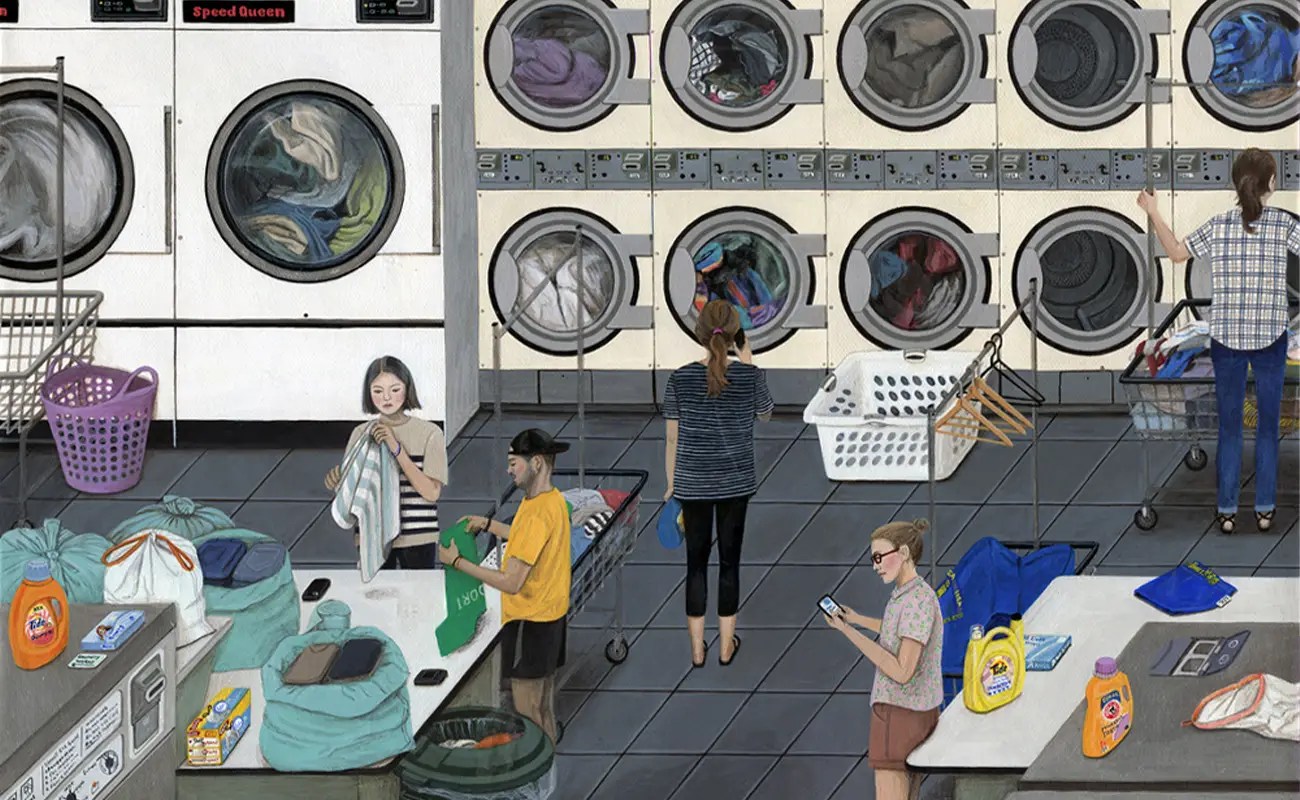
Her paintings often feature a subdued palette paired with finely rendered details, creating a balance between softness and precision. Figures appear alongside carefully catalogued objects, each element contributing to the overall narrative. The compositions sometimes resemble animated or illustrated scenes, yet they retain a grounded sense of reality. This blend of stylization and observation allows her to communicate complex emotional states through seemingly simple imagery. Rather than overwhelming the viewer, her work encourages slow looking, rewarding attention with layers of meaning embedded in small visual cues.
A compelling example of this approach appears in Zion and Us (2019). The painting depicts a tour bus moving through a canyon landscape, its form repeated with another identical vehicle attached behind it. The word “Zion” is prominently displayed, referencing the transportation system within Zion National Park. The scene captures both the scale of the environment and the intimacy of shared travel. While the canyon suggests vastness, the bus anchors the composition in human experience. Through this juxtaposition, Moon emphasizes how personal memories are formed within larger settings, where individual moments intersect with collective spaces.

Cataloguing Life Through Objects and Relationships
A defining feature of Moon’s practice is her attention to objects and their narrative potential. Everyday items populate her paintings in remarkable density, each one carefully positioned and rendered with clarity. These objects do not function as background details. Instead, they serve as markers of time, activity, and emotional context. A phone charger, a bag left open, or a fan placed near a bed can suggest an entire sequence of events. By including such elements, Moon transforms her compositions into visual records that extend beyond the central figures.
Her work frequently portrays relationships, particularly those shaped by proximity and routine. Scenes of family life, shared living spaces, and casual interactions reveal the dynamics of connection without relying on overt gestures. Figures are often depicted in relaxed states, engaged in quiet activities or simply existing alongside one another. This understated portrayal allows the viewer to interpret meaning through context rather than explicit action. The presence of others becomes part of the environment itself, reinforcing the idea that relationships are embedded within daily life.
This approach reaches a poignant expression in Three Generations (2024). The painting presents two women resting together in a bed, accompanied by a child nearby. The room is filled with scattered belongings, including a hair dryer, diapers, a backpack, and various household items. Each object contributes to a layered narrative, suggesting both care and exhaustion within a shared domestic space. The composition captures a moment that feels both specific and widely relatable. Through its detailed accumulation of items and gestures, the work reflects how memory is constructed through fragments, each one carrying its own significance.

Paige Jiyoung Moon: Memory as Method and Meaning
Memory is not simply the subject of Moon’s paintings but also the guiding principle behind their creation. She often works from recollection, reconstructing scenes based on what she chooses to retain rather than what might be objectively present. This process introduces a selective clarity, where certain details are emphasized while others recede. The resulting images feel intentional, shaped by the artist’s perspective and emotional priorities. By relying on memory, she transforms lived experience into something both personal and shareable.
Her compositions frequently adopt elevated or unconventional viewpoints, creating the sensation of looking back on a moment rather than witnessing it directly. This perspective reinforces the idea that the paintings function as reflections rather than immediate observations. The viewer becomes an active participant, piecing together context and meaning from the visual information provided. This interaction encourages a deeper engagement, as each detail invites interpretation and connection. The paintings unfold gradually, revealing their complexity over time.
Through this method, Moon constructs a body of work that operates as a visual archive. Each painting contributes to an ongoing record of her life, capturing experiences that might otherwise fade. At the same time, these works extend beyond individual memory, resonating with broader themes of time, presence, and connection. Her focus on ordinary experiences underscores the idea that meaning is cumulative, built from repeated actions and shared moments. In presenting these scenes with care and attention, Moon affirms the value of everyday life as a subject worthy of sustained artistic exploration.