

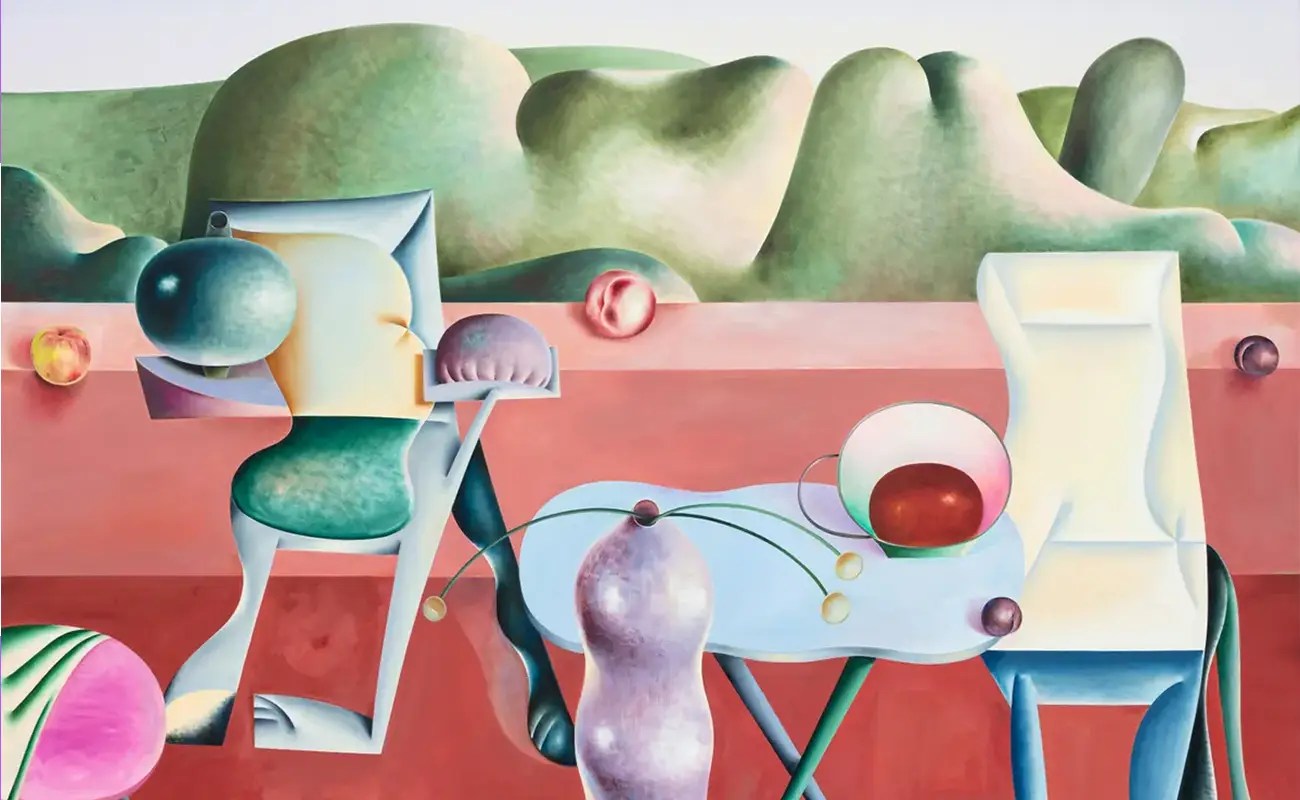
The Shape of Memory in Motion
Pablo Benzo has built a body of work that turns familiar things into sites of surprise. Born in Santiago de Chile in 1982 and later establishing himself in Berlin in 2013, he belongs to a generation of painters who understand tradition without becoming trapped by it. His canvases move between abstraction and representation, allowing interiors, plants, figures, household objects, and remembered fragments to coexist in shifting arrangements. A chair may seem almost alive, a lamp may carry emotional weight, and a room may open into several viewpoints at once. This ability to transform common surroundings into charged visual experiences gives his practice unusual vitality. Rather than presenting reality as fixed and measurable, he proposes that seeing is unstable, layered, and deeply personal. Every painting suggests that what appears simple on the surface may contain multiple histories, sensations, and emotional echoes waiting to be noticed by an attentive viewer.
His path to painting includes formative experiences beyond the studio. Benzo studied graphic design at the University of Chile, graduating in 2009, and he also worked as an illustrator and art director before dedicating himself fully to painting. Those experiences sharpened his sense of composition, color relationships, and visual clarity, while graffiti and street culture helped shape his imagination and connection to artistic community. Street language, improvisation, and public image-making introduced a spirit of immediacy that remains visible in his work. Even when his paintings are carefully resolved, they retain an alert, responsive quality, as if decisions are happening in real time. This combination of formal training and independent visual culture contributes to the tension within his images. They feel both refined and spontaneous, composed yet alive with sudden shifts. That balance has become one of the signatures of his evolving artistic language.
Moving to Berlin marked an important chapter in Benzo’s development. The city’s layered histories, international energy, and active contemporary art scene offered fertile conditions for expansion. Distance from Chile did not erase his origins, but instead complicated and enriched them. Migration often changes how memory operates, and Benzo’s paintings frequently carry that sensation of belonging to more than one place at once. Rooms feel inhabited by absence, objects seem loaded with private meaning, and space itself appears flexible. Berlin also positioned him within wider conversations about contemporary painting, enabling his practice to reach audiences across Europe, Asia, and the Americas. Yet despite growing international recognition, his work remains intimate in scale of feeling. He does not rely on spectacle. Instead, he asks viewers to notice subtle shifts: a curve that becomes a body, a shadow that becomes emotion, a domestic scene that quietly turns into something mysterious and newly alive.

Pablo Benzo: Inheritance Without Nostalgia
The history of modern art is present in Benzo’s paintings, but never as imitation. Echoes of Paul Cézanne, Pablo Picasso, Georges Braque, Édouard Manet, Cubism, and Surrealism can be sensed in fractured viewpoints, altered proportions, and spatial instability. Yet these influences appear less as references than as active tools for thought. Benzo has spoken of the courage and intuition of early twentieth-century artists, especially their willingness to dismantle accepted appearances in order to reveal subtler truths. That attitude remains central to his own work. He does not quote the past for prestige or decoration. Instead, he uses its radical energy to reconsider present-day experience. A table, window, vase, or figure becomes an opportunity to ask how perception is constructed. What do we notice, what do we miss, and how much of seeing is shaped by memory or desire? Through such questions, historical influence becomes contemporary investigation.
This relationship with modernism helps explain why his paintings feel intellectually alert while remaining emotionally open. Cubist shifts in perspective become methods for showing that a room can contain several moments at once. Surrealist dislocations become ways of expressing feelings that words cannot easily hold. Cézanne’s structural curiosity reappears in how objects anchor a composition even when space seems unstable. Manet’s directness survives in the confidence with which forms claim the surface. Benzo transforms these legacies into a language suited to the present. He understands that contemporary life is fragmented by speed, screens, movement, and constant reinterpretation. Therefore, a single stable viewpoint may no longer be enough. His images mirror that condition, yet they do so with warmth rather than anxiety. Complexity enters quietly, through rhythm, layering, and subtle contradiction. The viewer senses challenge, but also invitation.
What distinguishes this inheritance is the absence of nostalgia. Benzo does not long for a heroic past or treat modern masters as unreachable monuments. He engages them as fellow experimenters whose questions remain useful. This gives his work freshness. Instead of asking how painting once changed the world, he asks how painting can still sharpen perception now. That shift matters. In his hands, modernist innovation becomes less about revolution and more about sensitivity. A domestic interior can hold as much visual drama as a historic event. Fruit on a table can carry psychological tension. A cluster of leaves can suggest tenderness or unease. Through these choices, he updates historical ambition for contemporary conditions. The result is painting that feels informed by history while fully committed to the present moment, where uncertainty, intimacy, and multiplicity shape daily life.

Rooms, Objects, and the Quiet Drama of Seeing
Many of Benzo’s paintings begin with motifs that might otherwise pass unnoticed. Vases, chairs, clothing, lamps, windows, fruit, tables, and houseplants appear repeatedly, along with rooms that seem both inhabited and dreamlike. These are not grand symbols imposed from outside. They are elements of ordinary life, chosen precisely because they accompany daily routines. Once placed within the painting, however, they become unstable and newly expressive. Furniture may lean toward bodily presence, plants may pulse with character, and architecture may absorb traces of human feeling. Such transformations encourage viewers to reconsider their own surroundings. Objects often dismissed as neutral become carriers of memory and mood. Benzo shows that intimacy can be found not only in people but also in things that quietly witness our lives. Through this attention, the domestic environment turns into a stage where subtle psychological events unfold.
Perspective plays a crucial role in this transformation. Benzo frequently bends dimensions, overlaps spaces, and places images within images, creating nested acts of looking. A wall may become a frame for another scene, a window may open onto something impossible, or a tabletop may tilt toward the viewer while still receding into depth. These shifts create a sense that memory, observation, and imagination are operating simultaneously. Rather than offering a single route through the picture, he allows several paths to exist at once. The eye wanders, doubles back, and discovers new relationships between forms. This active viewing experience is central to his practice. Meaning is not handed over in a fixed statement. It emerges through movement, hesitation, and recognition. In that way, his paintings mirror how consciousness often works: partial, layered, and always reorganizing experience as it unfolds.
Although his images can appear enigmatic, they resist becoming puzzles to solve. Benzo has described his practice as an attempt to portray sensations, feelings, and memories that language cannot fully translate. That approach helps explain the emotional atmosphere of his work. A scene may feel calm yet unsettled, playful yet melancholic, intimate yet distant. Such mixed states are common in lived experience, where emotions rarely arrive one at a time. He trusts viewers to bring their own histories into the encounter, allowing significance to change according to mood, time, and personal memory. One person may see comfort in a softly lit interior, while another may sense absence. This openness gives his paintings longevity. They do not close after first interpretation. Instead, they remain responsive, changing with each return and revealing how perception itself is never complete.

Pablo Benzo: Color as Atmosphere, Form as Pulse
Color is among Benzo’s most distinctive instruments, and it operates far beyond decoration. Soft pastels, muted greens, warm yellows, pinks, blues, and occasional fluorescent accents create environments that feel welcoming yet slightly strange. Hue often organizes the composition structurally, guiding the eye across shifting spaces while also setting emotional temperature. A pale blue may calm a fractured room, while a sudden acidic note can introduce tension or wit. Because of his design background, he appears especially sensitive to how colors communicate before forms are fully recognized. The viewer often feels the painting before fully understanding it. This immediate sensory contact is essential to his appeal. His palettes invite entry, then reveal complexity. They soften spatial disruption without neutralizing it, allowing contradiction to remain pleasurable. Through color, uncertainty becomes seductive rather than alienating.
Surface and form deepen this experience. Rounded volumes, velvety textures, and pillowy contours give many works a tactile generosity. Shapes seem touchable, almost cushioned, even when their relationships are impossible. Benzo frequently balances this softness with crisp edges and geometric clarity, creating friction between comfort and precision. Such contrasts produce psychological charge. A curved plant leaf may rest beside a sharp architectural line, or a warm glowing object may sit inside a cool, dislocated room. These pairings prevent the paintings from settling into sweetness. They remain alert, slightly off-balance, and emotionally active. The viewer senses harmony and contradiction at the same time. That simultaneous experience is one reason his work lingers in memory. It satisfies the eye while keeping thought in motion.
Alongside painting, Benzo has also pursued collage, inspired in part by Henri Matisse and the possibilities of cut paper. Working with colored sheets, sometimes altered by hand to achieve the right tone, he cuts, rearranges, joins, and separates forms until a composition resolves itself. This practice complements painting through speed and spontaneity. Where a canvas may build gradually, collage can generate immediate surprises. Shapes meet unexpectedly, rhythms emerge quickly, and new spatial ideas appear through touch and movement. Those discoveries often echo the constructive energy already present in his painted work. Across both mediums, he demonstrates that composition is not merely planning but conversation with materials. His growing international exhibition history, including presentations in Berlin, Los Angeles, New York, Seoul, Basel, Shanghai, Santiago, Mykonos, Bern, and Tampa, confirms the broad resonance of that vision.


