
“In all her exhibitions with her passion to understand and see the places and people through her eyes she opens a unique journey in the beholder’s eyes.”
A Lifelong Search for Connection Through Art
Ursula Altenbach has built an artistic practice shaped by curiosity, cultural exchange, and a profound appreciation for beauty across borders. Known also by her Japanese artistic name, Biko, she has dedicated decades to creating works that connect people, places, and traditions. Her paintings, sculptures, and installations reveal an enduring commitment to dialogue between cultures, particularly between Europe and Japan. Rather than treating cultural influence as decoration, she transforms it into a living creative framework that informs both her visual language and her worldview. Through exhibitions across Denmark, Switzerland, Brazil, India, Spain, and Italy, she has continually expanded her artistic perspective while inviting audiences to engage with unfamiliar experiences through her work.
This international outlook emerged from a fascination that began in childhood. Growing up near Lucerne, Ursula developed an early interest in Japan, a country that seemed distant yet deeply captivating. Memories of wearing a costume inspired by a geisha during local festivities and studying the location of Japan on a globe at her grandmother’s home remained vivid throughout her life. Later, the 1972 Winter Olympics in Sapporo strengthened this fascination and transformed Japan into a lasting source of inspiration. These formative experiences gradually evolved into a deeper engagement with Japanese culture, ultimately becoming one of the defining influences behind her artistic identity.
Over time, travel and life abroad further enriched her understanding of cultural exchange. Living in different countries exposed her to new artistic traditions and ways of seeing the world. Rather than adopting a fixed style, she developed an approach that embraces transformation and discovery. This openness remains central to her practice today. Whether creating paintings on canvas and paper, constructing sculptural works, or developing installations, Ursula consistently seeks meaningful connections between places and people. Her art functions as a visual bridge, reflecting her belief that creativity can transcend geography and create shared experiences across continents.

Ursula Altenbach: The Influence of Japan on Form and Spirit
Japanese culture occupies a central place in Ursula Altenbach’s creative journey. Her engagement extends beyond visual references and enters the philosophical foundations of her work. Years of studying and teaching Sogetsu Ikebana shaped her understanding of balance, rhythm, and spatial awareness. While living in Denmark she first encountered Sogetsu Ikebana, beginning a relationship with the discipline that would continue for decades. Later, during her years in Brazil, she taught Sogetsu Ikebana to students including members of the Japanese Brazilian community, further deepening her connection to Japanese aesthetics and ways of thinking. With the Sogetsu School approaching its 100th anniversary in 2027, this tradition holds an especially meaningful place within her artistic life.
The principles associated with Zen philosophy and traditional ink painting are also evident throughout her artistic production. Many of her paintings employ restraint rather than excess, allowing empty spaces to carry significance equal to painted forms. Marks often appear deliberate yet spontaneous, combining confidence with sensitivity. This visual economy recalls aspects of sumi-e painting while remaining distinctly contemporary. Instead of directly reproducing historical traditions, Ursula adapts their underlying ideas to her own artistic language. The result is work that feels contemplative while maintaining a strong contemporary presence.
Her involvement with Ikebana International Zurich has further reinforced these influences. As a teacher of modern contemporary Sogetsu Ikebana, she encourages creative freedom while preserving essential principles of harmony and balance. Even during the restrictions of the COVID-19 pandemic, flowers, painting, music, and Japanese cuisine remained important parts of her daily life. During this period she received the Golden Moon Award from the Sogetsu School through the headquarters Facebook exhibition titled Everyone’s Ikebana Exhibition. These experiences highlight how artistic practice for Ursula extends beyond the studio and becomes an integral part of everyday living, offering both creative fulfillment and emotional resilience.

Between Structure and Gesture
One of the most compelling aspects of Ursula Altenbach’s work is the coexistence of opposing visual energies. Her paintings frequently balance geometric precision with spontaneous expression. Angular structures, intersecting planes, and carefully organized compositions appear alongside fluid marks, sweeping lines, and gestural interventions. Rather than creating conflict, these contrasting elements establish a dynamic equilibrium. Viewers encounter works that feel simultaneously controlled and intuitive, suggesting a continuous negotiation between discipline and freedom. This balance has become a defining characteristic of her artistic voice.

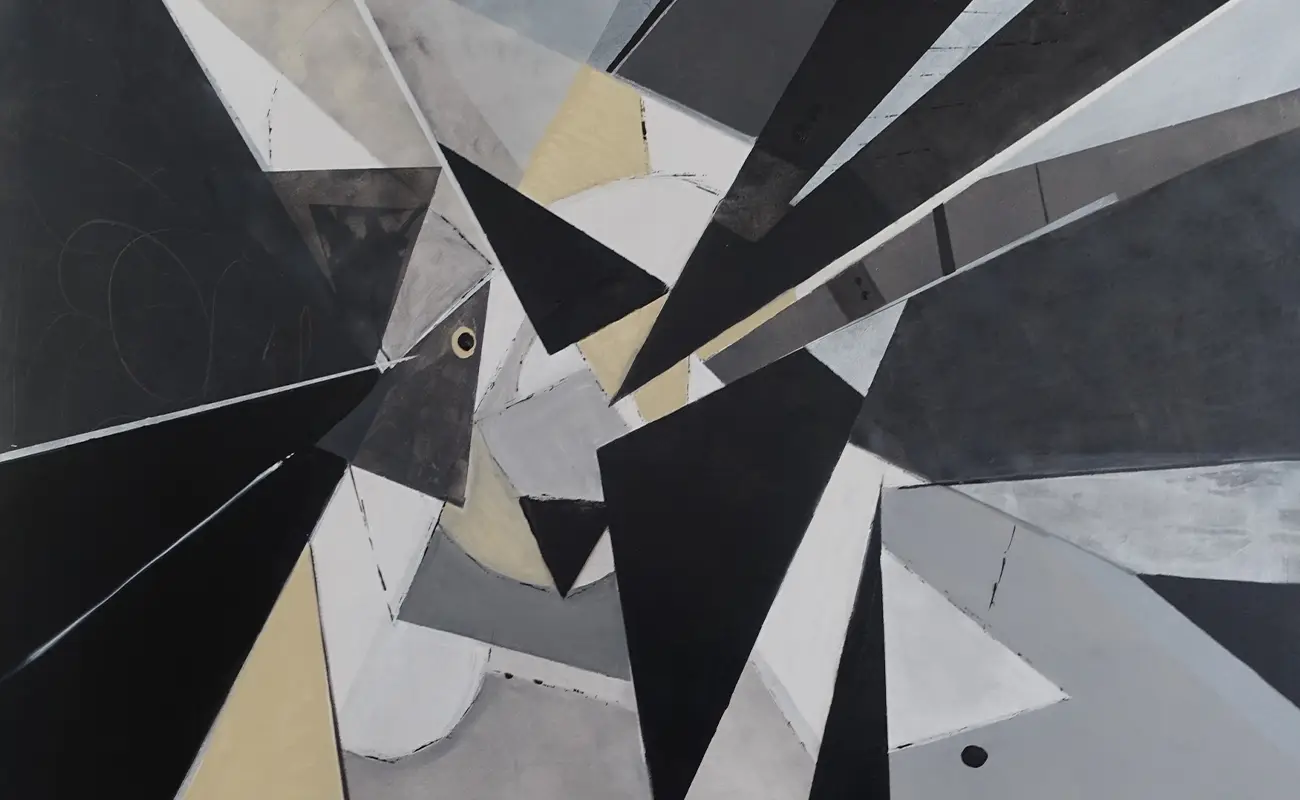
The painting 7th Sense exemplifies this approach. Executed in black, white, and subtle shades of gray, the work explores abstraction through a geometric vocabulary of triangles, lines, and points. Acrylic textures animate the surface while fractured forms create a sense of movement and expansion. Although rooted in geometric abstraction, the painting extends beyond formal experimentation. The title introduces the idea of intuition as a guiding force, inviting viewers into a space where rational structure and emotional perception coexist. Through this dialogue between order and uncertainty, the work becomes an exploration of inner awareness and personal interpretation.
A different yet related sensibility emerges in Steckenpferd. Here, energetic black and ochre fields interact with expressive brushwork and delicate linear elements. Broad painterly gestures establish strength and momentum, while finer curved lines introduce lightness and rhythm. The composition generates a sense of movement without relying on literal representation. White linear accents contribute an almost ethereal quality, creating contrast against the heavier acrylic forms. Together, these elements demonstrate Ursula’s ability to communicate complexity through abstraction, transforming simple visual relationships into emotionally charged experiences that reward sustained attention.

Ursula Altenbach: Creating Journeys Across Continents
International exhibitions have played a significant role in shaping Ursula Altenbach’s artistic development. Her work has reached audiences across Europe, South America, and Asia, reinforcing her commitment to cultural dialogue. Among these experiences, her exhibition at Art and Soul Gallery in Mumbai stands out as particularly meaningful. Supported by the Swiss Foreign Ministry and Hyatt Hotels, the project allowed her to immerse herself in the atmosphere of the city and translate those impressions into visual form. The exhibition reflected her desire to engage deeply with local culture rather than merely observe it from a distance.
Mumbai provided a rich source of inspiration. Ursula was captivated by the countless deities, vibrant clothing, elegant saris, fragrant flowers, powerful spice markets, and dramatic contrasts between wealth and poverty. She was equally fascinated by the sensory intensity of the monsoon season, the presence of cows throughout the streets, and the joyful energy of public festivals. These experiences informed the themes of the artworks presented in the exhibition. Rather than documenting the city literally, she transformed impressions, emotions, and observations into visual narratives that communicated both wonder and reflection. The resulting exhibition achieved considerable success and reinforced her belief in the transformative potential of cultural exchange.
Recognition for her achievements continues to grow. In 2024, Ursula received the Pitturiamo International European Art Award in Florence, adding another milestone to an already distinguished career. Yet awards represent only one aspect of her ongoing artistic journey. Each year she develops new bodies of work, continually refining her visual language while remaining faithful to her core values of curiosity, openness, and connection. Through paintings, sculptures, installations, and Sogetsu Ikebana, she invites viewers to see the world through her perspective, encouraging encounters that transcend borders and reveal unexpected relationships between intuition, place, and human experience.