
“Over the years, my digital collages went from very talkative to stripped-down, almost desert-like works, both literally and figuratively.”
Between Anonymous Voices and Endless Landscapes
Evelyne Chevallier has built an artistic practice that bridges photography, travel, sociology, and visual storytelling. Born in France and shaped by years of exploration across Latin America, she developed a distinctive approach that transforms photographic fragments into layered digital compositions. Her path toward art was anything but immediate. Before fully embracing her own creative voice, she spent two decades working within the photographic industry as a producer, journalist, iconographer, and head of picture departments for magazines. Additional years spent in luxury houses such as Cartier and Dior sharpened her sensitivity to visual detail and image construction. These professional experiences cultivated a highly trained eye, yet it was only after moving far from the familiar structures of Paris that she allowed herself to create images of her own. That turning point arrived in 2010 during a journey to northwestern Argentina, a place whose vast landscapes and cultural complexity would permanently redefine her artistic direction.
The dramatic geography of Jujuy, framed by the Andes and immense desert expanses, offered more than visual inspiration. The region confronted Chevallier with a profound sense of solitude that accompanied life in remote territories. At the same time, she became fascinated by handwritten messages scattered across walls, villages, and urban spaces. These brief statements, often anonymous and deeply personal, revealed unexpected narratives embedded within daily life. Seeking a creative outlet that could unite these discoveries, she turned to digital collage. What began as an experiment soon evolved into a sustained artistic practice. Through photography and digital assembly, she developed a language capable of connecting landscape, memory, and human expression. Since 2012, this body of work has been exhibited internationally, with presentations in Argentina, France, and Japan, while a residency in Montreal in 2014 further expanded the reach of her vision.
Travel has remained a central force throughout her life and work. Earlier experiences in Ecuador, where she lived for two years as a young adult and worked as a tour guide, established a lifelong attraction to movement, discovery, and cultural exchange. Rather than separating her professional chapters, Chevallier views them as interconnected experiences that gradually led her toward artistic creation. The landscapes she encounters, whether mountains, deserts, coastlines, or high-altitude plateaus, continue to function as catalysts for reflection and imagination. Immense horizons provide both mental space and creative energy, encouraging her to translate fleeting emotions into visual form. Within her practice, photography becomes a means of preserving encounters with places that inspire wonder, curiosity, and contemplation.

Evelyne Chevallier: Constructing Visual Dialogues from Fragments
Chevallier’s artistic language emerged from an unusual source: graffiti. Unlike traditional street art, the messages that first attracted her attention were often simple handwritten phrases left on walls by anonymous individuals. These fragments of language became the foundation of her earliest digital photocollages. Working entirely with photographic material and using Photoshop as her primary tool, she assembled images without adding painting or drawing. The resulting works combined visual evidence gathered during her travels into layered compositions that explored the voices hidden within public spaces. Through these arrangements, walls became documents of collective experience, preserving traces of affection, humor, political conviction, faith, grief, and resistance. Her background in sociology and Latin American literature reinforced this perspective, encouraging her to read urban surfaces as cultural texts rich with social meaning.
Over time, the geographic scope of her search expanded. What began with graffiti in northern Argentina gradually extended to other countries she visited, creating an evolving archive of visual and linguistic fragments. Through this process, she became increasingly interested in comparing how different communities communicate through public markings. Whether encountered in Jujuy, Buenos Aires, Paris, or New York, these anonymous interventions reveal common human concerns while also reflecting local histories and identities. Her collages frequently bring together contrasting elements that coexist in tension: urban and rural environments, speech and silence, density and emptiness, presence and absence. This persistent dialogue between opposites has become one of the defining characteristics of her work, creating compositions that evoke a balance similar to the complementary forces of yin and yang.
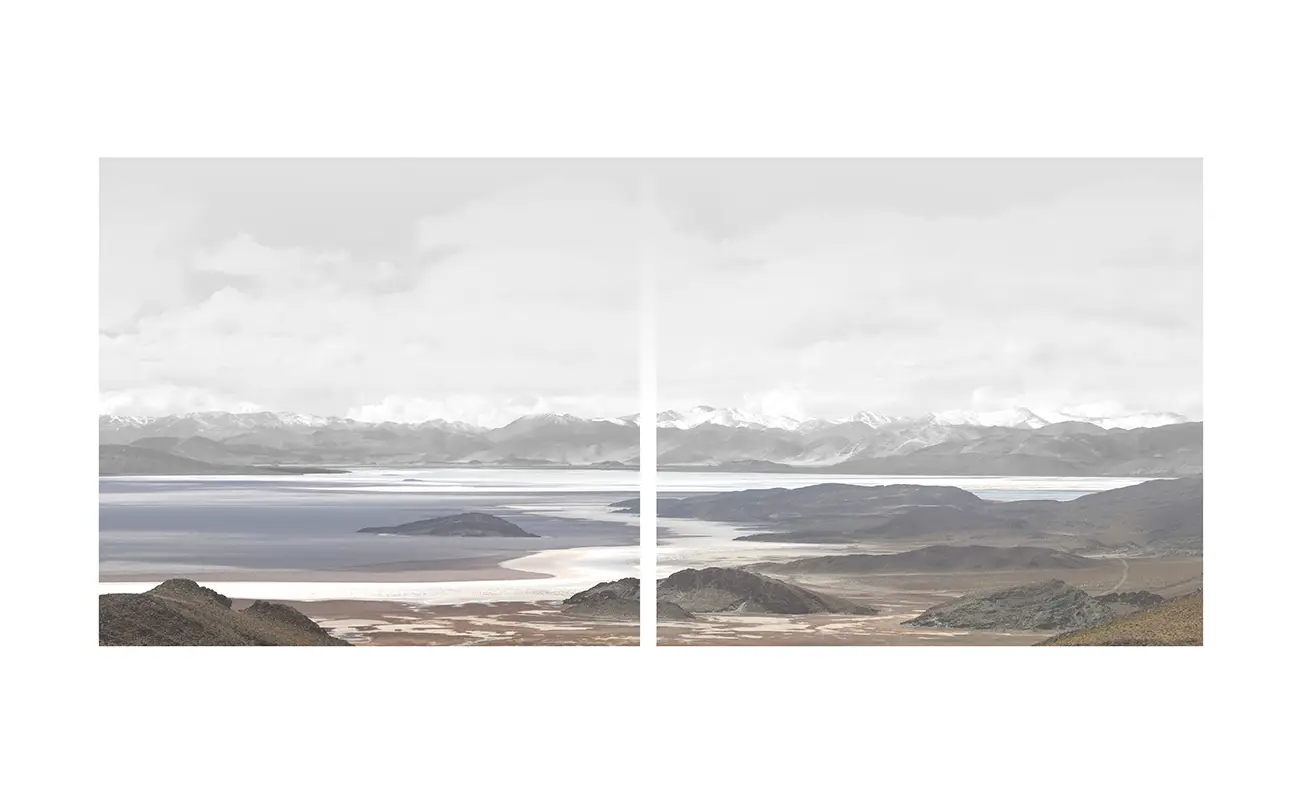
A significant transformation occurred during the pandemic years, when extended periods in Argentina encouraged deeper reflection and experimentation. The dense, text-heavy collages of earlier periods gradually gave way to more restrained imagery. Graffiti became less dominant, while photographs of extraordinary landscapes assumed greater importance. Simultaneously, Chevallier explored new structural formats, including diptychs, triptychs, and larger polyptych arrangements. These developments introduced additional spatial and conceptual possibilities, allowing visual relationships to unfold across multiple panels. The resulting works retain the intellectual and emotional complexity of her earlier collages while embracing a more spacious visual language. Silence became as meaningful as text, and open landscapes emerged as powerful counterparts to the human traces that originally inspired her practice.

Landscapes of Wonder, Memory, and Cultural Presence
Throughout her artistic journey, the landscapes of Argentina, Chile, Bolivia, and Ecuador have remained essential sources of inspiration. Chevallier is particularly drawn to the altiplano, where immense stretches of land create a sense of scale that challenges perception. These environments offer more than scenic beauty. They provoke emotional and physical reactions that she describes as overwhelming, moments when language becomes insufficient and photography provides a way to respond. The act of photographing serves both as a record and as an attempt to reconnect with the intensity of the original experience. Vast deserts, distant mountain ranges, and uninterrupted horizons become spaces where imagination can expand beyond visible limits, encouraging contemplation of what lies beyond the final ridge or dune.
Yet her interest in these territories extends beyond geography. Northern Argentina introduced her to a rich cultural landscape shaped by the interaction of Catholic traditions and Pachamama beliefs. Cemeteries, religious symbols, local rituals, political messages, and public inscriptions all became recurring points of fascination. Rather than isolating nature from culture, Chevallier observes how human presence leaves subtle but meaningful traces within the environment. Her photographs and collages frequently capture this coexistence, revealing landscapes as living spaces marked by memory, belief, celebration, and loss. These observations contribute to works that function simultaneously as visual explorations and cultural reflections.
Questions concerning contemporary society also run through her practice. The vast natural environments she seeks often appear in contrast with the pressures of globalized culture and environmental transformation. While her imagery avoids direct activism, it invites viewers to consider the fragile relationship between human activity and the natural world. Endless horizons symbolize freedom and possibility, yet they also raise questions about preservation and change. Through carefully assembled visual narratives, Chevallier encourages reflection on how places evolve and how personal and collective histories become embedded within landscapes over time.

Evelyne Chevallier: Transforming Mortality into Celebration
Among the works that hold particular significance within Chevallier’s career, the digital photocollage AllSaints occupies a special place. Created from photographs taken across several cemeteries in northern Argentina, the piece emerged through a process of extensive documentation, selection, organization, and digital assembly. Although the subject matter centers on death, the work deliberately resists somber interpretations. Instead, it reflects the vibrant atmosphere she encountered in local burial sites, where remembrance often carries a sense of color, vitality, and communal connection. By bringing together numerous photographic elements into a cohesive composition, she transformed observations of these spaces into an image that celebrates memory rather than mourning.
The enduring popularity of AllSaints, which has been sold multiple times, highlights the universal resonance of its themes. The work demonstrates Chevallier’s ability to address complex subjects through visual strategies that remain accessible and emotionally engaging. Rather than presenting death as an endpoint, the collage reflects the cultural practices and spiritual traditions that sustain connections between the living and the departed. This perspective aligns closely with her broader interest in the ways societies express identity, belief, and collective memory through visual signs and shared rituals.
Her creative process continues to balance observation and transformation. Daily life alternates between periods of photographing and periods of concentrated studio work. She collects images ranging from landscapes and architecture to flowers, objects, and urban details, building an extensive personal archive. Once seated at her computer, she often spends hours reviewing photographs before an idea gradually emerges. Shapes, colors, textures, and visual relationships begin to interact, generating the foundation for a new composition. This slow and attentive method allows intuition to guide the development of each piece. Through photography, collage, and visual experimentation, Chevallier continues to create works that connect distant horizons with intimate human traces, inviting viewers to navigate the space between silence and expression.