“Not all great work needs to be made in the studio.”
Cities, Movement, and the Refusal of Perfection
Lindsay Mapes has built a practice shaped by movement, persistence, and an unwavering attachment to painting. Raised across Arizona, Texas, Colorado, and Kansas City, she encountered art early through painting classes at the Kansas City Art Institute while still a teenager. That experience clarified her direction with unusual certainty. Painting was not simply an interest waiting to be explored but the central structure around which every future decision would revolve. Years later, that conviction still drives her work, even as her materials, methods, and surroundings continue to shift. Her journey carried her through formal study at the San Francisco Art Institute, later to Florence at Studio Arts Centre International, and eventually to London, where she completed an MFA at The Slade School of Fine Art before continuing with the Turps Off-Site programme. Each stage expanded her understanding of what painting could become while reinforcing the instinctive urgency that first pushed her toward art.
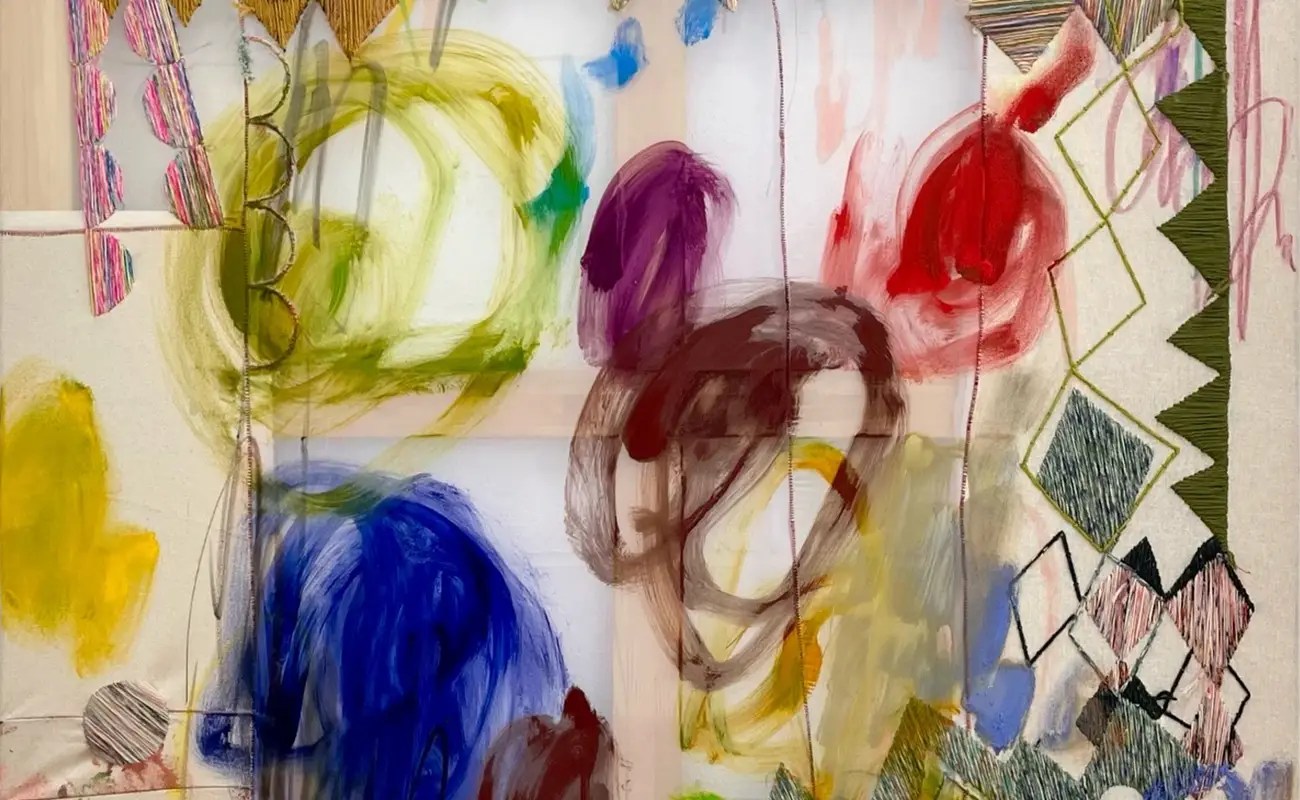
East London has remained her base since 2008, and the environment surrounding her studio continues to feed the intensity of her visual language. The city offers precisely what she searches for: friction, unpredictability, and evidence of human presence. Rather than seeking polished surfaces or controlled atmospheres, she gravitates toward crowded streets, shifting architecture, overlapping sounds, and imperfect textures. Those qualities filter directly into her paintings and textile works, where marks often collide, colours interrupt one another, and sewn elements introduce both delicacy and disruption. Her work carries the rhythm of urban life while maintaining an unmistakably handmade quality. Layers appear unstable, altered, interrupted, or reworked, creating surfaces that feel alive rather than resolved. This attraction to contradiction remains central to her process, allowing softness and aggression, structure and spontaneity, to exist simultaneously within a single composition.
Support from her family played a meaningful role in sustaining this direction from the beginning. She describes growing up within a household that encouraged possibility rather than caution, giving her the emotional confidence to pursue an artistic life seriously. Later, motherhood introduced another profound transformation. Time became fragmented, and the traditional expectations surrounding studio practice no longer matched daily reality. Instead of allowing those pressures to limit her work, she reshaped the conditions under which art could happen. Portable materials and craft processes entered her practice more deeply, turning kitchens, couches, and domestic spaces into active sites of production. That adjustment altered more than logistics. It expanded her understanding of painting itself, allowing sewing, fabric, cutting, layering, and tactile experimentation to move fluidly alongside paint. What emerged was not a compromise but a richer and more adaptable visual language capable of carrying intimacy, urgency, and physicality at once.

Lindsay Mapes: Stitching Intuition Into Material Form
Material experimentation sits at the centre of Lindsay Mapes’ practice, though her relationship to materials is rooted less in technical precision than in emotional instinct and physical engagement. Her paintings and textile works emerge through accumulation, interruption, destruction, and rebuilding. Fabric may be stitched carefully for hours before being cut apart moments later. Painted surfaces may remain unresolved for months while she repositions elements and reassesses balance, movement, and tension. That willingness to disrupt her own labour gives the work its distinctive energy. Nothing appears overly protected or fixed. Instead, compositions seem to hover between construction and collapse, carrying visible traces of decision making. The process becomes embedded within the object itself, leaving viewers aware not only of the finished image but also of the physical actions that shaped it. This creates an unusual immediacy that resists polish while maintaining remarkable complexity.
Her influences reveal a fascination with artists who challenged convention through intensity and material force. She speaks about Ugo Rondinone’s monumental “Seven Magic Mountains” rising from the Las Vegas desert, Alberto Burri’s fractured “Il Cretto,” and Pontormo’s emotionally charged “Deposition of Christ.” Alongside them stand Georgia O’Keeffe, Joan Mitchell, and Kara Walker, figures connected less by style than by conviction and fearlessness. What attracts Mapes is not a single aesthetic movement but the evidence of artists pushing against limitation. She studies the labour behind artworks, the social conditions surrounding them, and the courage required to make difficult visual choices. Those interests appear clearly within her own practice, where conflicting colours coexist beside delicate stitching and rapid gestures. Her work does not seek quiet harmony. Instead, it embraces collision, emotional friction, and unresolved movement as productive creative forces.
The contrast between slowness and immediacy plays a particularly important role in how her pieces evolve. Hand sewing introduces repetition, patience, and physical closeness to the material, while painting often arrives in bursts of movement and instinct. She frequently describes moments where music takes over the studio, leading her into periods of uninhibited making that feel almost separate from conscious thought. During these stretches she paints, cuts fabric, tears through stitched sections, rearranges fragments, and allows instinct to guide the work forward. That unpredictability becomes essential to the final result. Her compositions carry evidence of both restraint and release, balancing careful editing against spontaneous gestures. The result is a body of work that feels emotionally charged yet materially grounded, where every surface reflects accumulated time, revision, and physical interaction.

The Studio as a Space of Constant Reinvention
Inside her Hackney Wick studio, Lindsay Mapes maintains an environment built around movement and multiplicity. The large industrial space allows her to keep numerous works active at once, often rotating between ten and fifteen paintings simultaneously. Some evolve rapidly while others remain unfinished for years, revisited repeatedly until their structure finally settles into place. This extended relationship with unfinished work reflects her belief that editing carries equal importance to creation itself. She spends long periods observing pieces, shifting components, reconsidering colours, or physically moving materials around the room to discover new relationships between forms. That ongoing adjustment prevents the work from becoming overly predetermined. Instead, paintings develop through accumulated reactions, corrections, and unexpected discoveries that slowly reshape the visual language of each piece.
Her daily routine reflects the realities of balancing artistic ambition with parenthood and practical life. Earlier periods of leisurely preparation inside the studio have disappeared, replaced by a far more direct approach. Once she arrives, the focus is immediate and concentrated. Yet despite this efficiency, the studio remains playful and energetic rather than rigid. Podcasts about investigations, cults, and true crime often fill the background during long stitching sessions, while music signals a shift toward more physical painting sessions. These changing rhythms mirror the layered structure of her work itself, where concentrated hand labour coexists beside impulsive mark making. The atmosphere supports experimentation without demanding perfection. Instead of separating discipline from enjoyment, she combines them, allowing moments of intuition and pleasure to guide significant creative breakthroughs.
One quotation continues to shape her understanding of artistic practice: Philip Guston’s reflection on the gradual disappearance of outside voices during the act of painting. The statement resonates deeply with Mapes because it captures the rare moments when making becomes entirely immersive. She values the passage from self-consciousness toward instinct, where external pressures, expectations, and even personal identity begin to dissolve inside concentrated work. Those experiences form the emotional core of her studio life. Painting becomes less about producing objects and more about entering a state where material, movement, and thought operate together without interruption. That philosophy explains the physical intensity visible throughout her practice. Every stitched surface, torn textile, painted gesture, and reconstructed fragment reflects a search for presence inside the process itself rather than a pursuit of polished completion.

Lindsay Mapes: Reimagining Design Through Destruction and Repair
One of Lindsay Mapes’ most compelling recent projects involves the radical transformation of a Vitra Charles and Ray Eames chair for a charity initiative organised by The Furniture Practice in support of The Peel Charity. The commission places her in direct conversation with one of the most iconic objects in twentieth century design history. Rather than preserving the chair’s famous precision, she approaches it through disruption and reconstruction. Her instinct was immediate: dismantle it completely. By cutting apart an object celebrated for elegance, order, and functional restraint, she opens space for unpredictability, softness, and emotional texture. The act itself reflects many of the same tensions present throughout her wider practice, where destruction becomes a pathway toward reinvention rather than loss.
Textiles play a crucial role in reshaping the chair into something unmistakably connected to her own visual language. Wrapping, stitching, layering, and altering the object transforms industrial design into a tactile and emotionally charged sculptural form. Through this intervention, the chair stops functioning as a pristine symbol of modernist perfection and instead becomes vulnerable, physical, and deeply personal. The project also highlights her fascination with material relationships. Charles and Ray Eames famously explored how form could emerge directly from material possibilities, and Mapes recognises a parallel within her own methods despite the dramatically different outcomes. Her approach values looseness, visible labour, and imperfection where modernist design often pursued control and refinement. Yet both share an obsession with how materials shape experience.
This project also demonstrates the broader significance of her practice within contemporary art conversations surrounding craft, painting, domesticity, and material hierarchy. Mapes refuses rigid distinctions between fine art and textile processes, between studio production and domestic labour, or between destruction and creation. Sewing, painting, cutting, layering, and rebuilding all operate with equal importance inside her work. That refusal of hierarchy gives her practice its distinctive emotional force. Viewers encounter surfaces carrying evidence of touch, revision, exhaustion, pleasure, and persistence simultaneously. Whether working on expansive paintings or reconstructing a design classic, she remains committed to the physical act of making as a site of transformation. Through colour, fabric, gesture, and reconstruction, Lindsay Mapes continues to create work that embraces contradiction while insisting on the expressive possibilities hidden inside disorder.