
“The feeling of painting is like the first wind catching the sail of my boat, and in this very instance of the wind, or the brush, the day has instantly changed and the wind is at my back.”
Between Wilderness and Abstraction
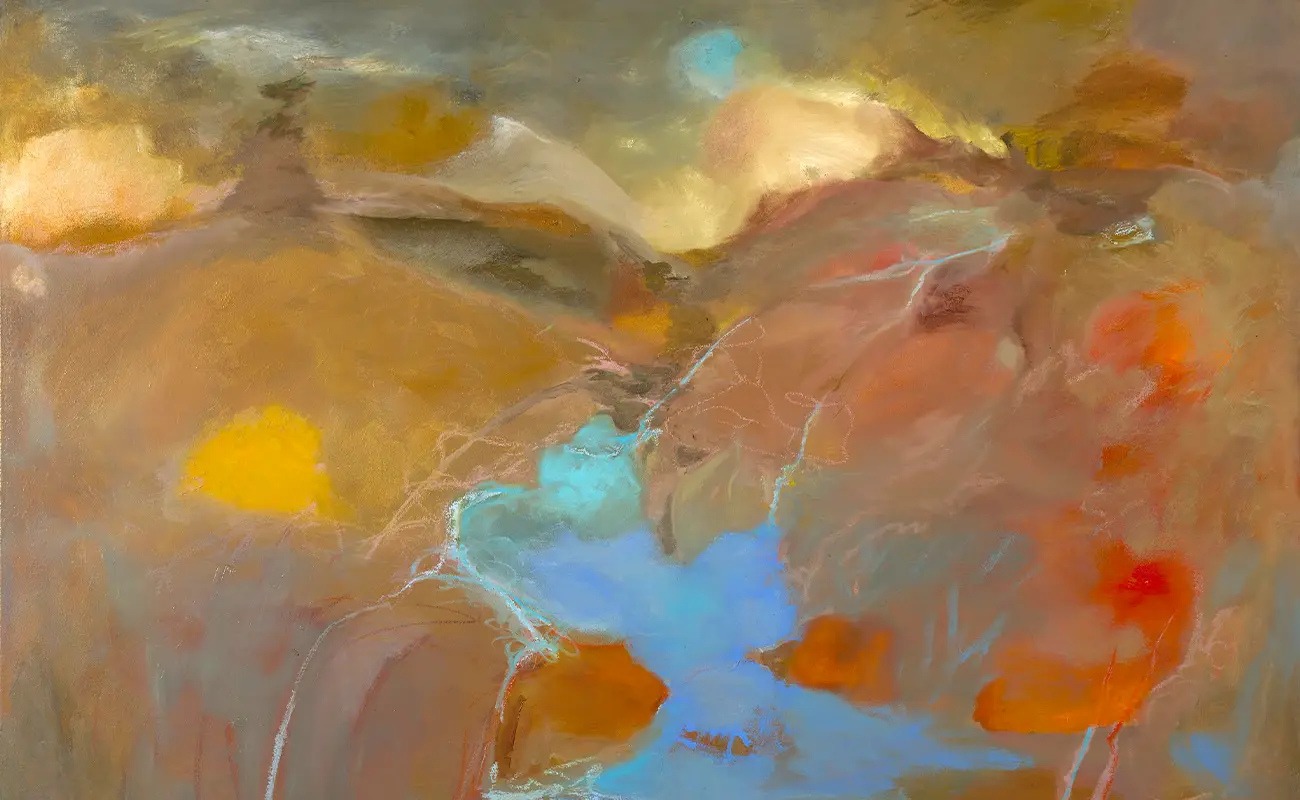
Anne Leveque has built a body of work that transforms abstraction into an immersive emotional experience shaped by solitude, movement, and contemplation. Based in California, she creates monumental oil paintings that hover between abstract landscape and complete non-objective expression, refusing fixed interpretation while inviting viewers into deeply personal encounters with color and space. Her paintings are not intended to illustrate recognizable scenes or narratives. Instead, they open a visual environment where sensation replaces certainty, allowing each observer to experience the work without imposed meaning. This philosophy sits at the center of her artistic identity and distinguishes her practice within contemporary abstraction. Through luminous surfaces, layered textures, and expansive compositions, Leveque constructs paintings that feel atmospheric rather than descriptive, emotional rather than literal. The effect is both meditative and physically immediate. Her canvases often suggest distant horizons, shifting weather, geological formations, or remembered landscapes, yet these impressions remain unresolved, intentionally resisting closure. By removing identifiable imagery, she creates space for perception itself to become the subject. That openness reflects her lifelong pursuit of peace and stillness, qualities that emerge not only in the finished paintings but also in the disciplined solitude through which they are made.
Nature remains inseparable from Leveque’s creative life and continues to guide the emotional atmosphere of her paintings. She has spent years living between the United States and Thailand, teaching workshops in Hua Hin while maintaining exhibition activity in Bangkok galleries. Her American studio environment is equally significant. She paints from a three-bedroom log cabin surrounded by twenty-two acres of forested land, a secluded setting she famously shares with a black bear and her cubs who regularly occupy her front porch. This relationship with wilderness is not treated romantically or symbolically. Instead, it shapes the rhythm of her existence and informs the stillness embedded within her work. Leveque approaches painting only after periods of quiet preparation, often spending days in solitude before beginning a canvas. Breath functions as an organizing force throughout the process, guiding both dramatic gestures and restrained passages of detail. She has compared the beginning of a painting to the first gust of wind catching a sail, an instant in which movement, momentum, and transformation suddenly become inseparable. That image captures the dual nature of her work, balancing instinctive release with sustained concentration. The paintings ultimately circle back toward calm, carrying the emotional residue of both action and restraint.
Her understanding of visual composition was also shaped early by family influence and transformative artistic encounters. During childhood, Leveque spent formative years with her grandfather, a watercolor painter who once declined an offer from Disney. His advice remained with her throughout her career, especially his insistence on avoiding black paint in favor of layered violets and purples to achieve depth. For decades she followed that guidance faithfully while developing her command of oil painting. Another decisive moment occurred when she encountered a solo exhibition by Richard Diebenkorn. The scale and emotional force of those large-format canvases permanently altered her artistic direction, leading her to commit herself to monumental painting without hesitation or reversal. Alongside painting, Leveque also explored sculpture, creating wax models for bronze casting through the lost wax process. Some of these sculptural works were exhibited in the Rotunda of the Hong Kong Stock Exchange, extending her interest in physical form and spatial presence into three-dimensional practice. Even now, after years of honoring her grandfather’s color philosophy, Leveque has spoken about integrating black India ink into her paintings, a striking evolution from the advice that first shaped her sense of depth and color.

Anne Leveque: The Physical Intelligence of Gesture
The physical energy within Anne Leveque’s paintings reflects a lifetime immersed in dance, choreography, and disciplined movement. Before fully committing herself to visual art, she trained extensively as both a classical ballet dancer and a modern performer between the mid-1960s and the 1980s. Her studies included work at the Royal London Ballet and the Martha Graham School of Contemporary Dance in both London and New York. During those years she performed internationally with numerous dance companies, taught master classes, and appeared as a guest artist alongside respected performers and choreographers. Her experiences included collaborations with companies connected to Oakland Ballet, Ethel Winter Repertory, Lotto Goslar, Danny Lewis, Charles Wideman, Mary Claire Sale, and even Gene Kelly at Universal Studios. Although painting eventually became her dominant artistic language, movement never disappeared from her practice. Instead, the principles of timing, balance, suspension, and bodily awareness migrated directly into her canvases. The sweeping arcs of paint, the pacing of layered surfaces, and the tension between expansiveness and restraint all reveal an artist who experiences composition physically as well as visually. Every mark carries the memory of motion, discipline, and controlled energy developed through decades of dance training.
Her academic background demonstrates an equally wide-ranging intellectual curiosity that continues to shape the rigor of her studio practice. Leveque earned degrees in science, educational administration, and fine arts, culminating in an MFA in Fine Arts from UCLA. Rather than following a singular artistic route from the beginning, she developed across multiple disciplines simultaneously, combining artistic instinct with analytical structure and pedagogical experience. Teaching became an important extension of her career, and she held positions as a teaching assistant at UCLA before serving as Assistant Professor at the University of Utah, San Jose State University, JFK University, and De Anza Community College. Her educational work also expanded internationally through master workshops and private instruction, including tutoring the daughter of the British Consul to Thailand. These experiences reinforced her commitment to artistic exploration as a shared process rather than an isolated pursuit. Students and fellow artists frequently describe her teaching as transformative, praising her ability to open creative perception and encourage freedom within abstraction. This educational dimension complements the openness present in her paintings themselves, where interpretation remains fluid and deeply personal rather than prescriptive or controlled.
Leveque’s career has never been confined to a single artistic category, and her work across film, theater, writing, and performance reveals a consistently interdisciplinary sensibility. In 1977 she served as a production assistant with the British Film Institute for Yvonne Rainer’s film Journeys from Berlin, later continuing production and continuity work in additional creative settings, including the Maui Writers Conference. These experiences in film sharpened her understanding of pacing, sequence, atmosphere, and visual tension, qualities that resonate throughout her paintings. Writing also became an important companion to her visual art, most notably through her book Syllables, which combines paintings and poetry into a unified meditative experience. The project reflects her belief that image, rhythm, silence, and language can coexist within a single creative philosophy. Rather than treating artistic disciplines as separate territories, Leveque allows them to inform one another organically. Her paintings often feel musical in rhythm, cinematic in atmosphere, and poetic in emotional resonance. This fusion of influences contributes to the unusual depth of her work, where abstraction becomes more than a formal exercise and instead functions as an expansive language shaped by movement, memory, performance, and reflection.

The Architecture of Breath and Color
Anne Leveque’s painting process is rooted in direct physical engagement with materials, resulting in surfaces that feel simultaneously raw and refined. She works exclusively in oil on canvas, constructing each composition through an accumulation of up to thirty distinct layers. Unlike many painters who organize colors through careful palette preparation, Leveque eliminates that intermediary step entirely. Paint moves straight from the tube onto the canvas, where it is manipulated through wiping, scraping, sanding, blending, erasure, and repeated revision. This approach allows color relationships to emerge intuitively rather than according to predetermined structure. Her canvases therefore retain a sense of immediacy and unpredictability, carrying visible evidence of transformation beneath their luminous surfaces. Areas of paint appear excavated or weathered, while translucent passages reveal traces of earlier decisions buried beneath later gestures. The paintings acquire a temporal quality through this layered accumulation, recording not only image but duration. Each surface becomes an archive of adjustments, disappearances, recoveries, and emotional shifts. That material depth contributes significantly to the contemplative atmosphere of her work, where viewers sense that the paintings have evolved slowly through cycles of construction and release rather than arriving fully resolved from the outset.
Color occupies a central role within Leveque’s visual language, functioning less as descriptive information and more as emotional climate. Her paintings often contain mineral violets, oxidized blues, ash whites, warm ochres, muted earth tones, and occasional eruptions of vibrant reds or coral hues. These chromatic relationships suggest weather systems, distant horizons, canyon light, or tidal atmospheres without becoming literal depictions of place. Instead of constructing recognizable landscapes, she creates environments that feel psychologically inhabited and emotionally expansive. Her refusal to impose identifiable imagery allows color itself to guide the viewer’s response, encouraging perception based on sensation rather than narrative interpretation. This emphasis on openness reflects her broader philosophy of abstraction as liberation from imposed meaning. Even when hints of architecture, horizon lines, or geological structures emerge, they remain suspended between appearance and disappearance. The paintings seem to hover at the edge of recognition without fully crossing into representation. That restraint gives the work its meditative power. Rather than directing the viewer toward a specific conclusion, Leveque creates conditions for inward reflection, where ambiguity becomes a source of emotional richness rather than confusion or uncertainty.
Breath remains one of the most important structural principles within her creative process, shaping not only the emotional tone of each painting but also its rhythm and pacing. Before beginning a canvas, Leveque intentionally empties her mind through solitude and silence, approaching the blank surface with a heightened awareness of stillness. Early gestures often arrive quickly and emotionally, carrying the force of instinctive movement across large expanses of canvas. Later stages demand increasing sensitivity and restraint as she refines the painting through subtle shifts, removals, and layered adjustments. This progression from energetic expansion toward calm resolution mirrors the cyclical movement of breathing itself. Leveque has explained that a painting becomes complete only when its movement returns to peace and the viewer can sense the stillness that guided its creation. That philosophy transforms painting into both an aesthetic and ascetic discipline rooted in concentration, patience, and self-awareness. The resulting works possess a quiet intensity that unfolds gradually through prolonged viewing. Their emotional resonance does not depend on spectacle or confrontation. Instead, it accumulates slowly, inviting viewers into prolonged states of contemplation where movement dissolves into silence and image opens into atmosphere.

Anne Leveque: Painting as an Act of Inner Freedom
Travel has profoundly shaped Anne Leveque’s understanding of humanity, perception, and artistic freedom, influencing the emotional architecture of her paintings without ever turning them into literal records of place. She has traveled extensively through approximately thirty countries and spent significant periods living in Asia, experiences she credits with preserving both her inspiration and her emotional equilibrium. Thailand became especially important in her life and artistic development, offering a setting where teaching, contemplation, and creative practice could coexist. Yet rather than translating specific locations into representational imagery, Leveque absorbs travel as atmosphere, rhythm, and expanded awareness. Her paintings evoke spaciousness and cultural memory without depicting identifiable destinations. The influence appears instead through emotional openness, spatial ambiguity, and an increased sensitivity to human presence within silence. Exposure to different cultures reinforced her belief that abstraction can communicate across boundaries of language and geography, creating encounters grounded in shared sensation rather than fixed interpretation. This philosophical openness defines much of her mature work. The paintings invite viewers into environments that feel universal yet deeply intimate, suspended between personal memory and collective emotional experience. Through abstraction, Leveque transforms travel into a contemplative vocabulary built from sensation, stillness, and perception.
Her exhibition history reflects the broad international reach of this visual language. Leveque’s paintings have appeared throughout the United States and abroad in solo exhibitions spanning Hong Kong, Bangkok, Napa Valley, Sacramento, Redding, and numerous additional venues. Displayed within galleries, public institutions, and cultural spaces, her monumental canvases have become known for their ability to transform entire environments through scale, luminosity, and atmosphere. Viewers frequently describe experiences of calm immersion when encountering her work in person, responding not only to the paintings themselves but also to the emotional spaces they create architecturally. Praise from students, collectors, and fellow artists consistently emphasizes the meditative quality of her abstractions and the unusual emotional accessibility embedded within their complexity. One admirer described standing among her paintings as resembling the experience of sitting alone in a quiet church surrounded by serene light. Such responses reveal how effectively Leveque’s paintings operate beyond conventional visual analysis. They function not simply as objects to be viewed, but as environments that alter perception and emotional tempo. This capacity to reshape spatial and psychological experience has become one of the defining achievements of her artistic career.
What ultimately distinguishes Anne Leveque’s work is the rare balance she maintains between technical rigor and emotional surrender. Her paintings are physically demanding constructions developed through labor-intensive layering, revision, and sustained concentration, yet they never feel overdetermined or closed. Instead, they retain softness, permeability, and openness even at their most structurally complex. This tension between control and release gives the work its distinctive emotional resonance. The paintings ask viewers not to decode them intellectually but to enter them slowly through sustained looking and intuitive response. Across luminous expanses of color, traces of erasure, sweeping gestures, and suspended forms, Leveque creates spaces where perception itself becomes fluid. Matter appears to dissolve into atmosphere, gesture fades into stillness, and memory drifts toward silence. Her abstractions do not attempt to illustrate peace in any conventional sense. Rather, they enact peace through process, rhythm, and visual experience. Rooted in solitude, wilderness, movement, breath, and lifelong inquiry, Anne Leveque’s paintings stand as meditations on inner freedom, inviting viewers to encounter not certainty or narrative, but the expansive possibilities of reflection itself.