

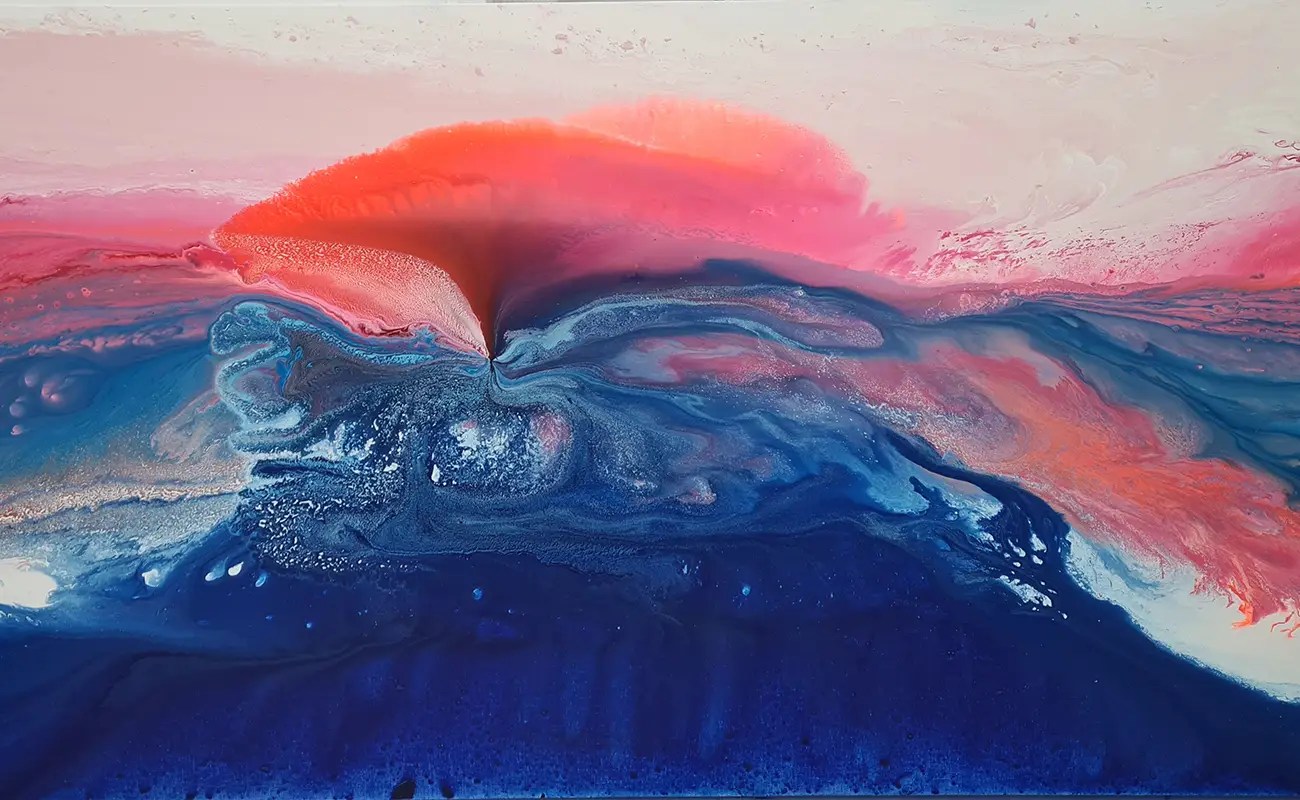
“Anne Mariën paints “the unpaintable”; she creates energetic visual experiences of beauty and brightness.”

Where Intuition First Found Its Language
Creative instinct shaped Anne Mariën long before she formally embraced life as an artist. Born in Mechelen, Belgium, she spent years carrying an intense desire to create, guided by a fascination with forms of beauty that resist verbal explanation and instead move through emotion and sensation. That attraction toward the unspoken became the foundation of her artistic direction. Although her full commitment to painting emerged later in adulthood, the impulse had always existed beneath the surface, quietly gathering force. A decisive transformation began in 2000 when she joined private art sessions led by the Belgian artist and activist Frans Croes in his attic studio at Zennegat, an idyllic location whose atmosphere encouraged experimentation and independence. Croes, known for his unconventional thinking and open creative philosophy, became an important early influence. Within that environment, Mariën gradually shaped an artistic language centered on instinct, emotional freedom, and the expressive power of abstraction. Her paintings would eventually become vehicles for experiences that could not be translated literally, only sensed through color, movement, texture, and atmosphere.
The moment Mariën created her first abstract triptych marked a turning point that defined the beginning of her artistic identity. The work rejected stylistic conventions and emerged through intuition rather than predetermined structure. It represented experimentation, rebellion, and liberation at once. Frans Croes responded enthusiastically to the painting’s vibrant chromatic energy and uninhibited spirit, recognizing a creative authenticity that could not be imposed through traditional instruction. Following their weekly sessions, Croes reportedly admitted that there was little more he could formally teach her, encouraging Mariën to continue exploring independently. She later pursued further artistic development at the Mechelen Art Academy, where she expanded her technical knowledge while maintaining the spontaneous freedom that had become central to her practice. The academy offered opportunities to experiment with monumental formats and diverse methods while also connecting her to exhibitions, artistic communities, and international cultural environments. Through those experiences, her creative vocation became increasingly clear, establishing a path grounded in emotional intuition rather than rigid academic systems.
Over time, Anne Mariën developed a body of work distinguished by vitality, movement, and a profound sensitivity to natural energy. Curator Jan Van Woensel described her approach for a 2025 exhibition in Monaco as “positive-abstract with a feminine energy, zest for life and vitality,” emphasizing the spontaneous emergence that characterizes her canvases. That spontaneity remains essential to her process because the paintings are never entirely planned in advance. Instead, each work evolves through interaction between emotion, material, gesture, and subconscious response. Nature, the emergence of life, and energetic transformation repeatedly appear throughout her oeuvre, not through direct representation but through atmospheric suggestion and sensory resonance. Painting functions for Mariën as an introspective act through which new sensations, emotional states, and visual experiences come into existence. Her ambition to paint “the unpaintable” reflects this philosophy directly. Rather than illustrating visible reality, she seeks to evoke experiences that exist beyond language and beyond fixed form, allowing viewers to encounter feeling itself through abstraction.

Untitled, 2011
Anne Mariën: Landscapes Reimagined Through Sensation and Memory
Nature serves as the emotional vocabulary of Anne Mariën’s work, though never in a descriptive or illustrative way. Her paintings do not attempt to recreate mountains, oceans, forests, or skies as recognizable scenes. Instead, they communicate the sensation of encountering them physically and emotionally. Experiences gathered during extensive travels become internalized impressions that later resurface inside the studio through abstract forms, textures, and chromatic atmospheres. Mariën has traveled through countries celebrated for dramatic landscapes and immersive natural environments, including Norway, Ireland, Greece, Spain, Portugal, Croatia, Slovenia, Vietnam, Thailand, Panama, Argentina, Ecuador, Jordan, and Cape Verde. These journeys expose her to shifting climates, vast terrains, luminous coastlines, geological formations, and changing weather systems that leave emotional traces rather than visual snapshots. Once back in Belgium, her studio becomes a contemplative environment where those accumulated impressions are transformed into paintings. The resulting works communicate physical exposure to nature’s elements while resisting direct narrative or figurative translation. Through abstraction, she recreates emotional memory rather than visible geography.
This relationship with nature creates remarkable ambiguity throughout her compositions. Many paintings suggest aerial coastlines, underwater formations, microscopic organisms, weather patterns, volcanic surfaces, or cosmic expanses without fully resolving into identifiable imagery. That uncertainty encourages viewers to move continuously between macrocosmic and microscopic associations, between external environments and internal emotional states. Her paintings often feel suspended between earthly and cosmic dimensions, where paint behaves almost like water currents, vapor, sediment, erosion, or organic growth. Such fluidity gives her work a sense of constant transformation, as though each canvas captures a living process rather than a fixed image. Art collector and former Council of Culture member Frank Nobels described each artwork by Mariën as “a spirited attempt to grasp the totality of life,” a phrase that reflects the expansive emotional ambition behind her practice. The paintings carry an immersive quality because they are built from layered impressions accumulated through movement, observation, and emotional absorption rather than through direct visual imitation.
Several admired artists have also contributed to Mariën’s broader visual sensibility, including Gerhard Richter, Herbert Brandl, David Hockney, Mark Rothko, and Katharina Grosse. Yet despite echoes of postwar abstraction and gestural painting traditions, her artistic voice remains highly individual. Certain works may recall aspects of Art Informel, Abstract Expressionism, or Tachisme, particularly in their fluid structures and energetic surfaces, but Mariën’s paintings possess a luminous warmth and regenerative energy that distinguish them from darker existential strains of abstraction. Her approach combines spontaneity with compositional balance in a way that feels instinctive rather than calculated. Radiant blues, mineral greens, volcanic blacks, vivid oranges, acidic yellows, and flashes of magenta interact dynamically across the canvas, creating emotional acceleration through color alone. Cooler compositions often generate translucent atmospheric depth, while warmer works radiate intensity and sensuality. Throughout all of them, there is movement toward illumination, renewal, and emotional openness rather than fragmentation or despair.
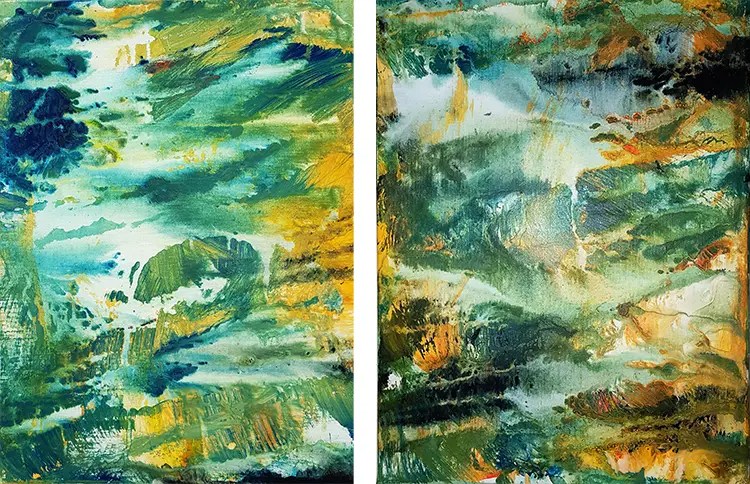
Forming 1, 2019
Forming 2, 2019
Material, Motion, and the Emotional Climate of Paint
One of the most compelling aspects of Anne Mariën’s practice lies in her ability to create paintings that feel simultaneously spontaneous and carefully orchestrated. Her surfaces pulse with motion through poured pigments, layered stains, dragged textures, gestural brushwork, and translucent veils of color that appear to evolve organically across the canvas. Yet beneath that apparent improvisation exists a strong compositional intelligence that holds the visual energy together. Rather than choosing between explosive freedom and meditative restraint, Mariën allows both tendencies to coexist. The result is a visual language that appears alive and continuously shifting. Paint becomes more than a medium in her work; it behaves like a living substance capable of embodying natural forces and emotional states. Drips resemble traces of time, textures evoke erosion or growth, and layered pigments create atmospheres that suggest memory, transformation, and movement. Each canvas appears suspended within an active process of becoming rather than existing as a finalized static object.
This dynamic relationship between control and surrender defines much of her technical process. Acrylic fluidity, scraping, staining, pouring methods, and expressive mark-making all contribute to surfaces that contain both unpredictability and structure. Importantly, these techniques never function as decorative gestures disconnected from meaning. Every material decision reinforces the emotional atmosphere of the painting itself. Certain compositions generate the sensation of immersion, as though the viewer has entered a shifting environmental condition rather than simply observing an artwork. Others communicate geological density or cosmic vastness through accumulations of texture and chromatic depth. Light frequently appears embedded within the paint, emerging from beneath translucent layers instead of resting superficially on the surface. This internal luminosity contributes strongly to the emotional accessibility of her work because viewers respond physically and intuitively to the atmosphere before attempting intellectual interpretation. The paintings invite emotional participation through sensation, rhythm, and spatial immersion rather than through narrative explanation.
Mariën’s abstractions remain remarkably approachable despite their complexity because they prioritize resonance over conceptual distance. Many contemporary abstract works emphasize theoretical interpretation or intellectual decoding, yet her paintings function differently. They operate as emotional climates where intuition, memory, imagination, and sensation coexist fluidly. Viewers are encouraged not to solve the image but to inhabit it emotionally. This openness contributes significantly to the regenerative quality often associated with her art. Even darker compositions contain movement, vitality, and subtle emergence rather than emotional collapse. Her paintings suggest transformation in progress, where chaos gradually reorganizes into light, balance, and atmospheric harmony. Such qualities explain why her work continues to resonate across varied audiences and international exhibition contexts. The emotional immediacy of her visual language allows audiences from different backgrounds to connect with the work through personal feeling rather than specialized art historical knowledge. In this sense, Mariën’s paintings become experiences rather than representations, emphasizing emotional presence above fixed interpretation.

Energy, 2018
Attraction, 2023
Anne Mariën: Building an International Presence Through Creative Evolution
Recent years have marked an important period of expansion within Anne Mariën’s career, particularly through her collaboration with curator Jan Van Woensel beginning in 2024. Their partnership has generated several significant projects that have increased international visibility for her work while deepening critical engagement with her artistic philosophy. Among these developments was the publication of the essay “The unpaintable” in Whitehot Magazine of Contemporary Art in New York, a text that explored the experiential and emotional dimensions of her abstraction. The collaboration also led to curated solo and group exhibitions alongside participation in international art fairs across Belgium, France, Monaco, the United States, and the Czech Republic. Cities including Antwerp, Mechelen, Knokke, Paris, New York, and Pilsen became important stages for presenting her evolving body of work to broader audiences. These exhibitions strengthened recognition of Mariën as an artist whose paintings communicate across cultural boundaries through atmosphere, intuition, and emotional immediacy rather than through narrative specificity.
Alongside these international activities, Mariën maintains a strong connection to her local environment in Mechelen, where her permanent exhibition at Hotel Elisabeth functions as both a presentation space and a place of encounter. There she regularly meets collectors, guests, and visitors while continuing to balance travel with intensive studio practice. This rhythm between movement and reflection remains deeply integrated into her creative process. Journeys outward into unfamiliar landscapes are consistently followed by inward periods of contemplation and artistic transformation. Her studio therefore becomes not only a workspace but also a meditative environment where accumulated experiences are filtered into abstraction. That ongoing exchange between external discovery and internal reflection gives her paintings their emotional density and layered atmospheric quality. Even as her visibility grows internationally, the essential core of her work remains rooted in intuition, sensory memory, and a deeply personal relationship with natural energy and transformation.
The next major milestone in Mariën’s artistic trajectory is the release of her first retrospective monograph, scheduled for winter 2026. The publication is expected to provide a comprehensive overview of her development, thematic concerns, and evolving visual language across years of sustained experimentation. Such a project arrives at a moment when her work occupies an increasingly distinctive position within contemporary abstraction. Her paintings resist rigid categorization because they combine emotional openness, gestural vitality, atmospheric sensitivity, and technical experimentation without becoming confined to any single movement or theoretical framework. What continues to distinguish Anne Mariën is her commitment to creating paintings that communicate sensation itself. Through luminous color, layered movement, and immersive spatial atmospheres, she transforms abstraction into a direct emotional encounter. Her art does not simply represent nature, memory, or feeling. Instead, it attempts to transmit their energy through paint, allowing viewers to experience something immediate, expansive, and deeply human.


