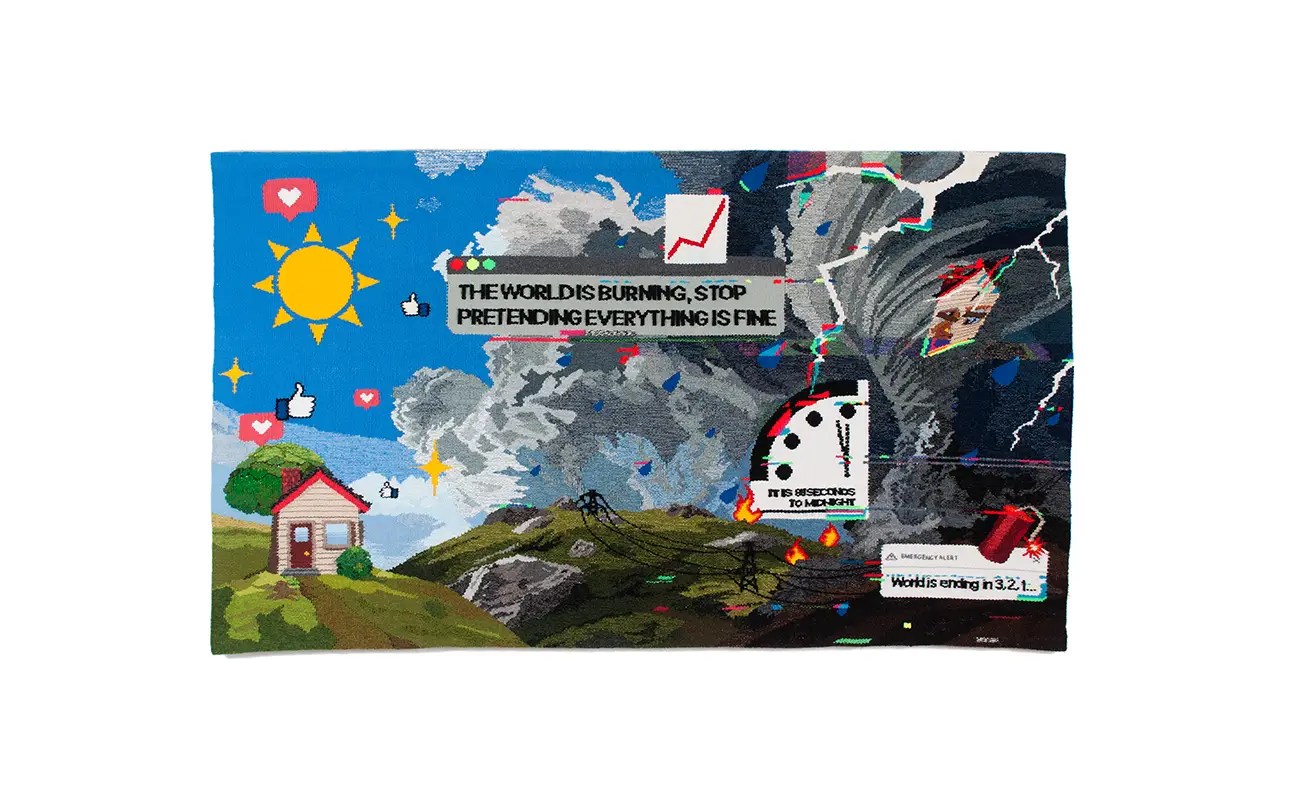
“Everything That Could Go Wrong, Did Go Wrong (But Maybe it’s Not My Fault)” achieved the feeling of overwhelm that often coincides with anxiety quite well.
Threads of Isolation and Reinvention
Molly Kent’s artistic journey emerged through a combination of circumstance, persistence, and an instinctive attraction to image-making that gradually evolved into a deeply personal visual language. After completing her Fine Art MA at Edinburgh College of Art in 2020, she found herself entering adulthood during one of the most disruptive moments in recent history. The Covid-19 lockdown in the United Kingdom interrupted conventional career paths and left many recent graduates uncertain about their futures. For Kent, however, that difficult period unexpectedly became a turning point. Unable to pursue traditional employment opportunities, she continued making work, refining her approach to textiles and expanding the ideas that had begun developing during her studies. What might have become a temporary experiment instead transformed into a sustained artistic practice grounded in persistence and curiosity. The environment of Edinburgh College of Art also left a lasting mark on her interests, particularly through its historical association with tapestry weaving, which encouraged her fascination with textile-based processes alongside rug tufting and other material techniques.
Her relationship with art never appears framed as a sudden revelation or dramatic career decision. Instead, creativity developed naturally alongside other intellectual interests that once seemed equally possible futures. During her school years, Kent balanced her enthusiasm for art with studies in Maths and Physics, even considering physics as a university pathway before ultimately choosing art school. That duality between analytical thinking and visual experimentation continues to echo through her work today. Her compositions often combine intricate planning with emotional intensity, producing pieces that feel both carefully constructed and psychologically charged. The tension between structure and instability becomes especially visible in the way she manipulates visual space, layering symbolism, digital references, and fragmented imagery into scenes that communicate emotional overload while remaining visually coherent.
Kent’s identity as an autistic and disabled artist is central to the way she experiences and interprets the world. Autism shapes not only the themes she investigates but also the rhythms and practical realities of her creative process. Her practice adapts to fluctuating energy levels and changing physical capacities, resulting in a working method that prioritises flexibility over rigid schedules. Some days allow long periods at the loom, while others limit her to administrative tasks or brief periods of activity. Rather than concealing these realities, Kent’s work openly reflects experiences of anxiety, instability, and sensory intensity. This honesty gives her art a distinctive emotional resonance, transforming private struggles into vivid visual narratives that many viewers recognise within their own experiences. The result is work that feels deeply autobiographical while simultaneously engaging with broader fears surrounding climate uncertainty, economic instability, and contemporary social tension.

Molly Kent: Internet Memory and Symbolic Worlds
Digital culture forms one of the defining foundations of Molly Kent’s visual language. Long before emojis and glitch aesthetics became widespread artistic motifs, these references had already entered her work during her late teenage years while studying for her Art Foundation Diploma. Their persistence across more than a decade of creative development reveals how fundamentally connected they are to her personal history. Growing up online provided Kent with a sense of communication and belonging that often felt easier than face-to-face interaction. As an undiagnosed autistic child and teenager, internet spaces became social environments where connection felt more manageable and less overwhelming. Hours spent communicating through MSN and Facebook Messenger gradually embedded digital iconography into her imagination, eventually resurfacing within her woven imagery as recurring symbols of memory, emotion, and fractured communication.
These references to online culture are never presented merely as nostalgic markers of early internet aesthetics. Instead, Kent transforms them into emotional devices that capture the complexity of modern psychological life. Glitches, fragmented visuals, and digital distortions operate almost like emotional interruptions within her compositions, mirroring anxiety, sensory overload, and instability. This relationship between digital imagery and emotional experience creates a striking contrast when combined with traditional textile techniques. Weaving and tufting possess long histories associated with patience, labour, and material permanence, yet Kent inserts symbols of fleeting digital communication into these ancient processes. The collision between contemporary internet culture and historical craft traditions gives her work a distinctive tension, allowing familiar digital signs to acquire unexpected emotional and symbolic weight.
Her fascination with narrative imagery also extends beyond internet culture into historical painting traditions. During her time at art school, Kent developed a strong interest in medieval religious painting, particularly works rich with dramatic storytelling and densely populated scenes. Paintings such as Hieronymus Bosch’s The Garden of Earthly Delights and Rogier van der Weyden’s Beaune Altarpiece became influential references because of their theatrical narratives and visually saturated compositions. These historical influences can be sensed in the layered complexity of her own work, where multiple symbolic events often unfold simultaneously within a single image. Like the religious paintings she admires, Kent’s scenes invite prolonged viewing, rewarding attention with recurring motifs, hidden details, and emotional contrasts that shift between humour, chaos, fear, and vulnerability. The result is a body of work that bridges medieval visual storytelling with contemporary anxieties shaped by digital life.

Landscapes of Anxiety and Emotional Architecture
Anxiety operates within Molly Kent’s work not simply as a theme but as an organising force that shapes atmosphere, imagery, and composition. Her scenes frequently emerge from dreams and nightmares influenced by personal worries and wider global concerns. Economic uncertainty, environmental collapse, and social instability enter her subconscious and reappear transformed into emotionally charged visual environments. Rather than depicting these fears directly through documentary realism, she translates them into symbolic scenarios filled with tension and surreal distortion. This approach allows emotional states to become architectural and spatial, turning psychological experiences into immersive visual worlds. Storms, destruction, glitches, and unstable landscapes combine to create environments that feel simultaneously internal and universal.
One of the strongest examples of this emotional architecture appears in her woven work Everything That Could Go Wrong, Did Go Wrong (But Maybe it’s Not My Fault). The tapestry holds particular personal significance for Kent not only because it is the largest piece she has produced, but because it gathers together many of the symbolic elements most central to her artistic language. Among these recurring motifs is the image of the burning house, which functions almost as a fragmented self-portrait. The symbol represents experiences of devastation, loss of control, and emotional collapse that have shaped different periods of her life. Through this imagery, the house becomes more than a physical structure; it transforms into a representation of vulnerability under pressure, capturing the sensation of being overwhelmed by circumstances that seem impossible to contain.
Despite the intensity of its themes, Kent also describes the creation of this tapestry as deeply enjoyable. The process of constructing storm-filled skies through carefully orchestrated colour variations became an absorbing puzzle that balanced emotional expression with technical problem-solving. She focused particularly on integrating glitch effects into lightning forms so they remained visually convincing while still preserving their fragmented digital quality. This interaction between chaos and control reflects a larger dynamic present throughout her practice. Her works often portray emotional overload, yet their construction depends upon patience, precision, and sustained concentration. That contrast gives the finished pieces a compelling energy, where intricate craftsmanship coexists with imagery of instability and fear. Through weaving, Kent transforms anxiety into something tactile and visually intricate, allowing overwhelming feelings to be examined through texture, colour, and symbolic narrative.

Molly Kent: Expanding Textile Language Into Sculpture
The physical process of making remains central to Molly Kent’s relationship with art. Her day-to-day routine is guided less by strict structure and more by responsiveness to fluctuating energy levels and health conditions. Living and working as a disabled artist means that consistency cannot always be relied upon, and this reality shapes the practical rhythm of her studio life. Some days allow for long, concentrated periods at the loom lasting up to ten hours, while other days make sustained physical work impossible. Instead of forcing a rigid schedule, Kent prioritises adapting to these changes while preserving as much time as possible for weaving and tufting. This flexible approach enables her to maintain creative momentum without separating artistic production from the realities of disability and chronic fluctuation.
Textile processes themselves appear especially suited to the emotional and conceptual concerns running through her practice. Rug tufting and woven imagery allow Kent to combine labour-intensive construction with bold visual storytelling, producing surfaces that contain both softness and intensity. The tactile quality of textiles introduces a physical dimension to themes that might otherwise remain abstract or psychological. Through thread, colour, and texture, digital anxieties and emotional fragmentation acquire material presence. Her practice therefore exists within a fascinating intersection of historical craft, contemporary digital symbolism, and autobiographical storytelling. This layered approach has helped distinguish her work within contemporary textile art, particularly as younger artists increasingly reconsider traditional mediums through the lens of internet culture and personal narrative.
Looking ahead, Kent is preparing to move beyond two-dimensional textile work into ambitious sculptural territory. An upcoming collaboration with Edinburgh Sculpture Workshop will support the creation of her first large-scale sculptural piece using unfamiliar materials and techniques. The opportunity represents a significant expansion of her practice, opening possibilities for her symbolic imagery to occupy physical space in entirely new ways. Considering the immersive qualities already present in her woven scenes, the move toward sculpture feels like a natural progression rather than a dramatic departure. Her interest in narrative environments, emotional architecture, and sensory intensity suggests strong potential for spatial installations capable of surrounding viewers rather than simply confronting them from a wall. This next phase signals an artist continuing to evolve while remaining deeply connected to the personal experiences and symbolic systems that define her work.