“The work comes from a sense but it does not have to provide a sense.”
A Current Moving Between Disciplines
Eugenio Azzola (Instagram) was born in northern Italy in 1971 and now lives in Austria, carrying with him a creative path shaped less by academic specialization than by restless curiosity. His artistic identity has grown through decades of movement between music, photography, writing, and painting, each discipline feeding the others rather than competing for dominance. Guitar has accompanied him for more than forty years, eventually leading to a conservatory diploma in 2005 and a career as a teacher. Photography entered his life earlier through industrial studies completed in 1998, while writing became a lifelong companion beginning in childhood. Instead of separating these practices into isolated territories, Azzola treats them as tributaries flowing toward the same destination. That philosophy appears repeatedly throughout his reflections, especially in his recurring metaphor of water, rivers, and convergence.
The artist describes his development not as a conventional curriculum but as a sequence of encounters, emotional shocks, and intuitive recognitions. Childhood exposure to illustrated books on painting and natural history opened his imagination toward both art and science. During adolescence, a kinetic sculpture exhibition by Paolo Di Marco triggered a revelation that he belonged among those who exist outside ordinary structures and expectations. Music later became another demanding force in his life, creating tension between technical discipline and the desire for improvisation. Those opposing impulses would eventually become central to his visual language as well. Structured repetition and unpredictable transformation coexist throughout his paintings, mirroring the balance between compositional order and emotional spontaneity that also defines music.
Travel deepened his artistic awareness during formative years spent in London, Holland, Paris, and Vienna. Working modest jobs while absorbing museums and urban environments, he encountered moments that permanently altered his understanding of art. One of the strongest memories came at the Tate Gallery when he unexpectedly stood before Picasso’s The Weeping Woman, a painting he had previously known only from books. The emotional impact was immediate and overwhelming. Photography became a way to process these experiences, particularly through black and white imagery and photomontage focused on urban estrangement. Even now, that sensation of displacement continues to echo through his visual practice, appearing in fragmented skylines, luminous structures, and uncertain landscapes suspended between memory and dream.

Eugenio Azzola: The Architecture of Open Resonance
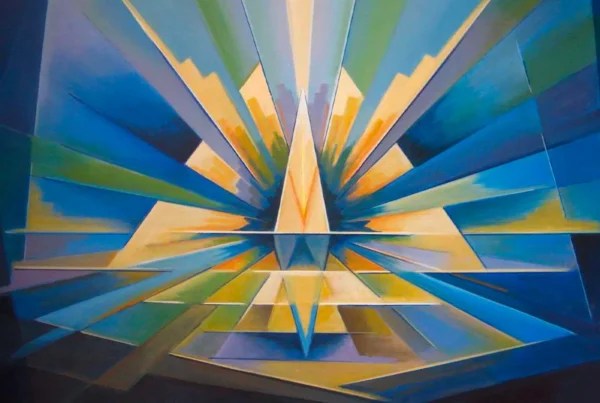
Azzola’s paintings emerged after years of observation and incubation, almost as though they had been silently forming beneath the surface of his other disciplines. Early experiments involved small figures sketched in notebooks and watercolor studies, but over time he began developing a highly distinctive process centered on tape, layering, cutting, and removal. His works are constructed through woven bands arranged on boards, often stabilized with fiberglass mesh and enhanced with oil paint, resin, silicone, graphite, or metallic elements. The procedure combines precision with unpredictability. Sections are masked, peeled away, rebuilt, and transformed through light and texture until entirely new spatial relationships emerge. This method is especially visible in East Fence, a monumental work whose creation process occupied two months and involved repeated stages of weaving, cutting, filling, masking, and illuminating.
The resulting paintings exist somewhere between abstraction and landscape. Geometric structures resemble skylines, fences, rivers, weather systems, or distant architectural formations, yet they resist fixed interpretation. Works such as Division Four, The Fields of Joy V, Shadow Boxer IX, and The End of the Worlds suggest emotional states more than literal scenes. Light appears to pulse beneath the surface, while layered bands create rhythms that feel almost musical. Azzola often speaks about searching not for provocation or conceptual spectacle, but for what he calls “open resonance.” Rather than imposing a message, he wants the work to remain available to the viewer’s internal frequency. Beauty, atmosphere, and emotional vibration become more important than explanation.
This approach also reflects his skepticism toward overly rigid conceptual systems in contemporary art. Azzola acknowledges that invention alone is insufficient and that originality has become increasingly elusive within a long historical continuum. Instead of attempting revolution, he focuses on creating works with inner harmony between form and content. He follows intuition, chance, and unconscious processes during creation, allowing the painting itself to guide decisions. The works in OpenResonance arise from “putting and removing,” adapting continuously to the flow of the image as it develops. That openness gives the paintings an unusual emotional elasticity. They can appear meditative, tense, luminous, melancholic, or ecstatic depending on the viewer’s state of mind, creating encounters that remain fluid rather than fixed.

Between Madness, Writing, and Human Connection
Writing occupies a deeply personal role within Azzola’s life and functions as the connective structure binding his many creative pursuits together. Although he published only one major literary work, La quinta felicità in 2009, the experience behind it profoundly shaped his artistic philosophy. The book emerged from six years connected to the former psychiatric hospital in Trieste, where he initially arrived for civil service in 1999. What began as a ten month assignment evolved into a transformative immersion in a community marked by fragility, suffering, joy, and unexpected wisdom. Those experiences introduced him to people living outside social norms, individuals he associates with the ecstatic intensity celebrated in the famous Jack Kerouac passage that opens OpenResonance.
The emotional and philosophical influence of those years extends across his entire body of work. Azzola became fascinated by the idea that truth, sensitivity, and poetic perception often emerge most strongly from people considered marginal or unstable. His paintings do not illustrate mental illness directly, yet they carry a comparable emotional instability through fractured spaces, shifting light, and unresolved atmospheres. He rejects clichés and simplistic communication in favor of works capable of sustaining ambiguity and emotional openness. According to his reflections, art should arise from meaning without necessarily delivering a single decipherable meaning. This distinction allows his paintings to function more like emotional weather systems than intellectual statements.
Relationships with mentors and collaborators also played a significant role in shaping his outlook. Martial arts teacher Denis Brecevaz helped him recognize that artistic gestures, musical phrasing, and physical movement all emerge from the same center of energy and intention. Writer and aesthete Claudio Nerenzi later encouraged his literary development and supported the publication of La quinta felicità. Fellow artist Paolo Di Marco described Azzola’s paintings as experiences capable of transmitting vibrations that transform into amazement, tension, and lightness. He even suggested that viewers should observe the paintings while listening to Azzola’s music, emphasizing the inseparable relationship between sound and image within his creative universe. These interdisciplinary connections reinforce the sense that his work operates less as isolated objects and more as interconnected emotional environments.

Eugenio Azzola: Landscapes Beyond Explanation
The visual language of Azzola’s paintings often suggests movement across thresholds. Fences, borders, horizons, rivers, sparks, churches, eclipses, and flight paths recur throughout titles and compositions, implying transitions between interior and exterior realities. Works like Borderfence, North Fence, and East Fence use repeating bands to construct structures that simultaneously divide and connect space. Others, such as Oregon, Out of the Woods or Sankt Nömmens Churches VII, evoke distant geographies transformed into emotional terrain. Even when the references appear concrete, the imagery remains suspended in uncertainty. Viewers are invited to inhabit states of transition rather than arrive at definitive interpretations. This ambiguity is essential to the atmosphere Azzola seeks to create.
Light functions as another central element within his practice. In many works, illumination appears trapped beneath surfaces or emerging through cuts and layered textures. The contrast between darkness and glow produces an almost cinematic sensation, recalling urban nights, reflections after rain, or distant city skylines seen through memory. His use of oil paint, resin, silicone, and metallic materials intensifies these effects by creating reflective surfaces that shift according to perspective and environment. The paintings therefore continue changing after completion, interacting dynamically with surrounding light and viewer movement. This instability contributes to their emotional depth and aligns with his belief that art should remain open rather than conceptually sealed.
Throughout his career, Azzola has consistently embraced the idea that all creative disciplines eventually flow together. Music, photography, writing, painting, travel, memory, and human encounters become interconnected currents feeding a single artistic identity. His recurring image of rivers entering the sea captures this philosophy with remarkable clarity. Distinctions between specialist and eclectic creator lose importance once experiences merge into a shared emotional source. That attitude allows his paintings to exist simultaneously as visual compositions, musical rhythms, emotional landscapes, and meditations on perception itself. In a cultural environment often driven by spectacle or confrontation, Azzola instead pursues resonance, subtlety, and beauty. His works do not demand immediate explanation. They ask viewers to remain present long enough to see what slowly begins to appear.