
“I want those who suffer from their fate, which is not their choice, to have the power to overcome their born environment on their own.”
Origins Shaped by Art, Language, and Crossing Borders
Sumire Kudo works as an oil painter in Los Angeles, yet the foundations of her practice were formed long before her current studio life. She grew up in a household where creative and intellectual pursuits were part of ordinary experience. Her mother taught art, while her father taught language and literature, placing visual expression and the power of words side by side from the beginning. That combination matters deeply when considering Kudo’s paintings today, because her images often function like essays translated into form. They carry ideas, arguments, and observations while still relying on color, composition, and human presence. Rather than separating image from thought, her upbringing encouraged both to exist together. This dual influence helps explain why her work is neither decorative nor casual in intent. Even when the subjects appear simple at first glance, they are rooted in questions about how people think, how beliefs are inherited, and how identity is shaped by forces that often remain unseen. Her paintings invite viewers into conversations that began early in her life.
Living across Japan, Australia, and the United States also played a decisive role in Kudo’s development. Exposure to different social settings, economic realities, and cultural expectations gave her firsthand experience of how “normal” behavior changes depending on where one stands. Customs that feel unquestioned in one place may seem strange elsewhere, and values treated as universal can quickly reveal themselves as local habits. For many people, such realizations arrive occasionally. For Kudo, they became a recurring condition of life. Moving among communities with different assumptions sharpened her awareness of how people adapt to systems they did not choose. She witnessed how environment can shape confidence, limit possibilities, or define status before an individual has spoken a word. These observations did not remain private reflections. They became the driving force behind her artistic direction, pushing her to investigate why people so often live according to rules they never consciously accepted.
Her academic path further strengthened that mission. Kudo earned a Master of Fine Arts in California and has exhibited primarily in museums and galleries across the United States. Formal study offered space to refine technique, but it also provided a framework for clarifying intent. She does not present painting as a romantic calling or a fixed identity. In fact, she has stated that she does not spend much time thinking of herself as an artist. For her, painting is above all a method for communicating concepts. That stance is revealing. It places emphasis not on personal mythology, but on usefulness, precision, and meaning. The canvas becomes a site where difficult questions can be made visible. Through that perspective, her career is not simply the story of a painter building exhibitions. It is the story of someone using oil paint to examine how social life directs private destiny, and whether people can recognize those pressures clearly enough to resist them.

Sumire Kudo: Figurative Images with Social Nerve
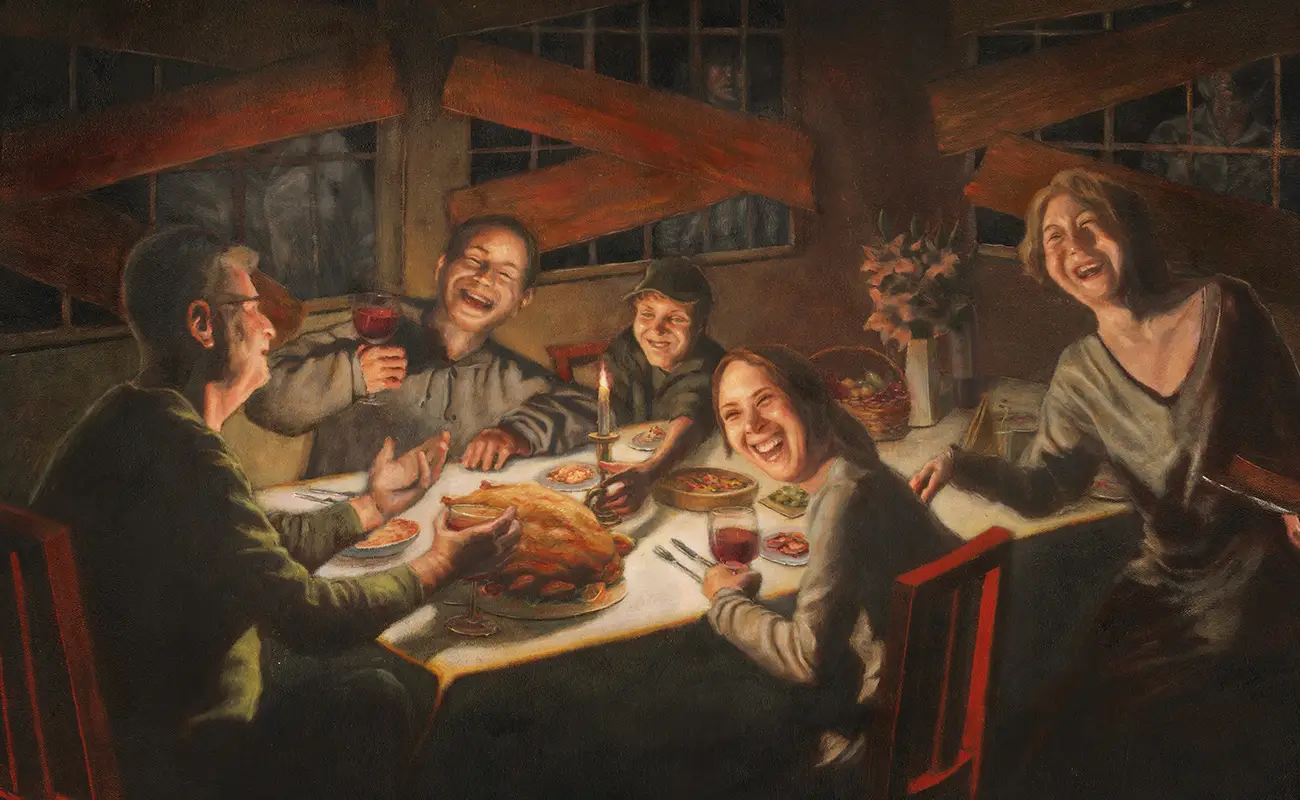
Kudo primarily works in figurative oil painting, using recognizable human forms as the entry point into more complex psychological territory. Figures allow viewers to immediately relate to gesture, posture, and expression, yet her paintings do not stop at likeness. She often incorporates surreal elements and symbolic imagery, shifting ordinary scenes into charged situations where hidden meanings rise to the surface. This combination gives her work a distinctive tension. Familiar bodies inhabit unfamiliar circumstances, and viewers are asked to reconsider what they usually overlook. Rather than offering literal narratives, she builds visual propositions. The figure becomes evidence, symbol, witness, and participant all at once. Oil paint serves this method well because it can move between realism and invention with great richness. Flesh, architecture, signs, and symbolic objects can coexist within the same carefully controlled space. Through this language, Kudo transforms figurative painting into a vehicle for examining power, conformity, and the habits that silently organize social behavior.
At the center of her practice is a sustained inquiry into the subconscious dynamics that shape society. Kudo has explained that ethics, logic, and standards of beauty are strongly influenced by the environments to which people belong. Families, nations, ethnic groups, and generations each produce their own version of common sense. Inside those circles, beliefs may appear natural and unquestionable. Outside them, the same beliefs can seem arbitrary or even absurd. Her paintings attempt to reveal that gap. She is interested in the ways people internalize values so deeply that they no longer notice them as constructed ideas. What feels personal may in fact be inherited. What feels voluntary may have been socially assigned long before reflection began. By placing these hidden mechanisms into visible scenes, Kudo asks viewers to reconsider the origins of their convictions. The work becomes social commentary not through slogans, but through carefully staged encounters between image and assumption.
This philosophical focus also carries a humane purpose. Kudo has spoken about wanting those who suffer under conditions they did not choose to find strength beyond the limits of their birth environment. That aspiration gives her practice emotional weight. She is not merely diagnosing systems; she is seeking openings within them. Many people live surrounded by expectations that punish difference, whether those expectations concern identity, success, gender, class, or belief. Kudo’s paintings suggest that such standards are neither eternal nor neutral. They are products of communities, repeated until they feel inevitable. If they were made, they can be challenged. Her images therefore encourage self-trust, especially for viewers whose values differ from those around them. In this sense, the paintings act as mirrors and instruments at once. They reflect the pressures of social life while also offering a way to think beyond them. The result is art grounded in critique yet directed toward possibility.

Psychology, Design, and the Discipline of Translation
Kudo’s influences extend well beyond the history of art. She has expressed strong interest in academic fields outside painting, especially the psychology of individuals and groups. That attraction is central to understanding her method. Many artists begin with sensation, memory, or formal experimentation. Kudo often begins with behavior. She studies how people move through institutions, how communities reward conformity, how biases are passed along, and how collective attitudes can feel natural even when they cause harm. These are not distant theoretical concerns for her. They are patterns she has encountered throughout life and, at times, personally struggled with. Because of that lived connection, the work avoids cold detachment. It is analytical, yet it remains deeply human. Her paintings emerge from observation sharpened by experience. They ask why people defend systems that diminish them, why exclusion can be normalized, and why individuals so often mistake inherited scripts for personal truth.
Her daily process reflects this conceptual orientation. Kudo has described beginning with questions about behaviors and psychological patterns that people unconsciously carry out. Before paint touches canvas, she first articulates these ideas in words. That step is significant because it shows that language remains an active part of her studio practice, echoing the literary influence present in her upbringing. Once the concept is clear, she translates it into visual form. This movement from text to image helps explain the clarity and force of her symbolism. Rather than decorating an intuition after the fact, she constructs a visual argument from a defined premise. Each composition must therefore do intellectual as well as aesthetic work. Objects, figures, spatial relationships, and gestures are selected for what they communicate. The painting becomes a carefully built sentence made of images, where every element contributes to meaning and where ambiguity is purposeful rather than accidental.
Another formative influence came through practical labor outside the studio. Kudo worked as a graphic designer to earn tuition for her MFA, and that experience sharpened her understanding of communication. Design demands attention to hierarchy, focus, rhythm, and how viewers move through visual information. Those concerns remain valuable in her paintings. She has noted that design helped shape how she leads the viewer’s gaze and perception through visual elements. This means the social and psychological themes in her work are supported by strong compositional intelligence. The eye is guided toward key relationships, symbolic contrasts, or moments of tension without heavy-handed instruction. Design training also likely reinforced economy and precision, encouraging images that communicate directly while retaining complexity. In Kudo’s hands, the disciplines of painting and design do not compete. They reinforce one another, allowing concept-driven art to remain visually compelling, accessible, and sharply organized.

Sumire Kudo: One Painting, Many Questions
Among Kudo’s works, one painting titled Female has drawn especially strong responses. The piece depicts a man speaking to a women’s restroom sign, an image at once simple, surprising, and layered with critique. Its power lies in the speed with which the situation can be grasped and the depth of what unfolds afterward. By addressing a sign rather than a person, the man treats gender as a fixed symbol rather than an individual reality. Kudo uses this visual exchange to expose the absurdity and violence of reducing people to labels. The restroom icon, designed for quick public recognition, becomes a stand-in for how society often simplifies identity into rigid categories. Because the scene is presented visually rather than explained verbally, viewers participate in the discovery themselves. They connect the metaphor through observation, which often creates a stronger and more lasting impact than direct instruction.
Kudo has said that what she appreciated most was seeing viewers understand the idea through visual information alone, without words. That reaction reveals an important principle in her practice. Although she begins many works with language and concept, she ultimately trusts painting to communicate what speech sometimes cannot. In Female, no lecture is necessary. The mismatch between human complexity and symbolic shorthand is evident in the image itself. This demonstrates how art can bypass defensive habits and reach understanding through recognition. A viewer may resist an argument stated plainly, yet still feel the truth of it when confronted with a compelling image. Kudo’s satisfaction with that response suggests she values active interpretation rather than passive agreement. The painting does not command a conclusion; it creates conditions in which viewers arrive at one. That distinction is crucial to the seriousness of her method.
Looking ahead, Kudo hopes to continue creating works in which each piece is built around a distinct concept. She has acknowledged that producing art in series may be more practical economically, yet she places greater value on ensuring that every painting carries its own meaning. This commitment speaks to her ethics as much as her aesthetics. She treats each canvas as an opportunity to address a particular question rather than repeating a successful formula. Because people’s lives and circumstances differ so widely, she hopes even a single work might resonate with someone’s experience, provoke fresh questions, or alter perspective. That ambition aligns perfectly with the broader arc of her career. Kudo does not seek image-making for its own sake. She seeks encounters between viewer and idea, between private experience and social structure, between inherited assumptions and newly possible thought. In that pursuit, her paintings remain urgent, thoughtful, and unmistakably purposeful.