“In a society that emphasizes division, I seek to rearticulate connection through the tactile act of wrapping.”
Snow, Fiber, and the Search for Nearness
Tomohiro Shibuki is an artist based in Tokyo whose work asks how separate things might share space without losing their own form. Rather than treating difference as a problem to be solved, he approaches it as a condition that can generate new relationships. This outlook shapes garments, sculptures, and installations that use felt alongside materials tied to particular places. His practice is guided by a wish to perceive individual elements as parts of a wider whole, where contrast does not lead to conflict. In an era that often rewards division, his art offers another possibility: coexistence through touch, proximity, and gentle transformation. The physical act of covering, wrapping, and layering becomes more than a visual strategy. It becomes a way of thinking about society, memory, and the fragile bonds that connect people to one another. Through this language of materials, Shibuki creates environments where separation softens and new forms of closeness begin to appear.
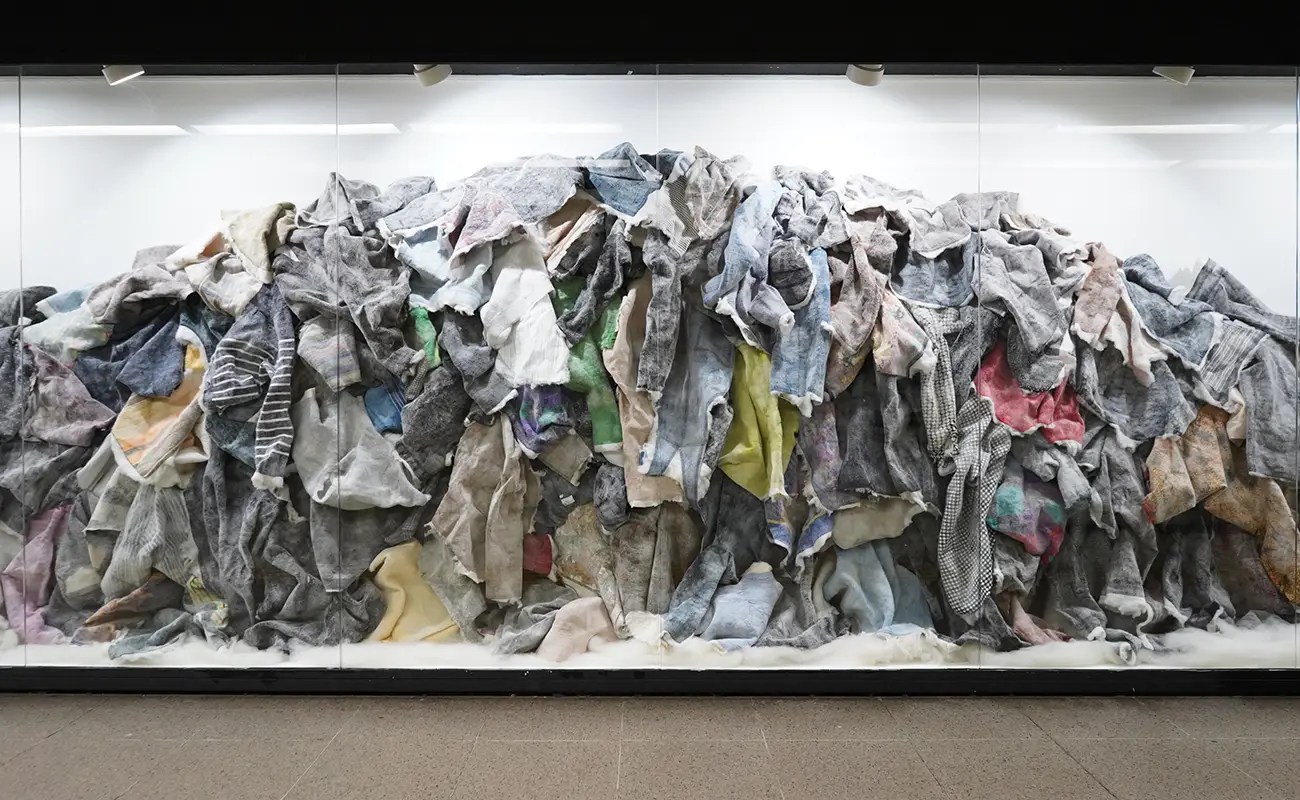
That concern with connection has become especially focused in recent years through the repeated motif of wrapping. Clothing and packaging are familiar coverings that often mark ownership, status, identity, or distinction. Shibuki reconsiders these ordinary functions by enveloping such objects in felt, changing their meaning through texture and concealment. What once emphasized difference can become a site of equality when edges blur and surfaces merge. Felt is central to this transformation because it is made of fibers that hold together through entanglement rather than rigid structure. Each strand retains a degree of freedom while also participating in a collective body. This condition mirrors the social relationships he seeks to imagine. His works do not erase individuality, nor do they flatten complexity. Instead, they suggest that separate entities may remain recognizable while entering a more compassionate arrangement. Through softness, warmth, and tactile presence, wrapping becomes a method for rearticulating how we might live beside others.
The emotional force of Shibuki’s practice lies in its refusal to dramatize unity as sameness. He is interested in forms that remain distinct in contour while still touching, leaning, or sharing atmosphere. This subtle balance appears in the way his surfaces gather around an object without fully consuming it, or in installations where multiple elements inhabit one spatial field. The viewer is invited to consider relation not as agreement but as coexistence. That distinction is important in contemporary life, where communication can be constant while bonds feel thin. Shibuki responds through material experience rather than slogans. Felt carries warmth, weight, and evidence of labor, reminding audiences that connection is something enacted through bodies and gestures. His work therefore speaks quietly yet clearly about how contact occurs. It suggests that nearness can be formed through patience, care, and attention to what surrounds us, even when the world insists on sharper lines and louder separations.

Tomohiro Shibuki: From Childhood Making to Material Philosophy
Creating objects was a source of joy for Shibuki from childhood, and that pleasure gradually became a lasting habit. What began as a natural impulse later found direction when he entered an art university with plans to become a designer. During his studies, however, his awareness shifted toward artistic practice. This transition matters because design often addresses function and solution, while art can hold uncertainty, contradiction, and open-ended inquiry. Shibuki’s later work reflects exactly that kind of expanded space. Rather than producing fixed answers, he builds situations where viewers sense relationships unfolding. His university years provided both technical discipline and a wider intellectual horizon, allowing intuitive making to develop into a coherent practice. The move from aspiring designer to artist was not a rejection of structure, but an enlargement of purpose. It enabled him to treat objects, garments, and installations as carriers of thought. From that point onward, materials would no longer serve appearance alone. They would become instruments for examining how lives intersect.
Textile study proved decisive in shaping the language he uses today. At university he worked extensively with felt and fiber-based materials, experiences that established the foundation of his continuing practice. Felt appealed to him for reasons that go beyond craft tradition or visual preference. It wraps, insulates, and holds warmth, making it deeply connected to bodily experience. Yet it also resists strict boundaries between inside and outside. Unlike hard surfaces that announce clear limits, felt is porous and composed of countless fibers whose relationships remain flexible. Shibuki finds this state compelling because it mirrors his philosophical concerns. Each fiber moves with relative freedom while also participating in a larger entangled structure. That image becomes a model for social existence, where individuals can retain autonomy while sharing life with others. Through felt, he discovered a medium capable of carrying abstract ideas in physical form. Its softness is not decorative. It is concept made tangible through touch.
Because of this, Shibuki’s use of textiles should not be mistaken for simple material preference. He chooses them because they are suited to expressing the themes at the center of his work. Many artists begin with ideas and later search for a medium; in his case, material and thought have grown together. Felt allows covering without aggression, transformation without destruction, and concealment without disappearance. It can absorb history while creating new surfaces. It can suggest care while also questioning systems of classification. These capacities make it ideal for an artist concerned with boundaries, coexistence, and subtle change. His sculptures and installations often rely on the viewer’s awareness that the material itself carries meaning before any narrative is explained. Texture, density, and enclosure communicate directly. This is why his style feels unified across different formats, whether garment, object, or immersive space. The consistency comes not from repetition, but from a clear understanding of how matter can think alongside the artist.

Landscapes of Hokkaido and the Quiet Lessons of Snow
At the root of Shibuki’s aesthetic sensibility are the snowy landscapes of Hokkaido, where he was born. That environment offered more than childhood scenery. It provided an early model for how contrasting things might exist together within one field. Snow covers insistent signage, architecture, roads, and traces of human activity with a shared layer of white. It does not erase these elements completely, yet it changes the way they relate to one another. Harsh differences become quieter. Competing forms enter a common atmosphere. For Shibuki, this natural condition revealed a mode of being in which distinctions remain while connection becomes visible. The influence of Hokkaido therefore extends beyond memory into method. His felt coverings echo the way snow settles over surfaces, softening edges without denying what lies beneath. The calm expanses of winter become a conceptual source for installations that invite viewers to sense relation through spatial experience rather than direct explanation. Nature, in this case, becomes a teacher of social possibility.
He describes an ideal relationship as one where forms keep their outlines while softly merging. This principle distinguishes his work from visions of total harmony that demand sameness or complete understanding. Shibuki is not searching for perfect consensus. Instead, he values a condition in which entities simply remain together. That modest statement carries considerable depth. Many social systems insist that difference must be resolved, ranked, or absorbed. His art proposes another route, where coexistence can occur without full agreement. The snowy landscape remains an enduring symbol because it demonstrates this balance so clearly. Buildings, paths, and objects are still present, yet they participate in a transformed whole. In his installations, viewers often encounter a similar sensation. Separate components maintain identity while entering a shared environment shaped by touch and atmosphere. This perspective gives his practice unusual emotional resonance. It does not promise grand unity. It honors the quieter achievement of staying near one another.
Shibuki also connects snow to other phenomena that loosen fixed identity. He mentions the gradual accumulation of dust over time and the way distant scenery fades into whiteness. These are subtle states in which objects drift from hard definition into ambiguity. Far from treating that ambiguity as loss, he sees it as creating margin or space, a zone that allows people to stay close to things and to the world. Such thinking helps explain the meditative quality of his work. Surfaces are often transformed not through dramatic gesture but through patient layering and partial concealment. Viewers are asked to notice transitions rather than declarations. Dust, distance, and snowfall all teach that perception changes slowly, and that what becomes less sharply defined may also become more open to relation. This sensitivity to gradual change sets Shibuki apart. He finds meaning in conditions many overlook, turning ordinary experiences of atmosphere into a profound visual language.

Tomohiro Shibuki: Spaces to Enter, Winds to Follow
Shibuki primarily produces and completes his work in the studio, a setting where sustained attention to material process can unfold. Yet the results increasingly move beyond the isolated object toward installation. In recent years he has focused more strongly on works that can be experienced as unified spatial environments. This shift is consistent with his larger concerns. If his art asks how distinct elements connect, then an entire room can become the most persuasive medium. Installations allow garments, sculptural forms, surfaces, and viewers themselves to enter relation. Rather than standing before a single item, audiences move within an atmosphere shaped by contact and proximity. Landscapes emerge inside galleries, not as literal scenes but as felt experiences of coexistence. The viewer senses how separate components gently interrelate while retaining their own presence. Through this expanded scale, Shibuki transforms philosophy into encounter. Space itself becomes wrapped, softened, and reorganized according to the values his practice has long pursued.
That direction is visible in his solo exhibition in Tokyo, titled Wind Passing Through. Presented at Gallery taga2 in Setagaya, the exhibition runs from April 9 to May 2. The title is especially revealing. Wind cannot be grasped, yet it can be felt through movement, temperature, and subtle shifts in surroundings. It passes among things rather than replacing them, making it an apt image for an artist concerned with relation. While the specific works are not detailed here, the exhibition title suggests circulation, permeability, and changing contact between bodies and space. It also echoes the softness and atmospheric qualities that define his use of felt. A current of air can connect distant points through invisible motion, much as his installations connect distinct elements through shared environment. In this sense, the exhibition title functions as an extension of his ideas, translating material thought into poetic language.
Looking ahead, Shibuki is preparing an art project in Otaru, his hometown, scheduled for autumn. He notes that this initiative has grown from an increasing desire to contribute to the place where he was born and raised. That statement reveals another layer of his practice: connection is not only conceptual or aesthetic, but geographic and personal. Returning creative energy to one’s place of origin mirrors his wider commitment to sustaining bonds across difference and distance. Otaru, linked to the formative landscapes of Hokkaido, represents more than a location on a map. It is part of the emotional and visual foundation from which his work emerged. By bringing new projects there, Shibuki closes a meaningful circle while opening another. The gesture joins memory, responsibility, and artistic growth. Just as his materials wrap objects into renewed relationships, this future project suggests an artist wrapping his own history into the present through acts of making and shared experience.