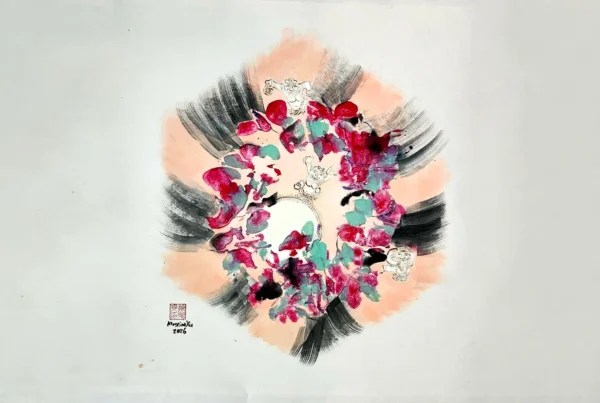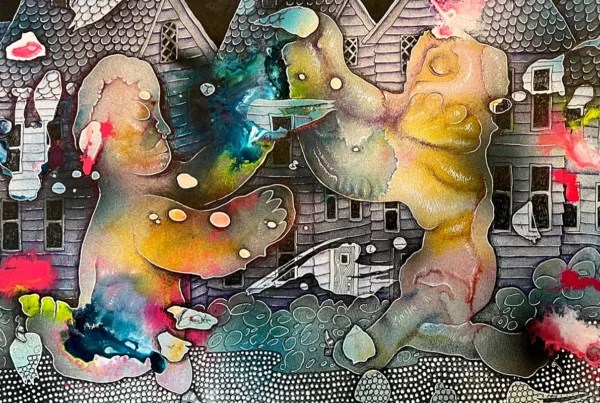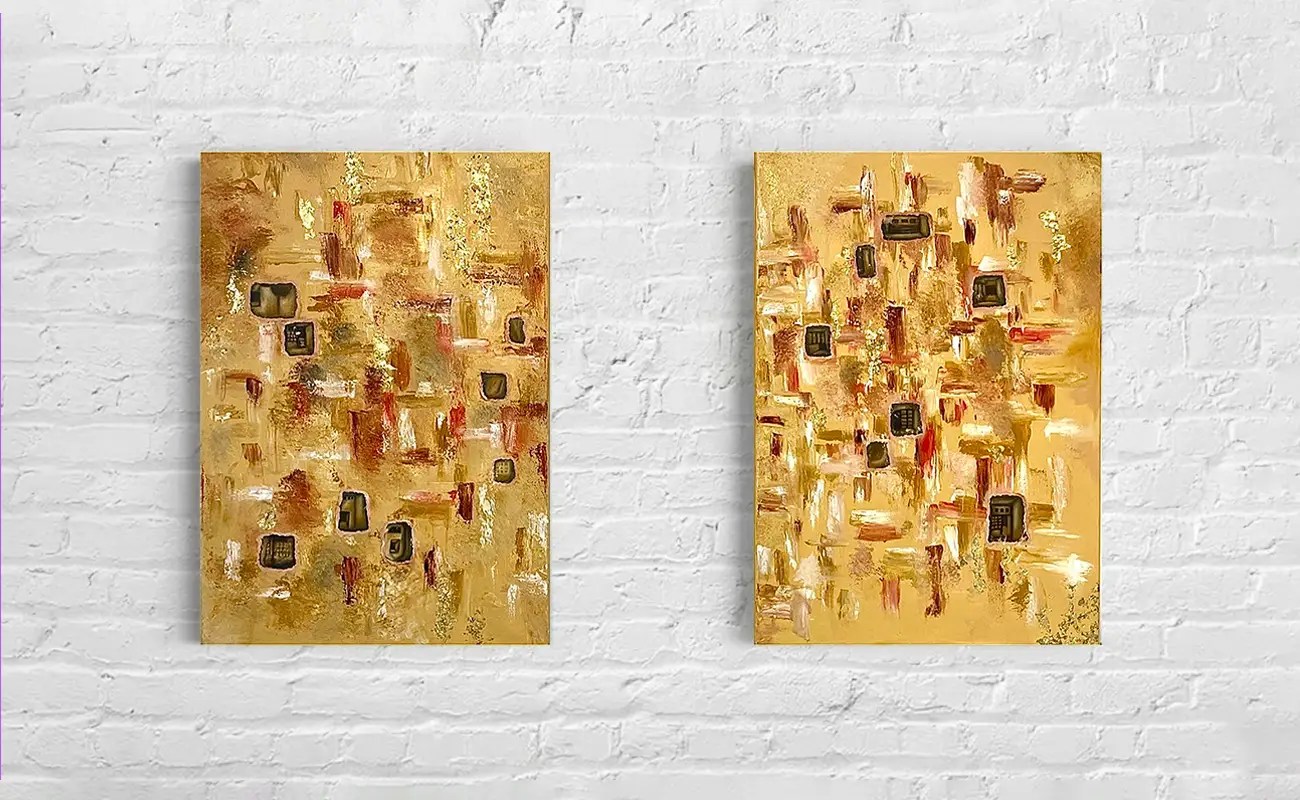
“Cultural memory, displacement, and nostalgia frequently emerge as recurring themes.”
Origins Written in Color and Sound
Veronika Otcuoglu has built an artistic voice shaped by movement, inheritance, and a lifelong closeness to creative expression. Born in Istanbul, Türkiye in 2001 and later based in Montreal, she carries Armenian and Greek roots that inform both the emotional and intellectual dimensions of her practice. Her paintings investigate cultural memory, identity, and symbolic storytelling, using imagery that often reaches beyond surface appearances. From an early stage in life, she was surrounded by artists and musicians, making creativity less a separate activity than a constant atmosphere. That environment appears to have given her a strong sense of rhythm, composition, and emotional cadence, qualities that continue to animate her visual work today. Rather than treating painting as decoration, she approaches it as a language capable of holding personal histories, layered meanings, and unresolved questions. This foundation helps explain why her paintings often feel reflective and resonant, connecting biography with broader cultural experience through carefully shaped visual narratives.
Growing up within a family where artistic and musical practices were present on a daily basis created an early sensitivity to tone, gesture, and atmosphere. Those influences can be felt in the way her compositions balance structure with feeling. Music often teaches timing, repetition, and contrast, while visual art teaches observation and transformation, and her paintings suggest an awareness of both disciplines. She has described art as a natural means of expression from childhood, indicating that image-making became an intuitive method for processing ideas and emotions. Such beginnings matter because they often determine whether an artist sees creativity as occasional labor or as an essential mode of thought. In Otcuoglu’s case, painting seems tied to self-understanding and communication. Her later focus on identity and memory can be read as an extension of those early experiences, where private feeling met shared cultural influence. This continuity between childhood environment and mature practice gives her work a sense of coherence.
The significance of her background also lies in its complexity. Armenian-Greek origins, birth in Istanbul, and later life in Montreal place her within multiple cultural frameworks at once. Many artists spend years searching for subjects worthy of sustained attention, yet Otcuoglu’s own lived experience already contained rich questions about belonging, translation, and inherited history. These concerns are not presented as slogans in her work, but instead emerge through symbols, settings, figures, and mood. Her paintings suggest that identity is not fixed or singular, but formed through memory, geography, family, and time. Because she has inhabited more than one cultural space, she is able to approach identity as something dynamic rather than static. This perspective gives her art relevance beyond autobiography, allowing viewers from many backgrounds to recognize their own experiences of movement, nostalgia, or cultural negotiation within the scenes she constructs.

Veronika Otcuoglu: Education Across Languages and Cities
Otcuoglu’s academic path reflects the same cross-cultural richness that appears in her art. She began her studies at the Lycée Français Pierre Loti d’Istanbul, where she received a French education known for encouraging intellectual curiosity and cultural awareness. Such a setting likely strengthened her ability to think across traditions and perspectives, skills that later became central to her artistic concerns. Education does more than transfer knowledge; it shapes habits of perception, analysis, and interpretation. For a young artist, exposure to multiple languages and histories can widen the field of imagination. Her early schooling therefore represents more than a formal milestone. It marks the beginning of a worldview attentive to complexity and dialogue. These qualities can be seen in paintings that bring together personal symbolism with broader historical references. Even before professional art training began, the foundations of her later practice were already forming through an environment that valued inquiry and cultural literacy.
After moving to Montreal at a young age, she continued her studies at Collège International Marie de France, where she completed her French Baccalaureate. Relocation during formative years often reshapes identity, especially when language, customs, and social expectations shift at once. For Otcuoglu, living between cultures and languages appears to have deepened her interest in heritage, memory, and the question of how people define themselves across borders. Montreal, with its multilingual and internationally connected character, would have offered fertile ground for such reflection. Rather than seeing displacement only as loss, her later paintings suggest that movement can also generate new forms of understanding. The experience of adapting to a new city while maintaining ties to earlier histories may explain why nostalgia and cultural continuity recur so strongly in her work. Her education in Montreal therefore complemented her upbringing in Istanbul, creating a dialogue between origins and new surroundings.
She later pursued focused artistic training through an apprenticeship at the Visual Arts Centre of Westmount in Montreal. This formative period allowed her to sharpen technical skills while experimenting with materials and approaches. Apprenticeship can be especially valuable because it combines discipline with exploration, helping artists translate instinct into craft. Otcuoglu then continued at Concordia University’s Faculty of Fine Arts in the extended program of the Painting and Drawing Department, graduating in 2024. University study likely expanded both her practical abilities and her engagement with critical conversations around contemporary art. Being part of a community of artists, educators, and critics often challenges creators to refine intention as much as technique. For someone already invested in symbolic narrative and cultural memory, that environment would have offered useful frameworks for development. Her progression from early talent to formal training shows a sustained commitment to building a professional and thoughtful painting practice.

Images of Heritage, Displacement, and Dream Logic
At the center of Otcuoglu’s work is a sustained engagement with Türkiye as cultural source, historical reference, and emotional landscape. Her paintings incorporate elements connected to the country’s art, history, mythological imagery, and political realities. These references do not function as simple illustrations. Instead, they appear as symbolic fragments within layered scenes that connect past and present. Through this method, she examines how collective histories continue to shape contemporary identity. Cultural memory becomes something active rather than distant, influencing the feelings and assumptions people carry into daily life. Her practice also addresses displacement and nostalgia, themes especially meaningful for those who live across borders or maintain ties to more than one homeland. By combining personal experience with broader historical currents, she creates works that feel intimate while remaining socially resonant. Viewers encounter not only painted surfaces, but questions about continuity, rupture, and what survives when place changes.
Although realism is the primary anchor of her style, Otcuoglu frequently introduces surrealistic features that transform ordinary scenes into reflective spaces. Realistic figures, landscapes, or interiors may be joined by unexpected objects, symbolic forms, or dreamlike disruptions. This interplay between observed reality and imaginative invention allows the paintings to communicate on several levels at once. A realistic image can establish familiarity, while surreal additions invite deeper interpretation. The result is often poetic rather than literal. Instead of stating a message directly, the work opens emotional and conceptual possibilities through juxtaposition. Such an approach suits themes like memory and identity, since both are rarely straightforward or stable. Memories shift, identities evolve, and history is often experienced through fragments rather than complete narratives. Her blending of visual languages gives form to that complexity. It also encourages viewers to slow down, notice relationships between elements, and search for meanings hidden within the composition.
Her range of subject matter further enriches this language. Landscapes in her practice often operate as spaces of remembrance, carrying emotional ties to geography and time. Portraits provide opportunities to examine presence, expression, and inner states, allowing identity to appear through gesture and gaze. Alongside these representational forms, abstract passages sometimes enter the image, creating rhythm, tension, or symbolic order. This combination suggests an artist interested not in categories but in usefulness. If realism serves one idea and abstraction serves another, both can coexist within the same painting. The same is true of cultural scenes, where social memory may be conveyed through architecture, clothing, or atmosphere rather than explicit narration. Across these varied subjects, a consistent thread remains: the desire to understand how individuals relate to inherited histories and contemporary life. Her paintings become meeting points where person, place, and imagination continuously interact.

Veronika Otcuoglu: Recognition, Exhibitions, and Expanding Presence
During her time at Concordia University, Otcuoglu participated in a group exhibition at the V A V Gallery, where her artwork Ceramic Waterfall was shown. Presenting work in a professional gallery setting is often a decisive step for emerging artists, since it shifts the painting from studio context into public conversation. For viewers, an exhibition creates the chance to encounter an artist’s ideas directly through scale, texture, and spatial presence. For the artist, it offers feedback, visibility, and the challenge of seeing one’s work among peers. The inclusion of Ceramic Waterfall indicates early recognition of her developing practice within an academic and professional environment. It also suggests confidence in her ability to translate personal themes into works suited for broader audiences. Group exhibitions can be especially important because they place artists in dialogue with other voices, highlighting both shared concerns and individual distinction. This moment marked a meaningful stage in her public emergence.
One year later, she was selected for the Global Art League competition at the Montreal Art Center & Museum, exhibiting alongside other finalists. Selection-based opportunities of this kind can broaden an artist’s network while signaling external confidence in the quality of the work. Competitive exhibitions often bring together diverse practices, making them valuable spaces for comparison, exchange, and discovery. For Otcuoglu, participation would have extended her reach beyond university circles into a wider contemporary art audience. It also aligns with the steady progression visible throughout her career: training, public presentation, and increasing recognition. Such developments matter because they create conditions for sustained practice. Visibility can lead to further exhibitions, publication opportunities, and international attention. In her case, these steps appear connected to a distinctive body of work grounded in cultural memory and symbolic realism, themes that can resonate across many contexts without losing their personal specificity.
Her growing international presence became clearer when her work Equity was featured in the third edition of the Arts to Hearts Project book, 100 Emerging Artworks of 2025. She was subsequently included in the 40th edition of Artist Closeup Contemporary Art Magazine, where her work Türkiye received attention. Following this, she presented a solo exhibition on Teravarna’s website, expanding access to her practice for viewers beyond local geography. These milestones suggest an artist moving from regional visibility toward broader international circulation. Publication, magazine features, and digital exhibitions each serve different functions, together building a more extensive audience. Importantly, the titles Equity and Türkiye hint at the conceptual range of her concerns, from social reflection to cultural identity. As her career advances, these recognitions position her as a painter whose work speaks both personally and collectively, using image to ask how history, belonging, and memory continue to shape contemporary life.