“In my installations, audiences physically sense historical tension through space rather than encountering it only through stories or texts.”

Spaces Where History Is Felt Rather Than Told
Contemporary installation art increasingly invites audiences to move beyond observation and into experience. Taiwanese artist Hsin-Mei Lin stands within this evolving field through her immersive environments that combine projection, spatial design, and participatory structures. Her work focuses on how history quietly shapes physical perception, encouraging viewers to feel historical tensions through their bodies rather than encountering them only through written accounts. Rooted in Taiwan’s layered political past, her installations construct sensory conditions where light, sound, and architectural arrangements work together to shape movement and awareness. The spaces she creates transform abstract historical narratives into immediate encounters that unfold through physical presence.
Lin’s background plays a central role in this approach. Growing up in Taiwan meant living within a society still shaped by the lingering effects of martial law and the era known as the White Terror. Although these events belong to the past, their influence persists in institutions, urban landscapes, and collective memory. For Lin, these historical traces are often subtle and rarely discussed openly in daily life. This quiet persistence inspired her to create artworks that reveal how unresolved histories remain embedded in the spaces people inhabit. Instead of presenting information through documentary formats, she constructs environments where viewers gradually sense unease, restriction, or tension through spatial interaction.
Her installations often guide audiences through shifting conditions of darkness, illumination, and physical constraint. Movement becomes a central method of understanding, allowing individuals to navigate corridors, chambers, or immersive projections that echo historical atmospheres. Through this method, the body becomes an interpretive tool. Memory is no longer confined to archives or narratives but emerges through posture, breath, and orientation in space. Lin’s practice therefore bridges artistic expression and historical reflection, offering environments where perception itself becomes a way of encountering the past.
Hsin-Mei Lin: Identity, Movement, and the Weight of International Contexts
Questions of identity and belonging have also shaped Lin’s artistic trajectory. Extended periods of study, travel, and participation in international residencies placed her within cultural environments where introducing herself often required explaining Taiwan’s complex geopolitical status. This recurring moment of self-introduction carried a subtle uncertainty. Taiwan’s layered colonial history and its ambiguous international recognition make identity something that often demands clarification. While crossing borders and presenting her work abroad, Lin became increasingly aware of how national narratives influence the way individuals are perceived and understood.
Holding a Taiwanese passport while traveling occasionally produced a quiet concern about being misunderstood or simplified. Such experiences informed her reflection on how identity is negotiated across borders. The process of describing Taiwan’s political and historical position revealed how easily complex histories can be reduced to brief explanations. These encounters gradually became part of her artistic thinking, encouraging her to consider how collective memory and national identity interact with personal experience. Rather than addressing these themes through direct statements, she translates them into spatial situations where uncertainty and tension are sensed through atmosphere.
Professional roles in both art and education further deepened these reflections. Lin works not only as an exhibiting artist but also as an educator engaged with younger generations. Within Taiwan, many historical experiences remain embedded beneath everyday life without frequent public discussion. The gradual disappearance of older generations raises questions about how memories of authoritarian rule and political conflict might continue to be preserved. For Lin, artistic practice offers another language through which these fragile memories can remain present. Installations become spaces where history can be encountered again through sensation and interpretation rather than through explanation alone.

War, Architecture, and the Body as Boundary
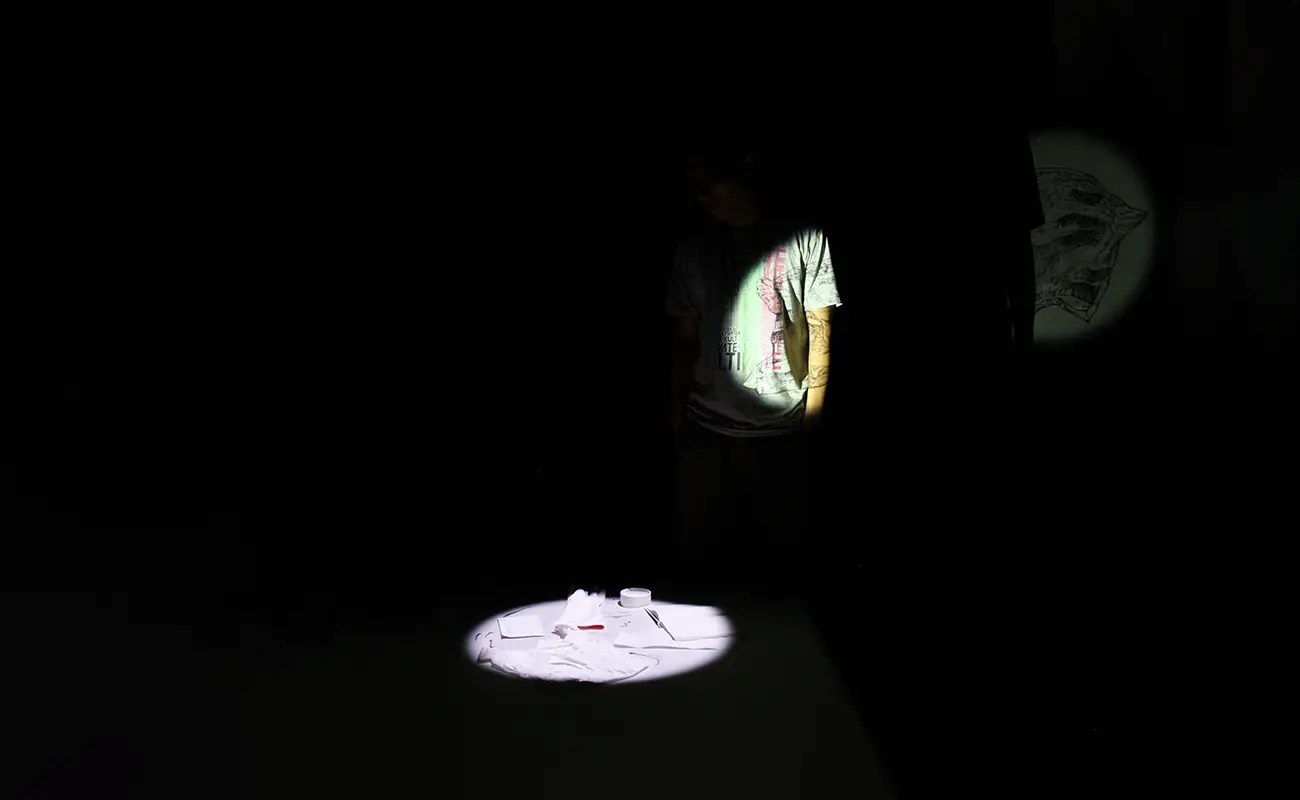
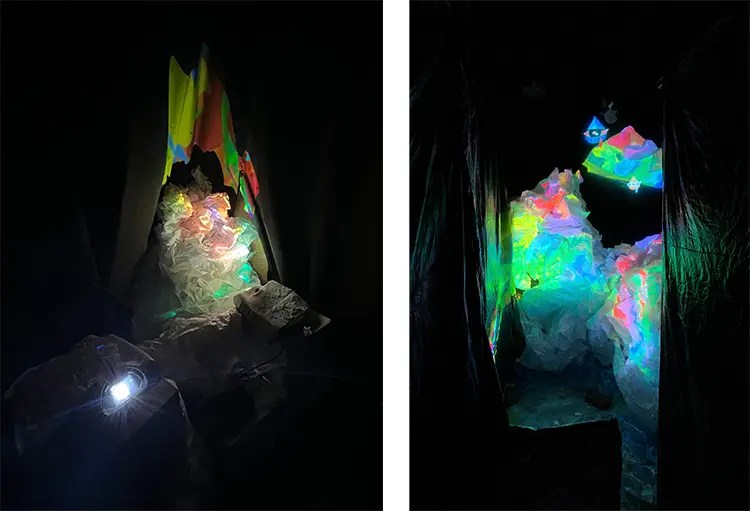
One of the most meaningful projects in Lin’s practice is the immersive exhibition Darkroom & Light: The Temporality and Shapes of War, presented in Taipei from December 2025 to January 2026. Earlier conversations with artist-researcher Dr Yun-Chu Chang, who has also written about the work in a different context, helped shape the dialogue surrounding the project. The installation occupied a school history classroom located directly across from Taiwan’s Ministry of National Defense. This proximity created a powerful dialogue between education, national authority, and historical memory. Conceived by Lin and co-directed with Ju-Ying Tsai, Chen Po-Jui, and Du Ke-Yu, the project incorporated immersive projection, material objects, and collaborative processes involving younger participants. The exhibition brought together generational perspectives, particularly those of Generation Z and Generation Alpha, to explore how war memory continues to shape contemporary understanding.
Visitors entering the exhibition encountered a small but evocative gesture. Each person received a piece of milk candy, a sweet long associated with Taiwanese childhood memories and wartime stories from soldiers mobilized during Japanese colonial rule. This moment of familiarity introduced a subtle emotional connection before visitors entered a sequence of eight narrow chambers enclosed in black fabric. Inside these spaces, the environment became heavy with humidity and darkness. Paper boats, ropes, suitcases, and plastic wrapped objects appeared within dimly shifting light. Sound responded to footsteps, encouraging slow movement as visitors navigated the compressed pathways.
The spatial design emerged from an unusual conceptual process involving bodily posture. Participants initially moved freely through the installation space during workshops, yet as pathways narrowed their bodies gradually shifted into positions of tension and confinement. These postures were later traced and translated into architectural shapes that defined the exhibition layout. Through this transformation, the human body itself became a structural boundary that carried memory and experience. The resulting environment suggested how war reshapes movement, perception, and social relations. Rather than presenting conflict through images of violence, the exhibition allowed viewers to encounter its pressure through restricted space, flickering light, and the slow choreography of the body.

Hsin-Mei Lin: Immersive Practice Between Art, Education, and Future Generations
Lin’s broader artistic practice extends across immersive installation, moving image, and transnational curatorial work. She often positions projects between exhibition spaces, public environments, and educational systems, forming a hybrid approach that connects contemporary art with pedagogical exchange. International exhibitions throughout Europe and Asia have allowed her installations to circulate across diverse cultural contexts. Her academic research also informs this work. Lin recently completed a PhD in Culture, Communication and Media at the UCL Institute of Education, University College London, where questions of perception, learning, and cultural memory became closely intertwined with her artistic development.
Daily life in her studio reflects this combination of research and experimentation. Writing, teaching, and collaborative preparation frequently intersect with hands on exploration of materials, projection technologies, and spatial arrangements. Each project often begins with investigation into historical narratives or social conditions before gradually evolving into immersive form. Rather than focusing on isolated objects, Lin constructs environments that operate as experiential frameworks. These frameworks encourage participants and viewers to move, pause, and reconsider how physical surroundings shape emotional and intellectual responses.
Future projects continue to explore the relationship between younger generations and historical memory within an increasingly unstable geopolitical climate. Taiwan’s contemporary position in global politics creates an atmosphere where the possibility of conflict is frequently discussed in international media. Lin’s work responds to this condition by examining how anticipation and uncertainty influence everyday perception. New immersive environments will likely continue to investigate how space, light, and bodily awareness can reveal the subtle pressures that history exerts on the present. Through these evolving installations, Lin sustains a practice that connects artistic creation with collective reflection, offering audiences environments where history becomes something sensed through movement and shared experience.
Credits
Collaborators
The installation was developed in collaboration with Wang Luying, Song Yunai, Li Chunhui, Guo Fangtong, Huang Yingxuan, Wang Tingfeng, Lu Pinlun, Su Shizhen, Xie Xianghe, Yan Tinghan, Wu Boyou, Wu Bingrui, Shi Bingyi, Xie Yingwen, Luo Hongjun, Wu Zicen, Ni Xiangyun, Chen Liangqun, Peng Yuya, Cai Peiyu, Meng Yutong, Zhang Yunchen, Zeng Yuxin, Yang Muxuan, Liu Yanting, Zhu Yirui, Lin Boyuan, Hong Ziyue, Tang Chenkai, Cai Yixian, Du Jiayin, Lin Yijie, Gao Zhenyu, Chen Yujia, Liu Youyou, Wang Xinyue, Li Xinwei, Zhou Zhiyan, Liu Tingan, and Lu Yuting.
Photo Credit
Yang Quan-Cong.