
“Art is as good as an artist is critical of themselves.”
Fragments of Truth in Motion
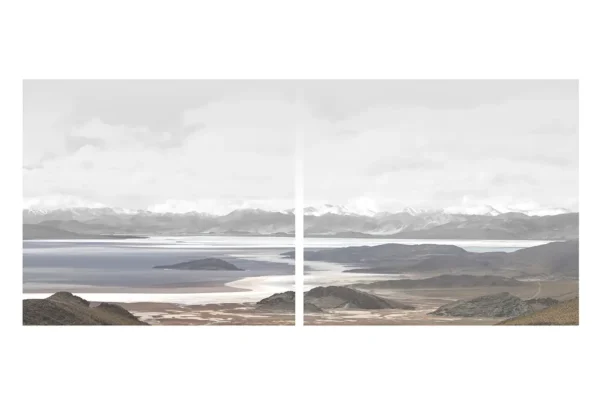
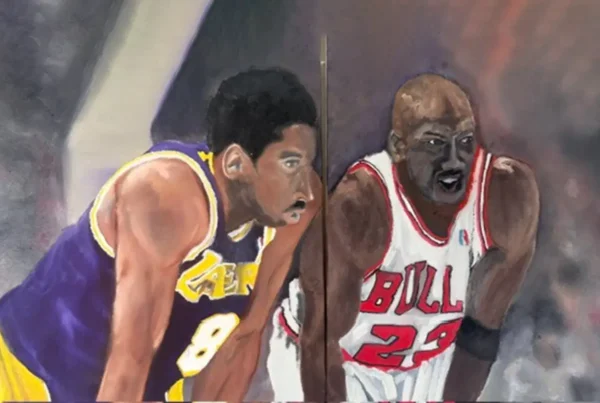
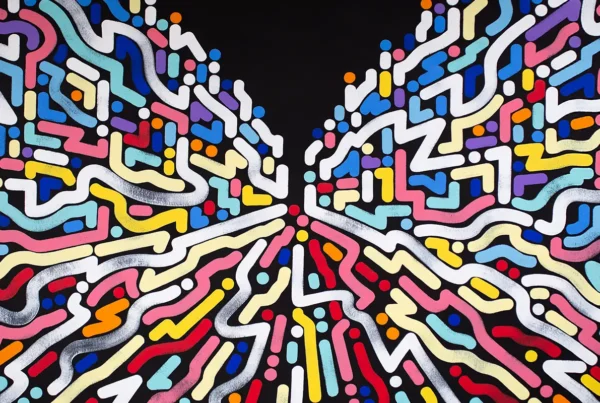
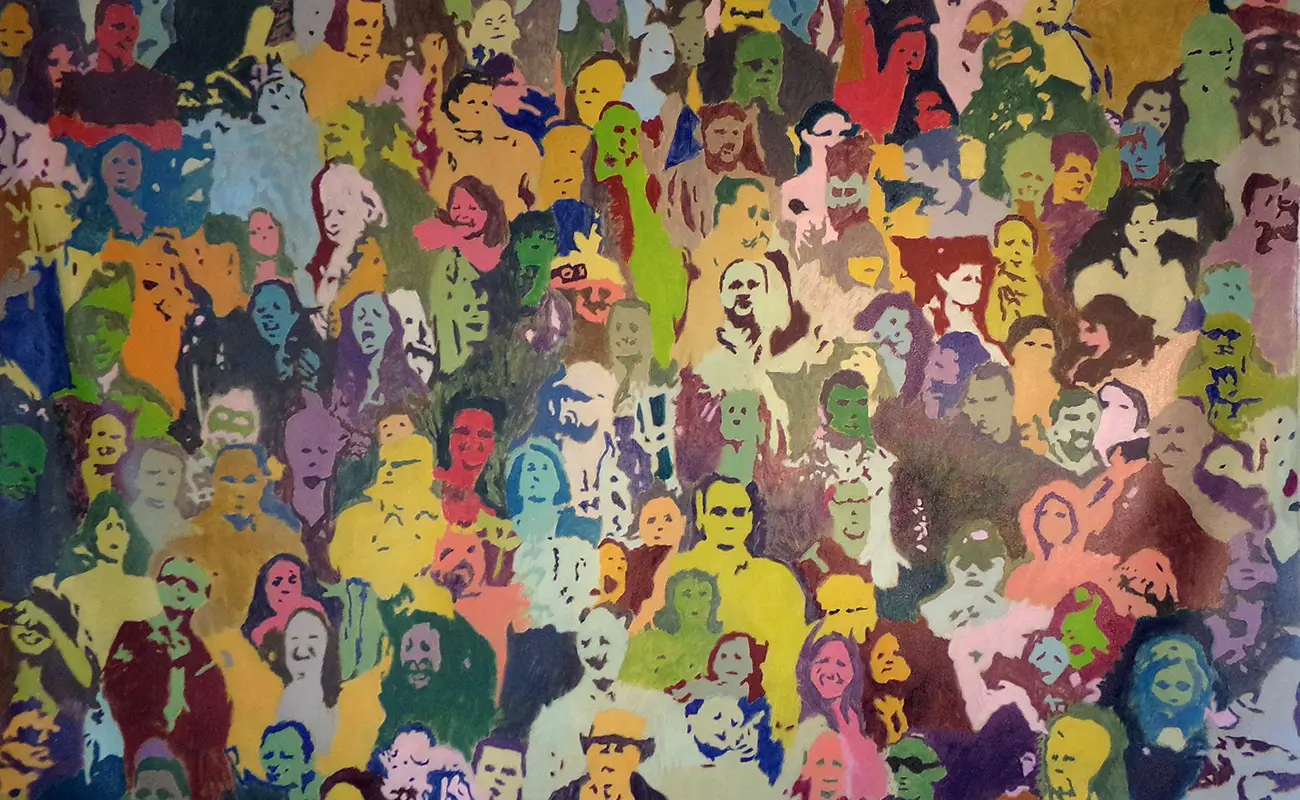
Joseph Nam’s artistic philosophy begins with a deceptively simple proposition: “one and one and one is three.” This phrase functions not merely as a conceptual anchor but as a method for constructing meaning through accumulation and contrast. Working across painting, video, and sound, he approaches art as an evolving proposition rather than a fixed declaration. His aim aligns with Jasper Johns’s idea of creating something that resembles truth, not as an absolute, but as an approximation shaped by perception and experience. Experimentation guides his process, allowing ideas to surface through action and revision rather than rigid planning. The works often feel fragmented, yet they cohere through a persistent inquiry into how parts relate to one another. Viewers encounter images that appear layered both materially and philosophically, inviting sensation before interpretation. In this way, Nam positions art as an event that unfolds gradually, asking the audience to feel first and analyze later.
His academic foundation began in Hawai‘i, where he completed a Bachelor of Fine Arts in 2014. Initially drawn to painting, he found himself gravitating toward printmaking, influenced in part by mentors who introduced him to the discipline’s technical and conceptual possibilities. The gender dynamics within the departments, with painting largely led by women and printmaking guided by male instructors, shaped his awareness of artistic communities and perspectives. Printmaking processes, particularly the emphasis on transfer and reversal, left a lasting mark on his approach. Even as painting became central to his practice, he considers it largely self-taught, a field learned through persistent exploration rather than formal instruction alone. This combination of structured training and independent discovery fostered a mindset that values process as much as outcome. Techniques absorbed in the print studio would later resurface in unexpected ways, especially in his monotype paintings where impression and gesture intersect.
After graduating, Nam spent nearly two years in Brooklyn, New York, immersing himself in a city he continues to regard as a benchmark for ambitious exhibitions and rigorous artistic dialogue. The density of galleries and the intensity of its art scene provided both inspiration and challenge. Exposure to diverse creative communities broadened his understanding of how geography influences artistic production. Encounters with other cities, including Los Angeles, Miami, and South Korea, further clarified the differences in pace, audience, and critical culture that shape regional art scenes. Eventually, he returned to Hawai‘i, where he has lived and worked for the past decade. The distance from major mainland centers has not diminished his engagement but instead sharpened his perspective. Working from the place where he grew up allows him to synthesize global influences with personal history, reinforcing his belief that context and experience continually reshape artistic identity.

Joseph Nam: Influences, Icons, and Expanding Conversations
Nam’s artistic development traces back to high school, where an early aptitude for visual expression was encouraged by supportive opportunities and exposure to significant works. Andy Warhol’s Marilyn portraits captivated him during those formative years, introducing him to the power of repetition and celebrity imagery. In college, his focus expanded toward Jasper Johns and the Abstract Expressionists, alongside artists such as Richard Tuttle, David Salle, and Martin Creed. Conceptual art also became a vital reference point, emphasizing ideas over purely aesthetic concerns. Art school presented a landscape in which students often gravitate toward certain artistic models while striving to differentiate themselves. Nam experienced this dynamic firsthand, absorbing influence while questioning how to establish his own position. The tension between homage and independence continues to inform his practice, shaping a body of work that acknowledges precedent without surrendering to imitation.
Over time, his constellation of influences has broadened considerably. Barnett Newman’s commanding color fields, Marcel Duchamp’s radical redefinition of art objects, and the phenomenon of Zombie Abstraction all contribute to his evolving perspective. He also draws meaning from Edvard Munch’s psychological intensity, Glenn Ligon’s text-based investigations, and the material experimentation of artists such as Christopher Wool and Rashid Johnson. Contemporary painters including Josh Smith, Joe Bradley, and Jeff Elrod offer additional points of dialogue, while Ragnar Kjartansson and Bruce Nauman expand the conversation into performance and conceptual practice. Beyond visual art, music and film have become enduring passions since his teenage years, when access to a computer opened pathways to endless media. John Lennon’s creative spirit resonates alongside his interest in composing and recording music. This interdisciplinary curiosity reflects a belief that artistic language is fluid, capable of shifting between image, sound, and narrative without losing coherence.
Such varied influences do not translate into a single recognizable style. Instead, Nam embraces multiplicity as a defining characteristic. He admires the instantly identifiable visual language of Jean Michel Basquiat, yet resists confining himself to one aesthetic signature. His practice operates more like a television set with channels that can be changed, each frequency revealing a different mode of expression. Themes often circle around philosophy and the human condition, with works designed to provoke an immediate reaction before intellectual clarity emerges. Critical self-assessment plays a central role in this process, as he believes the strength of art depends on the artist’s willingness to question and refine their output. If a particular piece fails to resonate with a viewer, he accepts that another might succeed. This openness underscores his conviction that art thrives on diversity rather than uniformity.

Process, Experiment, and the Shape of Thought
At the core of Nam’s daily practice lies a commitment to pursuing ideas he has not yet realized, or at least has not realized in his own way. Inspiration often begins with a simple impulse to see something that does not yet exist. From there, experimentation guides the next steps, whether through layering paint, transferring ink, or exploring new formats. The monotype trace technique has become especially significant, allowing him to merge printmaking’s logic with the scale and presence of painting. In this method, pigment is applied to a matrix surface, and the canvas is pressed onto it so that marks appear through contact and pressure on the reverse side. The resulting imagery carries an element of unpredictability, as impressions reveal themselves gradually. Such procedures reinforce his belief that art is an evolving conversation between intention and accident, where meaning arises through interaction rather than strict control.
Future projects reflect both reverence and curiosity. He expresses interest in creating study paintings inspired by Jasper Johns’s American Flag works, not as replicas but as analytical exercises that examine structure and symbolism. Homage pieces influenced by David Salle and the Pictures Generation signal an engagement with layered imagery and cultural reference. Large cut paper compositions reminiscent of Matisse, expansive picture collages, and even comic book page paintings occupy his imagination. Screen printed paintings promise another return to printmaking roots, integrating mechanical repetition with painterly gesture. Parallel to these visual ambitions is a growing dedication to music production, a pursuit that demands time and resources but remains central to his creative aspirations. This forward-looking agenda demonstrates that his practice is never static. Each prospective project builds upon prior knowledge while pushing toward unfamiliar territory, sustaining a cycle of renewal and inquiry.
The philosophical underpinning of his work ensures that experimentation is never random. The idea that multiple elements combine to create something greater than their sum informs both composition and concept. Layers of color, intersecting marks, and varied media operate as visual equivalents of his foundational statement. Viewers are encouraged to encounter the surface viscerally before constructing interpretation. He seeks to generate a reaction rooted in sensation, trusting that intellectual engagement will follow. This approach aligns with his belief that art approximates truth rather than declaring it outright. Through persistent questioning and revision, he shapes works that feel provisional yet purposeful. Each canvas or project becomes a site where thought takes physical form, revealing the interplay between fragmentation and unity that defines his broader philosophy.

Joseph Nam: Red, Creation, and the Synaptic Image
Among his works, the multi titled Sun Times / Max Cherry / Clifford / Knight / Symbol / Red Leaf occupies a particularly meaningful position. This painting stands out not only for its layered title but for the intensity of its composition. Dominated by red, the surface pulses with a sense of movement that suggests something primordial. The dynamism of the forms evokes the spark of creation itself, as if the image captures the instant when matter organizes into consciousness. He has described the effect as akin to a synapse firing within the brain, a metaphysical event translated into pigment and gesture. The painting embodies his philosophy of multiplicity, with its many titles hinting at shifting identities and interpretations. Each name frames the work differently, reinforcing the idea that perception alters meaning. The piece resonates deeply within his oeuvre, serving as both personal milestone and conceptual touchstone.
Technically, the painting exemplifies his adaptation of the monotype trace technique on a larger scale. By applying paint to a prepared matrix and pressing the canvas onto it, he generates marks that arise through transfer rather than direct brushwork. This process introduces an element of reversal and surprise, as the final image only fully reveals itself once the canvas is lifted. The physical act of pressing and lifting becomes integral to the composition’s energy. Red accumulates in varying densities, creating depth and vibration that animate the surface. The resulting forms appear at once organic and abstract, resisting singular interpretation. In this work, process and philosophy converge seamlessly, demonstrating how his printmaking background continues to inform his painting practice.
Sun Times / Max Cherry / Clifford / Knight / Symbol / Red Leaf encapsulates the trajectory of Nam’s artistic journey, linking his academic training, philosophical inquiry, and commitment to experimentation. The painting’s layered identities mirror his broader refusal to settle into a single stylistic category. Its intense chromatic field recalls the influence of American abstraction while asserting a distinctly personal sensibility. The sense of creation embedded within its red expanses aligns with his desire to prompt viewers to feel before they comprehend. Through this work, the principle that one and one and one is three becomes tangible, embodied in pigment and pressure. It stands as a testament to his evolving practice, where each new project builds upon past explorations while opening space for further transformation.