“I believe that when contrasting elements exist together in one form, they reach their most complete and beautiful state.”
A Life Shaped by Questions Rather Than Answers
Geonwoo Lee’s artistic identity is inseparable from a period of uncertainty that many would consider unproductive, yet which ultimately became the foundation of his creative philosophy. Born in Seoul in 1992, he grew up with a strong sense of curiosity and a willingness to test himself, but he did not move smoothly into higher education or a predefined profession. Instead, his early adulthood was marked by a prolonged pause, a time when he resisted following established routes simply because they were available. This pause was not passive. It carried the weight of confusion and discomfort, particularly the shock of reaching adulthood without a clear sense of direction or self-definition. Rather than suppress these feelings, he chose to confront them directly, understanding that unresolved questions would only grow heavier with time.
That confrontation took a decisive form when he moved alone to an unfamiliar region, deliberately cutting himself off from the comfort of known relationships and routines. In this new environment, everyday life became a form of investigation. New tasks, unfamiliar surroundings, and constant self-questioning filled his days. He asked himself what he was capable of, what he feared, what he genuinely loved, and what he instinctively rejected. Over the course of roughly a year, he documented these thoughts in a daily journal, treating his own inner landscape as carefully as any external subject. This disciplined habit of observation gradually revealed patterns he had not previously recognized, showing him that identity is rarely consistent or singular.
Through this process, Lee arrived at a realization that now sits at the heart of his work. Qualities he once labeled as strengths could, in certain situations, become limitations, while perceived weaknesses often contained unexpected potential. More importantly, he recognized that human beings naturally contain contradictions that cannot be neatly separated. Kindness exists alongside cruelty, beauty alongside discomfort, and sincerity alongside selfishness. These oppositions do not cancel each other out. Instead, they combine to form a more complete and honest picture of reality. This understanding did not remain confined to introspection. It gradually transformed into a broader contemplation of life itself, becoming the conceptual ground upon which his artistic practice continues to stand.

Geonwoo Lee: From Wood to Form, and Form to Thought
Lee’s entry into the art world was neither planned nor romanticized. For a long time, becoming an artist did not even register as a realistic possibility. Art felt distant from his daily life, something admired from afar rather than pursued. The turning point arrived unexpectedly around 2015, when a close friend suggested that he consider learning carpentry. At first, the idea felt foreign and even intimidating. Still, a quiet curiosity pushed him to explore books on woodworking, and he soon found himself captivated by the physical presence and expressive potential of wood. This curiosity grew into commitment when he discovered an artist through a book and waited six months for the opportunity to study under him, eventually receiving formal training in woodworking for a year.
During this period, Lee balanced two parallel paths. On one side, he produced commercial furniture, responding to functional demands and client expectations. On the other, he pursued sculptural work that allowed him to construct forms rooted in his own internal questions rather than market needs. His true interest lay in the latter. Sculpture offered him the freedom to give shape to his inner voice, even if that meant dedicating more than a year and a half to a single piece. This slow, immersive approach came with practical difficulties. Without the resources to maintain a private studio, he worked in a shared space until circumstances abruptly forced him out, leaving him without a place to continue his practice.
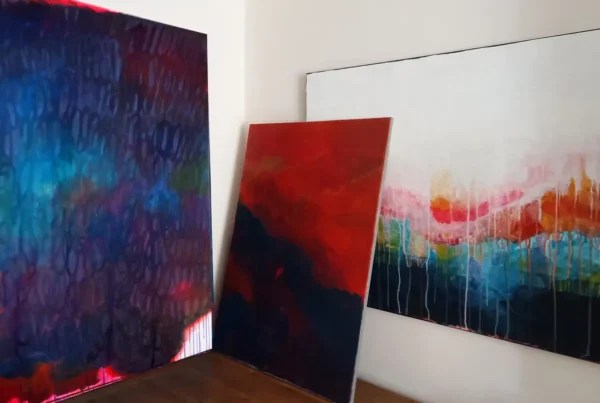
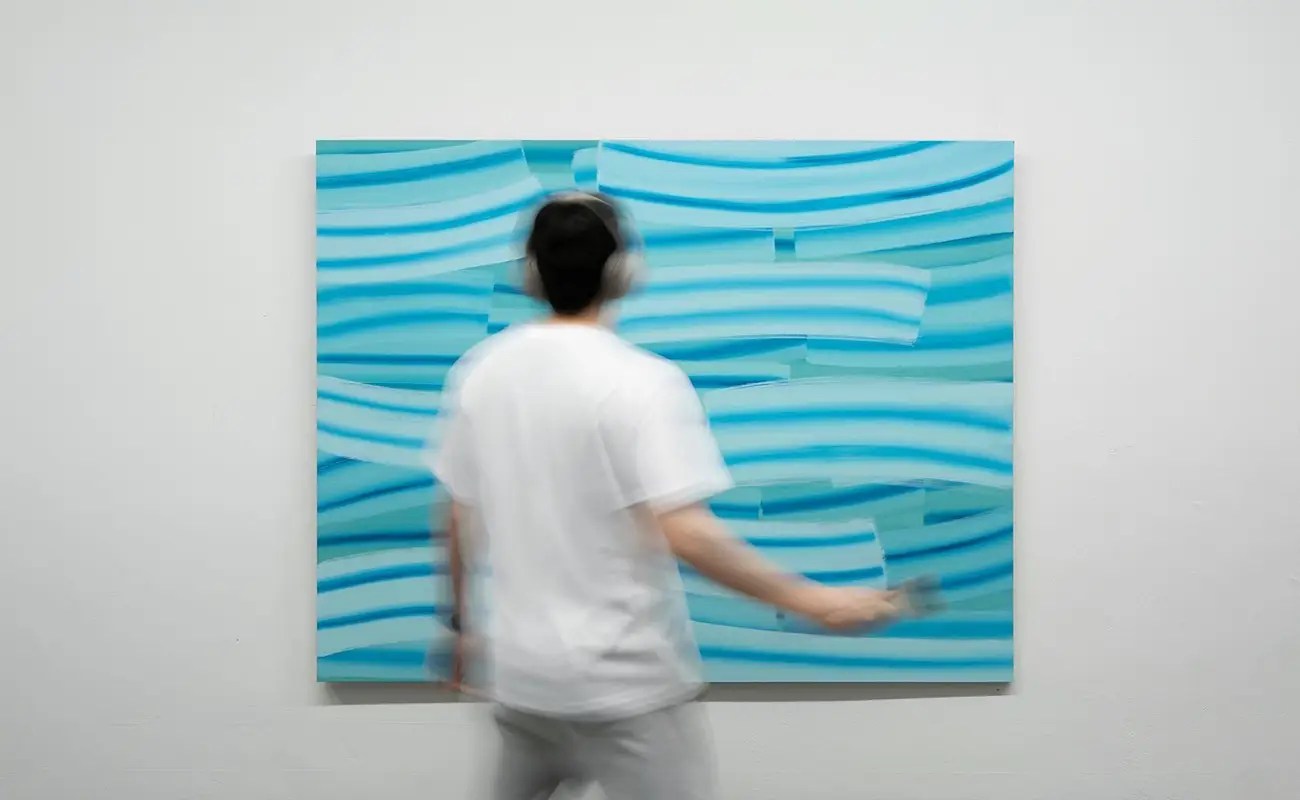
This sudden loss led to a period of stagnation and emotional heaviness, yet it also triggered a critical shift in perspective. Lee realized that if his artistic philosophy was stable, then material and format were not the core of his work. With this in mind, he turned to painting, not out of convenience alone, but because it allowed him to continue creating within the limitations of a small room. The transition was challenging. Lacking formal training in painting, he taught himself everything through experimentation, from handling brushes to understanding the differences between oil and acrylic. Out of this struggle emerged the Baram Series, also known as the Wind Series, which has since become a defining body of work. Through painting, he found a new way to express enduring questions about nature, humanity, and the invisible forces that connect them.

Nature, Simplicity, and the Space Between Opposites
At the core of Lee’s practice lies a commitment to allowing opposing values to exist together within a single form. This idea is not treated as a visual trick or intellectual exercise, but as a reflection of how life itself operates. Whether working with wood, paint, or digital media, he consistently explores the tension between perfection and imperfection, natural elements and artificial structures, and orderly systems and irregular disruptions. Rather than resolving these tensions, his work holds them in balance, suggesting that harmony does not require uniformity. This approach stems directly from his own experiences of self-examination, where contradictions proved to be unavoidable and meaningful.
Nature plays a central role in this philosophy, particularly in the Baram Series, where wind functions as both subject and metaphor. Wind is invisible, yet its presence is undeniable through movement and change. By using it as a conceptual medium, Lee reflects on nature as the most constant force in an ever-shifting world, while also considering the humans who exist within its systems. His observations extend to everyday life, where the contrast between natural and artificial materials is impossible to ignore. Time spent camping has become especially important to his process. Removed from constructed environments, he focuses purely on sensing and reflecting, allowing these experiences to influence the emotional clarity of his work.
Despite the depth of thought behind his practice, Lee consciously avoids unnecessary complexity in presentation. He does not wish to burden viewers with dense theories or inaccessible references. Life itself, in his view, is already demanding and layered. Art, therefore, should offer moments of immediate visual clarity and comfort. This belief has guided him toward a minimalist formal language that emphasizes simplicity without sacrificing meaning. By keeping forms approachable, he invites audiences of all ages and backgrounds to engage freely, encouraging personal interpretation rather than prescribed understanding. His goal is not to impress, but to create works that coexist gently with people, remaining present in their lives without demanding explanation.

Geonwoo Lee: The Weight of Beginnings and the Direction Ahead
Among Lee’s many works, one piece holds particular emotional significance: KIWA from his first body of work, the KIWA Series. This sculpture represents the true beginning of his life as an artist and continues to shape how he understands creation. When he first started working with wood, driven by ambition that now seems almost reckless, he began three large-scale pieces at once. Their sheer size and weight required constant assistance and a spacious workshop. To avoid disturbing others, he often worked alone in the early morning hours, standing in front of heavy machinery while the rest of the space slept. The process stretched over a year and a half, demanding both physical endurance and unwavering focus.
The most defining moment came shortly before his first exhibition. Two weeks before the opening, cracks appeared across the surface of the completed work, caused by the natural expansion and contraction of the wood. The shock was overwhelming. Repairing the damage seemed like the obvious solution, yet after long reflection, Lee chose another path. He decided to leave the cracks untouched, accepting them as evidence of time and material behavior rather than defects to be concealed. This decision transformed the piece. What initially felt like failure became a visible expression of his belief in coexistence, where damage and beauty occupy the same space. The public response was enthusiastic, and the cracks eventually became a recognizable characteristic of his work.
Today, Lee continues to expand his practice while remaining grounded in these formative experiences. Alongside painting, he is actively developing Generative Art and Media Art, collaborating with professional programmers and integrating recent advances in AI technology to bring his ideas into new contexts. These digital works are intended to exist beyond traditional gallery walls, entering everyday spaces where people encounter art unexpectedly. At the same time, he is envisioning new sculptural projects that build upon his earlier explorations of form and material. Collaborations with various brands and artists also play an important role, offering opportunities to create outcomes distinct from conventional exhibitions. Through all of these directions, his guiding principle remains unchanged: to explore contradiction without fear, and to allow diverse elements to exist together without hierarchy.