Country Origins and a Global Visual Language
The work of Saxon JJ Quinn occupies a distinctive position within contemporary abstraction, shaped by a life that has moved fluidly between rural Australia and some of the world’s most influential cultural capitals. Raised in country Victoria by his mother, the Australian artist Dianne Coulter, Quinn grew up surrounded by creative labour as a daily, lived experience rather than an occasional pursuit. Coulter’s home studio and gallery formed a backdrop to his childhood, embedding an understanding of making, material, and patience long before Quinn identified himself as an artist. That early immersion established a sensitivity to texture and intuition that continues to inform his paintings, sculptures, and works on cement, giving them an immediacy that feels both personal and broadly resonant within global visual culture.
Before committing fully to painting, Quinn’s professional life moved through fashion, publishing, startups, and product design, culminating in a role as a Lead Product Designer. These experiences sharpened his awareness of hierarchy, balance, and visual communication, skills that quietly underpin his compositions today. His relocation to New York City in 2016 marked a pivotal shift. Walking the city endlessly, absorbing its surfaces, conversations, and contradictions, Quinn encountered an intensity that clarified his creative direction. Encouraged by his mother during her visit, he returned to Australia with a renewed focus, transforming a neighbour’s garage into a studio and beginning what initially felt like a private, exploratory practice that soon gained momentum.
Over the past decade, Quinn’s work has been exhibited across Sydney, Melbourne, Los Angeles, Manhattan, Hong Kong, Seoul, Madrid, and Copenhagen, resisting any suggestion that his art belongs to a single geography or moment. This mobility is not presented as spectacle but as a quiet insistence on openness, allowing his visual language to absorb influences from each location without becoming fixed. His surfaces speak through subtle signs, marks, and symbols that echo global trade, urban erosion, and personal memory. Rather than anchoring meaning to place, Quinn allows his work to function as a shared visual shorthand, capable of being read differently depending on where and how it is encountered.

Saxon JJ Quinn: Material, Cement, and the Poetry of Imperfection
Central to Quinn’s practice is his sustained engagement with cement, a material that dictates pace, patience, and unpredictability. His attraction to cement grew from years of wandering through cities, particularly New York, where aged pavements, stoops, and walls revealed the quiet beauty of wear accumulated over time. Cement, for Quinn, carries a history within its surface, recording pressure, weather, and human movement without needing narrative explanation. Each batch behaves differently, setting with its own tonal shifts and textures, which introduces an element of chance that he actively embraces. This variability challenges initial intentions and requires a form of collaboration between artist and material.
The process typically begins with preparing and setting cement bases under specific conditions, with Quinn favouring dry, overcast days that allow the surface to cure gradually. Once set and sanded, oils are often introduced to exaggerate imperfections rather than conceal them. From this foundation, he builds compositions through a careful balance of planning and spontaneity. Initial concepts establish structure, while later additions of pastel, lead, and occasional minimal spray paint introduce freer gestures. These marks sit lightly against the density of the cement, creating a tension between weight and movement that defines much of his work.
Completion is determined less by exhaustion of ideas than by restraint. Quinn routinely steps away from a piece overnight, returning with fresh eyes to test whether further intervention is necessary. If the urge to add is absent, the work is considered resolved. At times, rough details continue until a piece leaves the studio, reflecting his acceptance of uncertainty as a productive force. This approach positions cement not simply as a support, but as an active participant in shaping the final image, ensuring that no two works share the same surface language or emotional register.

Between Childlike Freedom and Urban Experience
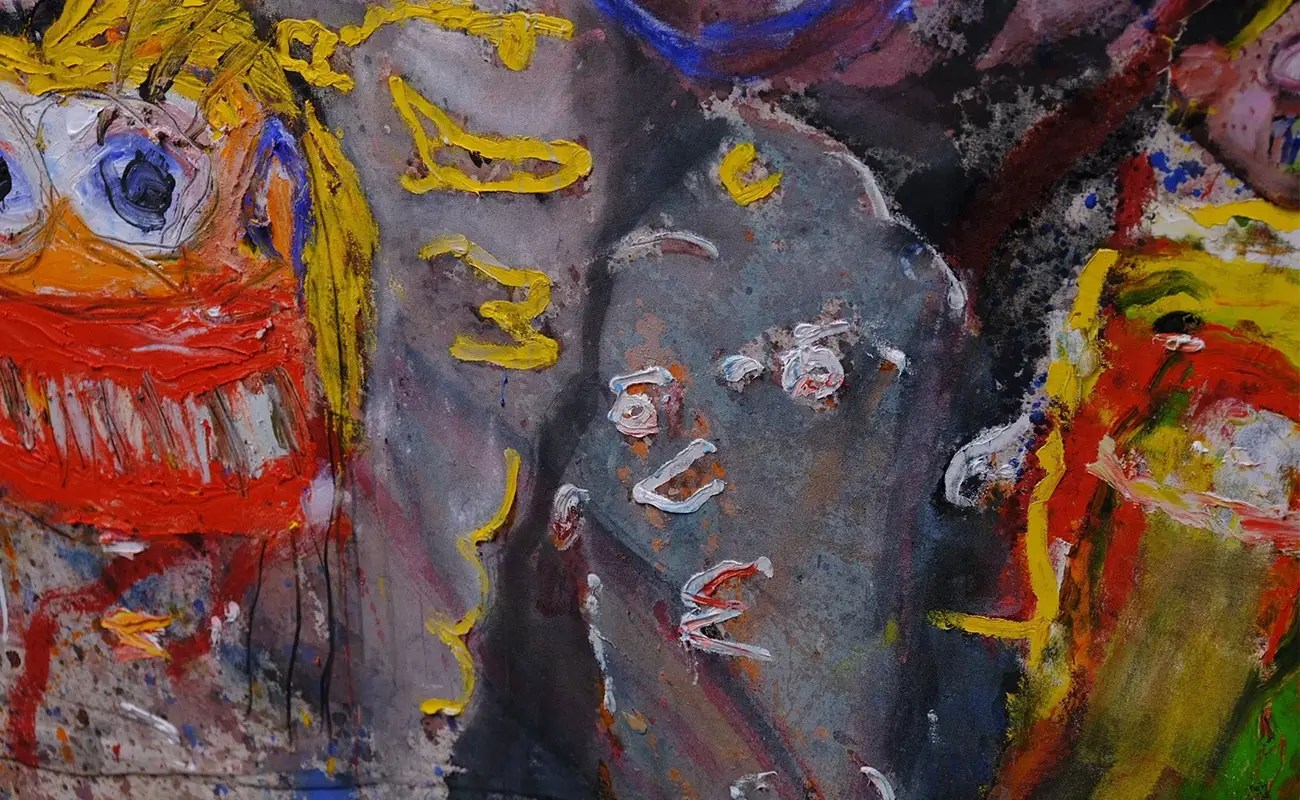
Quinn’s paintings and ceramic figures reveal an ongoing dialogue between the raw energy of childhood expression and the layered complexity of urban environments. He shares a philosophical kinship with the CoBrA artists of the mid twentieth century, who rejected detached intellectualism in favour of instinct, colour, and the unfiltered logic of children’s drawings. In Quinn’s work, this influence emerges through ghostly traces of paint and graphite, loose forms, and figures that feel intentionally unresolved. His ceramic sculptures, often playful and irreverent, nod to the monumental traditions of ancient empires while subverting them with humour and exaggeration, functioning as quiet critiques rather than declarations.
These surfaces accumulate scrawls, symbols, and intuitive scores that invite viewers to read, reinterpret, or simply experience them without seeking fixed meaning. The urban landscape remains a constant influence, informing both texture and rhythm. Weathered buildings, cracked pavements, and worn materials appear not as literal representations but as abstracted memories embedded within the work. This connection to place is emotional rather than descriptive, allowing viewers to project their own experiences onto the surfaces Quinn creates.
Children’s drawings play a crucial conceptual role in this balance. Quinn is drawn to their absence of limitation, where imagination overrides correctness and logic. That freedom allows a dog to grow five legs or breathe fire without justification, a quality he values deeply. By positioning minimal, almost naïve drawings against expansive, dream-like backgrounds, he creates a contrast that feels both calm and chaotic. This interplay reflects his belief that art can hold contradiction without resolving it, offering space for curiosity rather than instruction.

Saxon JJ Quinn: Recognition, Collections, and a Life Intertwined with Art
Quinn’s growing international recognition is reflected in the acquisition of his work by significant private and institutional collections. His paintings are held by Spain’s Colección María Cristina Masaveu and the Fundación Carmen & Lluís Bassat, foundations known for stewarding works by artists such as Picasso, Miró, and Banksy while exhibiting globally. His work also appears in notable private collections, including those of NBA player Blake Griffin and American rapper Joey Bada$$. These placements underscore the broad appeal of his visual language, which resonates across disciplines without relying on spectacle or overt narrative.
Alongside his own practice, Quinn maintains an active engagement with contemporary art through collecting. Artists such as Sebastian Helling, Tyrrell Winston, Hunter Potter, Taylor White, Hetty Douglas, Slawn, and Sune Christiansen feature within his personal collection, reflecting an interest in varied approaches to material, gesture, and cultural commentary. This reciprocal relationship with the art community situates him within an ongoing conversation rather than a solitary pursuit, reinforcing the openness that defines his work.
Now living in Murwillumbah in Australia’s Northern Rivers region with his wife, daughter, and two dogs, Quinn balances studio time with family life and ongoing design work. Fatherhood has introduced a renewed sense of playfulness into his practice, aligning closely with his admiration for children’s creative freedom. Art remains a therapeutic space where anxiety recedes and focus sharpens, often allowing entire days to pass without digital interruption. His daily routines, shaped around early mornings, surfing or training, studio work, and time with family, reflect a life where making is not separated from living. Instead, each informs the other, sustaining a practice that continues to evolve through patience, observation, and a commitment to honest material engagement.