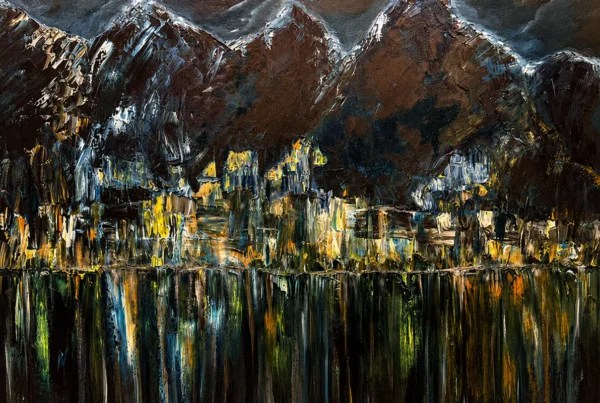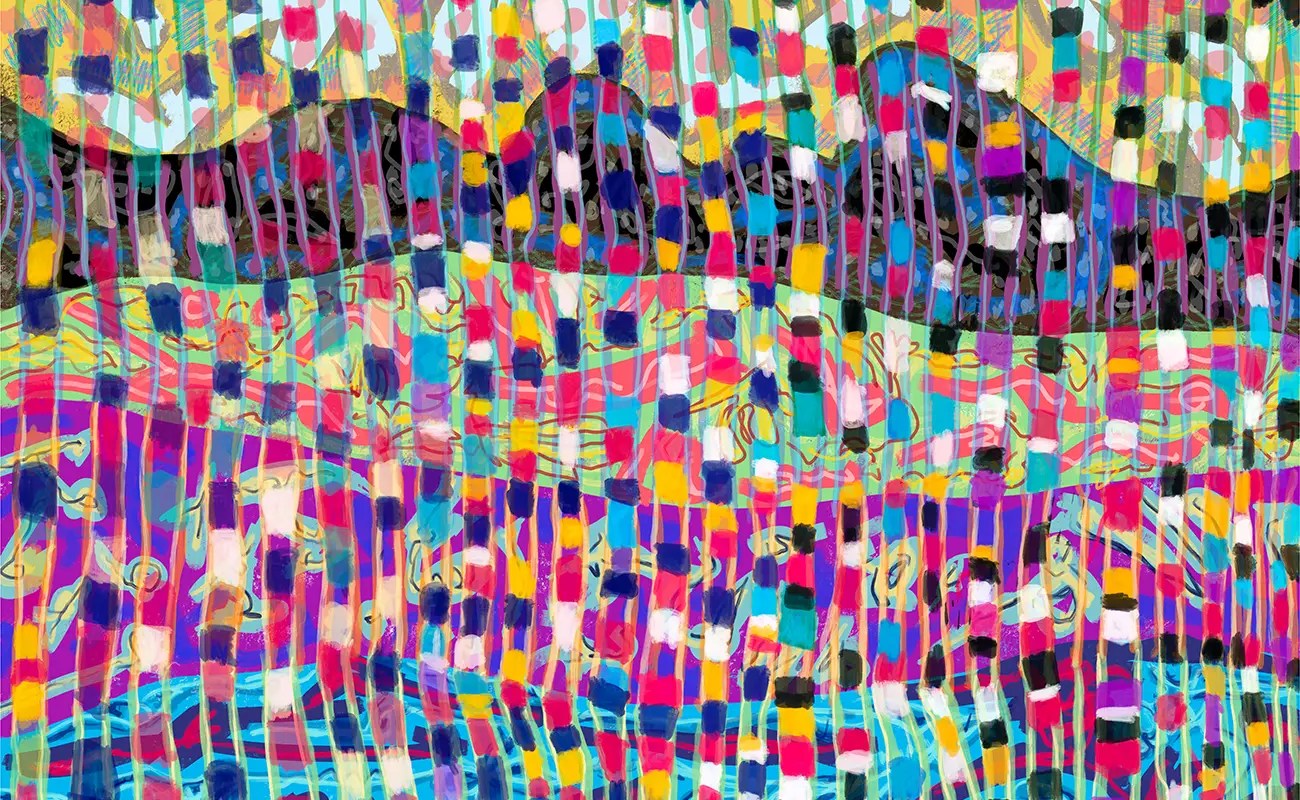
“The terrifying is rendered contemplative, and pain is woven into pattern.”
Origins of an Experimental Vision
From early childhood, Dimitrije Martinovic’s relationship with visual culture has been shaped by moments of intense recognition rather than passive observation. Born in Yugoslavia and now based in Toronto, he has built a multidisciplinary practice that moves fluidly between film, video, performance, drawing, painting, sculpture, and photography. His earliest encounter with art occurred before formal education or theory entered the picture, when an icon of his family’s patron saint in his grandmother’s home commanded his attention. The image did not simply attract his gaze. It demanded comprehension, provoking questions about construction, intention, and material presence. That formative experience instilled a desire not merely to depict images but to understand how meaning is embedded within visual form, setting the groundwork for a lifelong commitment to making.
Throughout his youth and early adulthood, Martinovic pursued drawing with sustained intensity, developing his abilities outside institutional frameworks. Entirely self-taught, he cultivated an uncommon capacity to draw complex subjects directly from memory, reinforcing an internalized relationship to imagery rather than one dependent on external reference. This period of concentrated practice fostered a deep trust in intuition and recall, qualities that later became essential as his work grew increasingly experimental. Drawing functioned not only as a technical discipline but as a way of organizing perception, allowing him to translate inner experience into visible structure without relying on conventional representation.
The continuity between these early years and his current work remains striking. Even as his materials and technologies have changed, the underlying impulse persists: an insistence on images as sites of encounter rather than illustration. Martinovic’s art has consistently resisted easy legibility, favoring instead a space where viewers are invited to linger and negotiate meaning. That sensibility, rooted in childhood wonder and sustained through decades of practice, continues to inform his evolving approach to abstraction, digitization, and interdisciplinary experimentation.

Dimitrije Martinovic: Education, Experimentation, and International Recognition
A decisive shift in Martinovic’s artistic trajectory occurred in the mid 1970s when he enrolled at the Ontario College of Art, now known as OCAD University. Studying within the Experimental Arts department, he entered an environment defined by risk-taking and cross-disciplinary exploration. This period coincided with a broader cultural moment in which experimentation was not peripheral but central to artistic production. Film, video, and performance were treated as legitimate and urgent forms, and Martinovic gravitated toward these media with conviction. The atmosphere encouraged artists to test boundaries and to treat process as integral to meaning, principles that became foundational to his practice.
By the 1980s, his work had gained significant visibility beyond Canada. Exhibitions across North America and Europe positioned him within an international conversation around experimental media. A particularly notable achievement came when a video centered on his parents was acquired by the Museum of Modern Art in New York. This work, along with another video piece, also entered the collection of the National Gallery of Canada in Ottawa. Such acquisitions affirmed the emotional and conceptual resonance of his practice, which often balanced personal subject matter with formally innovative approaches to time, memory, and documentation.
Despite these institutional milestones, Martinovic did not settle into a singular mode of production. Over subsequent decades, he continued to work across drawing and painting, photography, and experimental filmmaking. Participation in events such as Manif d’Art 4 in Québec City in 2008 and Nuit Blanche in 2009 as part of the Salon des Refusés reflected his ongoing engagement with both established and alternative exhibition contexts. These experiences reinforced a commitment to adaptability, ensuring that his work remained responsive to shifting cultural and technological conditions.

Digital Abstraction and the Return to Drawing
After a hiatus of nearly twenty five years, Martinovic returned to drawing approximately three years ago, prompted by a convergence of influences rather than nostalgia. Observing David Hockney’s embrace of the iPad as a legitimate drawing tool resonated deeply with his own background in photography and video, both inherently tied to computer-based processes. His initial experiments were intentionally rudimentary, involving finger painting applications and basic Photoshop tools operated with a mouse. These early works functioned as tests rather than finished statements, allowing him to reenter drawing through unfamiliar means while preserving a sense of play and discovery.
The decision to purchase an iPad one year later marked a significant transformation in his workflow. The device offered immediacy, portability, and a tactile connection that bridged traditional drawing instincts with digital flexibility. Martinovic’s recent digital drawings and paintings extend a decades-long dedication to experimentation, situating abstraction within a mutable, virtual space. Where historical abstraction sought to replace depiction with inner experience, digitization amplifies that ambition by enabling continuous revision and layering. His compositions draw from early modernist abstraction while remaining firmly situated within contemporary digital practices.
These works are characterized by instability and motion. Forms collide, fragment, and overlap, producing images that feel intentionally unresolved. Emotional and psychological states are suggested through color relationships, rhythmic structures, and spatial tension rather than through representational cues. Meaning remains open, shaped by the viewer’s attention and proximity over time. In this way, Martinovic’s digital practice does not offer answers but creates conditions for sustained looking, where interpretation unfolds gradually rather than arriving fully formed.

Dimitrije Martinovic: The Hanging Gardens of the Yurei and Future Directions
Among Martinovic’s recent works, The Hanging Gardens of the Yurei stands as a concentrated expression of his digital abstraction. Drawing heavily on Japanese art and cultural history, particularly from classical periods that have long fascinated him, the piece synthesizes horror and beauty into a single visual field. The imagined garden, tended by spectral caretakers, becomes a site where fear is rendered contemplative and pain is reorganized into pattern. Forms resist stable categorization, hovering between plant and apparition, sanctuary and nightmare, inviting viewers to navigate a shifting perceptual landscape.
Rather than presenting fixed symbols, the work operates through ambiguity. Meaning is constructed through the act of looking, as attention reveals relationships between layers, colors, and gestures. The painting transforms what once disturbed the living into a visible logic that emphasizes emotional presence over narrative clarity. On his Instagram account @d9.martinovic, where many of these digital works are shared, each post is accompanied by a short text that articulates his theoretical and philosophical positioning. These reflections expand upon the conceptual, formal, and material decisions that shape each piece, offering insight without prescribing interpretation.
This pursuit aligns with Martinovic’s broader engagement with ideas articulated by Gilles Deleuze regarding the tension between catastrophe and cliché. His practice seeks productive friction rather than resolution, maintaining energy through ongoing experimentation. Since retiring in May of this year, he spends most days working on his tablet, embracing a newfound freedom that supports sustained creative focus. Looking ahead, he plans to explore animation through AI technologies while also considering a return to figuration, an unexpected yet logical extension of a career defined by continual reinvention.
This article coincides with Provisional Trajectories: Recent Digital Paintings, on view at Gallery 1313, Toronto, from January 21 to February 1, 2026. The exhibition presents a selection of Martinovic’s most recent digital works, offering audiences a physical encounter with pieces that have largely circulated in virtual spaces.