“I just love the smell of paint, the movements involved in painting and interacting with others.”
Walls as Origins and Memory Carriers
The artistic practice of Kai Semor emerges from a long and sustained relationship with walls, surfaces, and the physical act of painting. Living and working in Cologne, he brings nearly three decades of experience as a graffiti artist into a contemporary abstract language that feels both grounded and expansive. His early years were shaped by classical style writing, a discipline that trained his eye, body, and sense of rhythm through repetition and scale. That foundation remains present, not as lettering, but as an internalized vocabulary of movement and spatial awareness. Over the last ten years, his attention has shifted increasingly toward abstract painting, a transition driven by an enduring fascination with large-format works encountered in museums and public spaces.
These formative experiences continue to influence how he approaches painting today. The memory of standing before monumental canvases, whether abstract, realist, or surreal, informs his ambition to create works that command space and attention. Even when working on smaller formats, his compositions retain a sense of expansion, as if they are fragments of something larger. The surface is never treated as neutral. Instead, it becomes an active participant, echoing the walls that first shaped his artistic instincts. This sensitivity to scale and material presence connects his early street-based practice to his current studio work in a seamless and thoughtful way.
Semor’s development was also shaped by a decisive personal turning point. After spending fifteen years working in an office environment, he recognized that stability alone could not replace fulfillment. Choosing to abandon a predictable income in favor of an uncertain artistic path marked a profound shift in his life. This decision continues to inform the seriousness and focus of his practice. Painting is not approached casually or as a hobby, but as a necessary and life-defining pursuit. That commitment is felt in the density of his surfaces and in the patience required to build each composition, layer by layer, without shortcuts.

Kai Semor: From Classical Writing to Constructed Abstraction
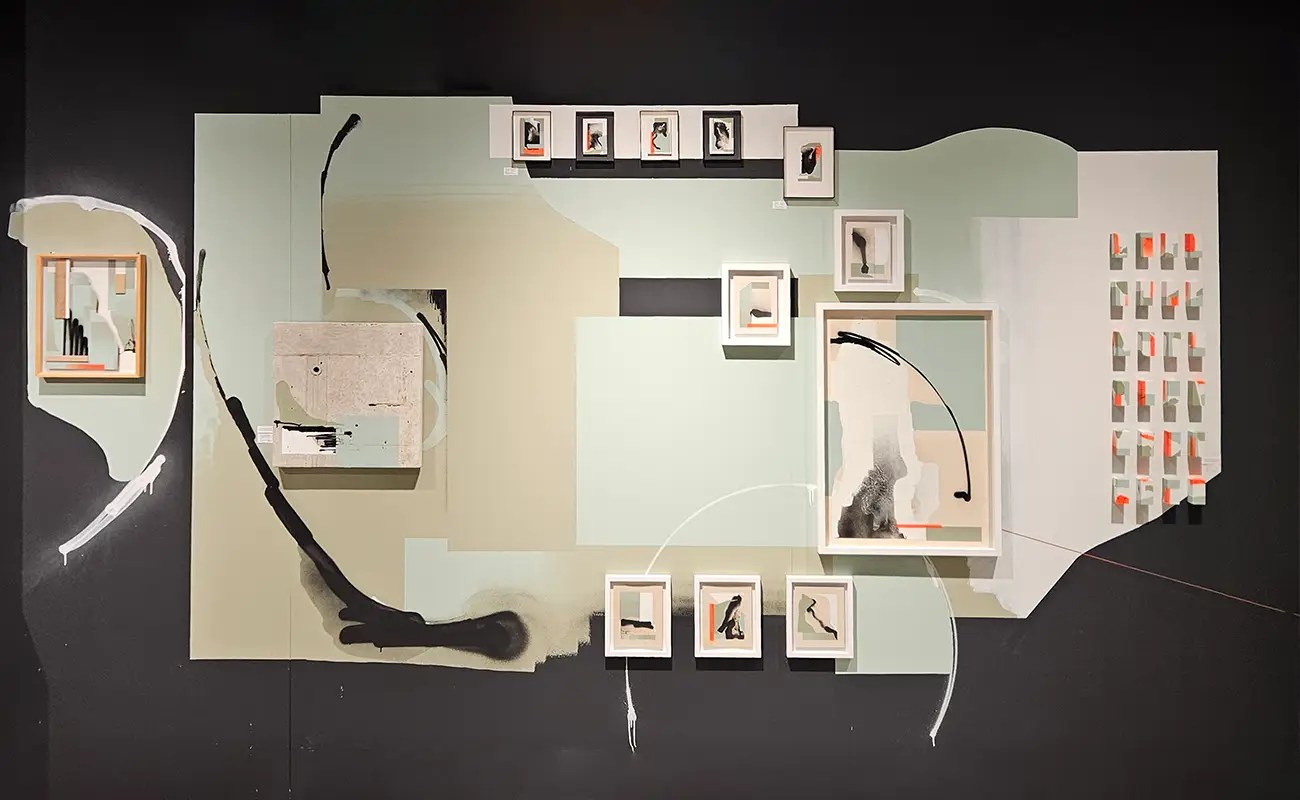
The transition from graffiti writing to abstract painting in Semor’s work did not happen abruptly, but through sustained experimentation with spray cans and surfaces. Spray paint remains central to his process, acting as both a technical tool and a conceptual bridge between past and present. Through it, he found increasing access to abstraction, discovering how gesture, overspray, and gradient could replace letterform while preserving energy. His style resists simple classification, combining clear forms with soft transitions, textured structures, and overlapping planes that generate depth. Each painting feels assembled rather than improvised, even though he never relies on preparatory sketches.
Color plays a defining role in establishing this sense of construction. Semor repeatedly returns to a specific palette that includes Malachite55, H2.10.60, dusky pink, black, white, greyscale tones, and neon red. These hues are not chosen for decorative effect, but for their ability to articulate space and tension. Muted fields establish calm and order, while sharper accents introduce disruption and focus. Fluorescent red, especially within his FluorSeries, operates as a visual catalyst. It punctuates the surface, pulling the eye across layers and anchoring compositions that might otherwise dissolve into atmosphere.
Despite the precision of his results, emotion remains the primary motivation behind the work. Rather than engaging with overt political narratives or illustrative themes, Semor uses abstraction to process internal states. Sweeping motions familiar from graffiti are compressed and translated into smaller formats, where they interact with geometric blocks and sprayed textures. This interplay between control and impulse defines the emotional core of his paintings. Viewers are invited to sense tension, balance, and release without being directed toward a fixed interpretation, allowing the work to remain open and experiential.

Architecture, Texture, and the Archive of the Everyday
A deep fascination with architecture and raw material surfaces underpins much of Semor’s visual language. Everyday encounters with the built environment become moments of quiet study. When walking past walls, he examines concrete, chipped paint, wood imprints, and subtle gradients formed by time and weather. These observations are documented through photographs and collected into a personal archive that functions as a wellspring of influence. What attracts him most is exposed concrete, particularly when it bears traces of construction processes or natural wear. These surfaces offer a balance between rigidity and vulnerability that resonates strongly with his approach to painting.
This archive does not serve as a source for direct imitation. Semor avoids copying textures or recreating specific walls. Instead, he allows the emotional and visual impact of these materials to guide his decisions once he steps into the studio or approaches a wall. The influence is filtered through memory and intuition, resulting in compositions that feel familiar yet unplaceable. Structures emerge that suggest architecture without depicting it, and surfaces appear weathered without referencing a specific location. This method allows the work to remain abstract while retaining a strong sense of material authenticity.
The painting process itself is driven by an initial impulse that often leads to working on several pieces simultaneously. This way of moving between works sustains momentum and keeps intuition active. Painting becomes a physical and sensory experience, fueled by movement, the smell of paint, and continuous interaction with surfaces. His determination to make the most of time available is evident in this energetic workflow. Straightforwardness and discipline act as quiet motors behind the scenes, ensuring that pleasure and focus remain aligned throughout the process.

Kai Semor: Scale, Collaboration, and Meaningful Moments
While studio paintings form a crucial part of Semor’s practice, large-scale works have played a significant role in shaping his artistic growth. In 2025, he realized a mural spanning 120 square meters in Euskirchen, Germany, a project that demanded both physical endurance and compositional clarity. Another landmark experience took place in Wageningen in the Netherlands, where he collaborated with fellow artist and close friend JackLack on a wall measuring 60 meters in height and 25 meters in width. These projects were intense and immersive, pushing his abstract language into architectural dimensions where every decision carried amplified consequences.
Such murals are not isolated achievements, but extensions of a broader dialogue between scale, surface, and collaboration. Working alongside other artists introduces new rhythms and shared problem-solving, enriching his understanding of abstraction in public space. At the same time, Semor places equal value on moments of quiet growth within the studio. He speaks of a particular studio piece that brought him deep satisfaction and personal development, highlighting that significance is not measured solely by size or visibility. Encounters with people and fellow artists, whether during exhibitions or informal exchanges, continue to shape his perspective and motivation.
Daily routines provide a steady framework for this evolving practice. Mornings typically begin in the studio or at a wall, accompanied by simple rituals such as coffee before returning to ongoing projects or initiating new ones. This balance between continuity and openness keeps the work responsive and alive. Currently, his focus is directed toward an exhibition opening in February, while multiple projects planned for 2026 are already taking shape. This forward-looking mindset reflects a practice rooted in experience yet constantly oriented toward new possibilities.