
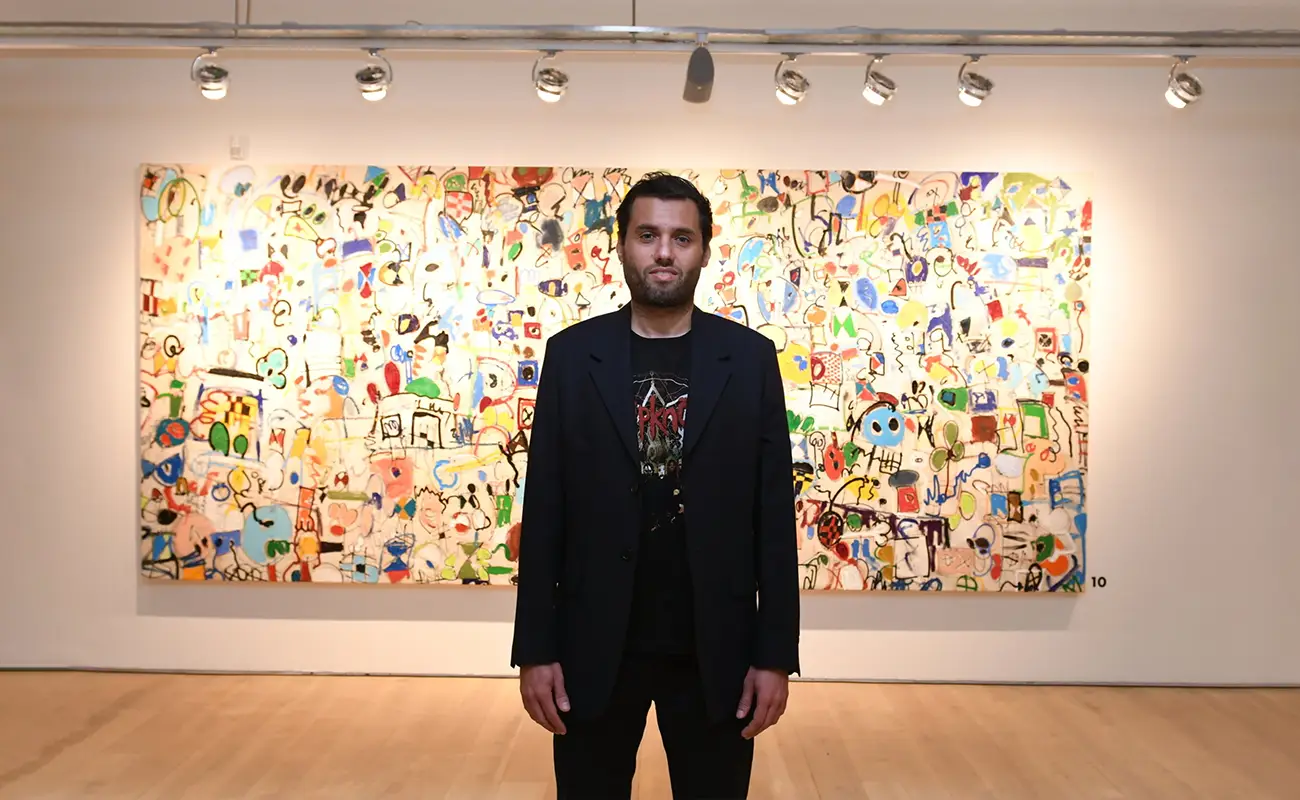
Reckless Elegance: A Practice Built on Motion, Math, and Myth
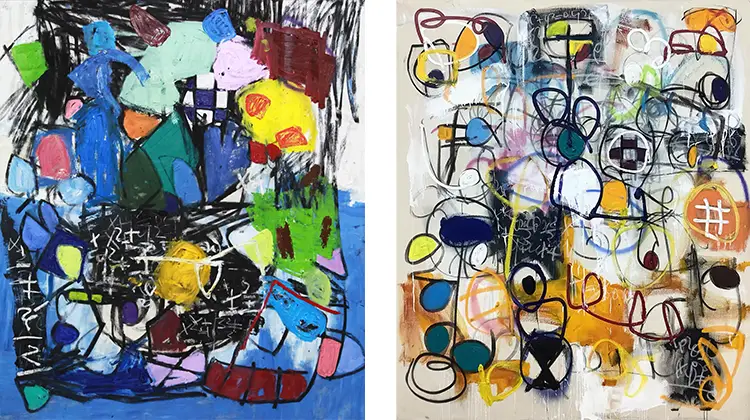
Born in Tunis in 1978, Taher Jaoui creates large-scale paintings that radiate a vivid, unfiltered energy. His works are uncontained, layered explosions of shape, texture, and color that invite the eye to wander in organized chaos. Although he arrived at painting without traditional fine arts training, his unique background in mathematics and finance, coupled with experience as an actor, continues to influence his creative approach. This diverse trajectory has enabled him to develop a visual language that draws heavily from the subconscious, intuitive movement, and conceptual frameworks rooted in science. Today, Jaoui’s works are held in numerous private collections across Europe, the Middle East, Asia, and the United States, a testament to the global resonance of his distinctly expressive style.
His creative process is fundamentally physical, often likened to a dance between the artist and the canvas. Jaoui moves around his work, rotating it repeatedly, attacking its surface from every angle until composition and energy find equilibrium. This kinetic method, informed by his acting background, allows him to transmit emotion through bodily gestures that are captured directly on the canvas. By using materials like oil, spray paint, charcoal, and acrylic on raw canvas, he builds highly textured surfaces that pulsate with movement. The result is a densely populated composition, packed with cartoon-like forms, boxes, circles, and scattered color fields, unified by their rhythmic interaction and a persistent undercurrent of spontaneity.
Jaoui’s influences are varied yet interconnected, ranging from street art and graffiti to Abstract Expressionism, African primitive art, and the myth-driven intensity of the COBRA movement. His works are also dotted with references to his scientific education—mathematical symbols, chalkboard-style scribbles, and structural logic seep into his compositions, suggesting the presence of a calculated intelligence beneath the surface disorder. These interwoven references not only speak to his dual affinity for intuition and reason but also anchor his practice within a broader lineage of modern art movements that have challenged form and meaning through radical experimentation.
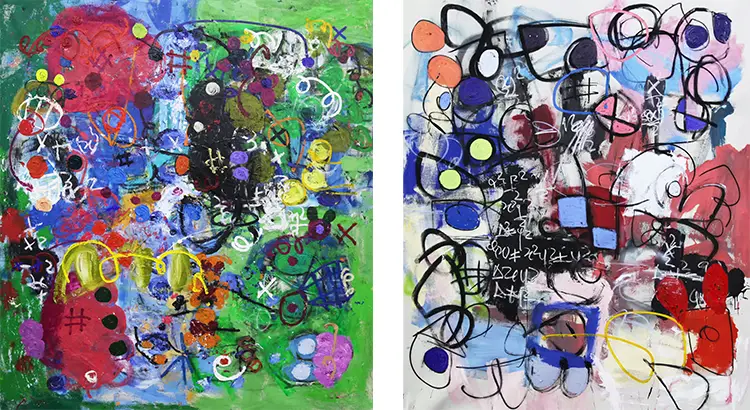
Taher Jaoui: Reconfiguring Chaos Through Subconscious Control
Jaoui’s artistic journey is inextricably tied to a personal evolution from logic to impulse. Having studied sciences and worked as a financial engineer before transitioning to art in 2013, he embodies a duality that continues to inform his work. His early experiments with collage eventually gave way to painting, where he found a deeper, more physical means of expression. A lack of formal art education did not hinder his development; instead, it freed him from academic constraints, allowing for an instinctive, self-directed process driven by curiosity and emotional authenticity. His engineering background remains present, however, in the structured chaos of his compositions, which often resemble systems in flux, bound by their own internal rules.
At the heart of Jaoui’s technique is a negotiation between spontaneity and intention. His paintings appear impulsive but are in fact the result of an intricate conversation with the canvas. Shapes are repeated and rotated, surfaces are layered until they achieve both visual density and conceptual clarity. The use of recurring circular motifs, for example, serves not only as a formal device but also as a nod to recurring themes of continuity, motion, and transformation. These circular patterns echo both the universality of mathematical structures and the organic rhythms of living forms. In works such as A New Circus in Town, the scale itself becomes a crucial part of the narrative, amplifying the immersive quality of the abstract creatures and symbols that populate the composition.
The COBRA movement, active from 1948 to 1951, has had a particularly strong impact on Jaoui’s conceptual outlook. Like the artists of COBRA, who sought to dismantle cultural conventions and access the primal subconscious, Jaoui treats the canvas as a site of instinctual creation. He channels mythological and psychological archetypes through abstract forms that feel simultaneously ancient and futuristic. The rawness of his imagery, often compared to cave paintings or children’s drawings, is not accidental—it’s a deliberate embrace of the unschooled and the intuitive. This approach helps him bypass intellectual filters, creating a space where emotion and gesture are paramount.
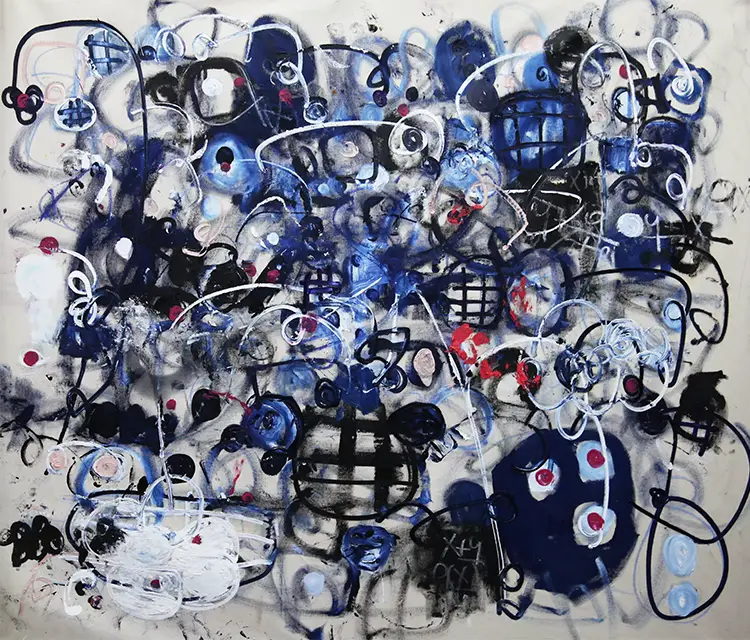
Building Visual Syntax: The Influence of Science and Street
Mathematics is not merely a reference point in Jaoui’s work—it’s a structuring force. Equations and formulas don’t function as decipherable content but as symbolic elements that convey logic, order, and intellectual rhythm. These motifs appear like graffiti on an urban wall or calculations on a chalkboard, adding to the texture while hinting at a deeper architecture beneath the surface. This fusion of analytical and expressive modes allows Jaoui to position his work within a unique space where formal abstraction intersects with coded language. Rather than obscuring meaning, these elements open the door to multiple interpretations, inviting viewers to find personal resonance in the chaos.
His compositions often blend influences from visual cultures typically considered outside of the fine art canon. Cartoon forms, graffiti-style marks, and the rebellious spirit of street art collide with references to post-war abstraction and Cubist fragmentation. This eclectic layering mirrors the diversity of Jaoui’s own cultural and academic background, bridging North African heritage with European education and a globally nomadic art practice. Shapes can resemble skulls, bubbles, or scientific diagrams, all coexisting in vibrant, unruly constellations. The result is a visual syntax that resists linear reading, favoring multiplicity over singular interpretation.
Color plays a vital role in heightening the impact of these works. Whether using subdued neutrals or explosive chromatic blends, Jaoui uses color fields to create zones of psychological depth and spatial tension. These contrasting palettes often serve as emotional cues, guiding the viewer’s eye and mood through the work. His physical engagement with the materials—scraping, smearing, layering—adds a tactile dimension that turns each painting into both an object and an event. It is through this rigorous physical process that the work becomes more than image; it becomes documentation of time, motion, and cognitive release.
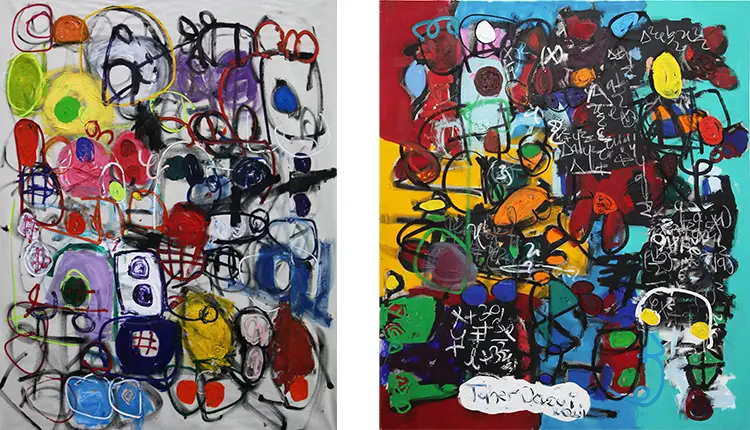
Taher Jaoui: Mapping Emotion Through Gesture and Geometry
For Jaoui, painting is not simply a visual endeavor but a way of grounding himself, of turning internal dialogue into external form. The studio becomes a psychological space where motion, thought, and feeling are distilled into shapes and lines. His approach is both meditative and explosive, with each painting serving as an emotional map created through a high-stakes process of trial and discovery. The works demand attention not just for their aesthetic complexity but for the psychological depth they encapsulate. The act of creating becomes a ritual that provides Jaoui with confidence, clarity, and peace—a dynamic he equates to dancing with a familiar partner, where rhythm and trust guide the outcome.
Working primarily on a large scale, Jaoui uses size to amplify the intensity of his visual language. These monumental canvases absorb the viewer, turning observation into immersion. Every stroke, mark, and symbol contributes to a layered narrative that resists closure. Despite their density, these compositions maintain a surprising sense of balance. His understanding of space, likely honed through his studies in computer science and engineering, allows him to organize chaos with a precise visual logic. It is this ability to maintain cohesion amid apparent disorder that gives his work its magnetic power.
Jaoui’s refusal to conform to stylistic or conceptual boundaries places him within a lineage of artists who create outside prescribed systems. His paintings exist in a space where emotion is intellectualized and intellect is emotionalized, where visual language is free to evolve without explanation. The anarchic sensibility in his work doesn’t speak of destruction, but rather of construction through freedom. This balance between thought and instinct, between gesture and geometry, becomes the foundation of a practice that is constantly expanding. His artworks are not static statements but living systems, each one a vibrant negotiation between energy and control, chaos and clarity.