

“Painters paint. Period. My job is simply to show up, paint from my heart, let the process flow, without rules or judgment… until the canvas sings.”
Rooted in Paradise and the Quiet Signal from Within
Stephen Lucas stands as an artist whose work cannot be tied to a single geography, even while his life has been shaped by a series of meaningful locations. Currently based on the island of Kauai, where he lives with his wife and business manager Debra, Lucas has cultivated a daily painting practice that reflects both discipline and devotion. Their move from Los Angeles in 2015 was marked by a conscious shift allowing him to create a slower pace of living, one that aligned more deeply with his natural rhythm. Active within the Kauai Society of Artists, Lucas maintains a visible presence in the local creative community, yet his non-representational abstract paintings transcend any regional identity. The significance of his work lies solely in how he channels emotional experience, instinct, and curiosity into visual form.
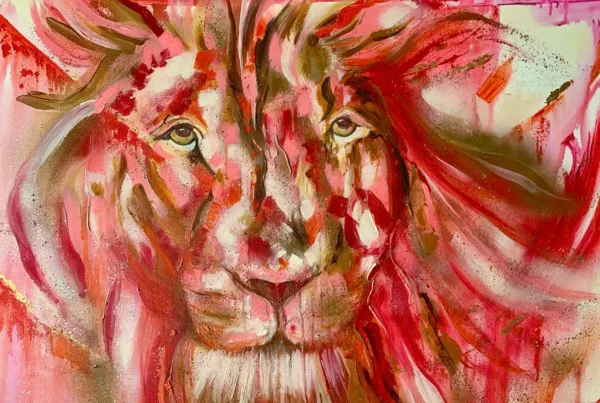
Although the lush environment of Hawaii surrounds Lucas, it is clear to every viewer that his paintings originate from an internal landscape rather than a physical one. His approach lies beyond narrative literalism, favoring instead a conversation between intuition and emotion that unfolds directly on the canvas. Each work becomes a sensate flow between his subconscious vision and conscious response, allowing imagery to surface gradually rather than through premeditated planning. This method positions his art within a broader abstract tradition while remaining distinctly personal. Lucas paints every day, not as a ritualistic gesture, but as a vehicle whereby he can express his innermost thoughts and feelings and at the same time achieve a rewarding sense of fulfillment. The act of painting functions as both exploration and communication, offering him a way to translate the experiences of the moment into color, line, and form.
This devotion to daily painting reflects his truth that his art is not an occasional pursuit but an innate way of being. Lucas was once asked how he decided to become a painter. That question surprised him as he realized, “I never made that decision – because being a painter never came up as a question for me.” With this newfound wisdom, he quickly replied to the person, “I don’t have a choice whether or not to be an artist…it’s who I am.” Lucas does not separate inspiration from labor; instead, he treats consistency as the foundation that allows surprise to occur. Over time, this steady engagement has allowed him to refine a visual language that feels spontaneous yet grounded in decades of experience. His work invites viewers to engage with abstraction not as something distant or intellectual, but as a living process shaped by feeling and discovery. By trusting the act of showing up each day, Lucas has built an exceptional body of work that speaks with sincerity and emotional clarity, anchoring his place within contemporary abstract painting.

Stephen Lucas: Early Encounters with Creation and Self-Perception
Lucas’s artistic sensibility began forming long before he understood what it meant to be an artist. At the age of seven, his first experience working with clay sparked an immediate sense of fulfillment. The tactile act of shaping material by hand introduced him to the satisfaction of bringing something new into existence. That early joy laid the groundwork for a lifelong attachment to making, one driven less by outcome and more by the experience of creation itself. These formative moments instilled a confidence that creativity was not reserved for special occasions, but available through direct engagement and curiosity.
A defining experience occurred when Lucas was twelve, when his father enrolled him in his first drawing lesson. The assignment required him to study his own reflection and draw exactly what he observed. This exercise demanded honesty, patience, and close attention, forcing him to confront perception without embellishment. Through this process, Lucas learned how to truly look, developing observational skills that would later support his abstract explorations. By ninth grade, his dedication was evident through awards in ceramics, signaling both talent and commitment. Yet circumstances shifted after high school when he lost access to a kiln, disrupting his primary medium and pushing him toward new forms of expression.
Rather than halting his creative output, this limitation redirected it. Lucas turned to drawing imagined characters, allowing invention to replace observation as his guiding force. This transition marked an early step away from strict representation and toward abstraction. Without the constraints of physical materials or external subjects, his imagination gained prominence, encouraging risk and experimentation. These drawings satisfied his ongoing need to express himself while quietly reshaping his artistic priorities. What began as a practical adjustment ultimately became a philosophical shift, opening a path that would define his future work and reinforce his trust in intuition over imitation.

From Bohemian Streets to Academic Discovery
At twenty years old, Lucas acted on impulse and moved to New Orleans, a decision that would profoundly influence his artistic development. Living in the French Quarter in 1979, he immersed himself in a culturally rich environment fueled by music, conversation, and creative exchange. During the day, he worked in a frame shop, gaining exposure to a wide range of artworks. Evenings were spent studying life drawing and printmaking, guided by local artists who shared both technical knowledge and personal philosophies. This period offered Lucas an education rooted in community and lived experience rather than formal structure alone.
After a year, Lucas returned to California and enrolled at Ventura College, where his ambitions sharpened. Determined to become a serious painter, he began studying influential figures in abstract art, encouraged by his instructor Wesley E. Johnson. Time spent in libraries absorbing the ideas of artists such as Wassily Kandinsky reshaped his understanding of what painting could be. He recognized that art did not need to replicate reality to hold meaning. Instead, it could communicate emotion directly, using form and color as expressive tools. This realization solidified his commitment to abstraction as both a visual and philosophical approach.
Printmaking, particularly intaglio etching, became central to his development during this time. Working with zinc plates required him to think in reverse, as the printing process mirrored the original marks. This challenge led him to adopt blind contour drawing, a method that involves drawing without looking at the paper. By removing conscious control, Lucas discovered a way to bypass habitual thinking and access a deeper source of imagery. This technique proved transformative, breaking open new possibilities and reinforcing his belief that the most compelling work emerges when intention gives way to instinct.

Stephen Lucas: Process, Persistence, and the Art of Showing Up
Lucas’s painting process remains rooted in exploration rather than predetermined outcomes. Each canvas begins with a subtle reference to blind contour drawing, often through loose preliminary marks that set the stage for discovery. He may establish an initial structure using a black round brush or apply color with a sponge to create an atmospheric base. From there, the painting evolves through a dynamic exchange of action and response. Shapes are introduced, adjusted, and challenged through layers of opaque light and dark tones. This ongoing negotiation can extend over weeks, requiring patience and openness as the composition gradually asserts itself.
Completion arrives not through external criteria, but through an internal signal. Lucas describes knowing a painting is finished when its elements align and resonate, when color, line, and composition reach a point of harmony that feels unmistakable. This moment, when the canvas seems to sing back to him, confirms that the work has reached its own resolution. Alongside this intuitive practice, Lucas has developed a pragmatic understanding of the art world. He recognizes that sustaining a career requires visibility and organization. By balancing creative integrity with consistent showing and record keeping, he embodies the dual roles of artist and businessman, demonstrating that persistence, honesty, and daily dedication form the true foundation of a lasting artistic life.