
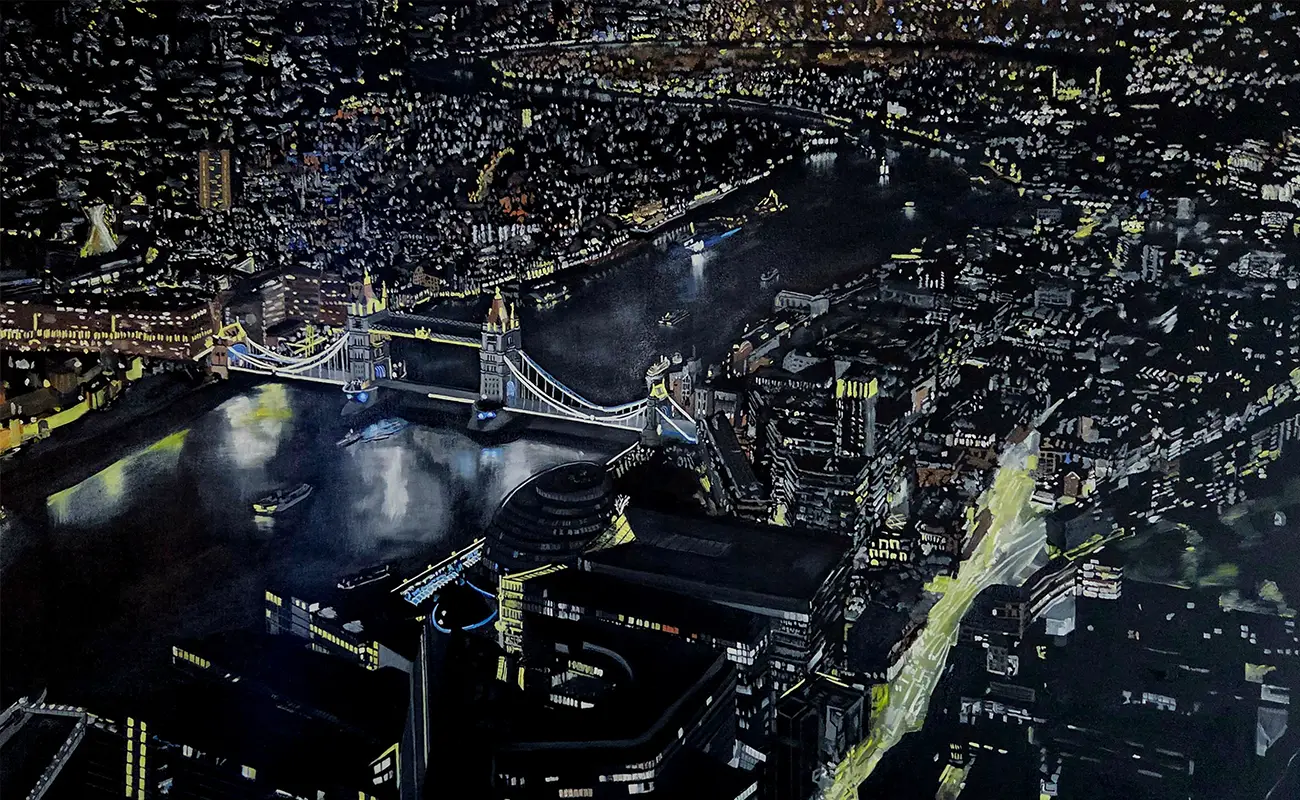
“It was painting that saved me; it gave me a reason to see each day’s sunrise and brought me peace and tranquillity.”
Echoes in Brick and Brushwork
Stephen J Crawford, who also goes by the moniker The Original Mad Yorkshireman or TOMY, has carved out a space in contemporary art that refuses to obey boundaries. With an origin story rooted in everyday grit rather than formal ateliers, Crawford channels his creative energy into oil paintings that span architecture, wildlife, seascapes, and allegorical portraiture. His work does not merely represent the visible world; it interprets its undercurrents. Whether capturing the gravity of a decaying Gothic arch or the glint in the eye of a painted gorilla, Crawford invites viewers into an intimate, sometimes uncomfortable dialogue with presence, emotion, and place.
His path to becoming an artist is anything but conventional. Born into a lineage of painters and decorators, Crawford never set out to be an artist in the traditional sense. It was a nudge from a persistent friend—and a moment of reluctant compliance—that led him to attend his first art class nearly fifteen years ago. That morning turned out to be a turning point. Painting, initially just a distraction during a period of poor health, became an obsession. Over the last nine years, it has taken on a deeper role: not only a profession but also a meditative practice and emotional anchor. Oil paint became his primary medium, and in time, even the act of stretching and priming his own canvases turned from cost-saving necessity into a meaningful ritual.
Crawford’s fascination with old architecture continues to serve as one of the emotional cores of his art. He is deeply captivated by how historical structures—mouldings, statues, facades—speak of a city’s memory, especially when juxtaposed against the sleek, imposing lines of modern buildings. This interplay between past and present fuels many of his cityscapes, where age and innovation share the same visual frame. To him, the built environment is more than backdrop; it is a living participant in the conversation between progress and identity, between decay and resilience.
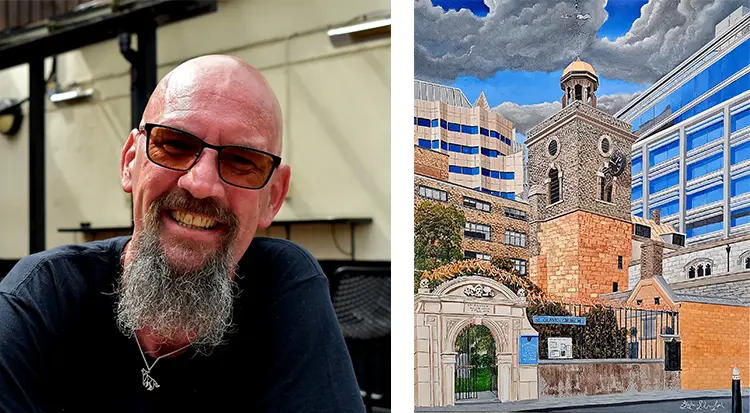
Stephen J Crawford: The Canvas as Companion
For Crawford, painting is not a silent act—it is an exchange. He describes his canvases as collaborators, claiming they “talk” to him throughout the process. What may sound whimsical at first glance is actually a description of his deep engagement with the work. He does not impose an image onto the surface; instead, he listens, responds, and adjusts as the piece evolves. This intuitive process means that even the most structured compositions are infused with a sense of discovery, as if the painting is finding itself in real time. Each canvas becomes a dialogue between vision and vulnerability, method and spontaneity.
Among his body of work, a painting titled Defiance holds particular emotional weight. This large-scale oil piece emerged from his imagination and evolved through the act of painting itself. It depicts a sailor standing atop a mast as the ship beneath him sinks into oblivion. For Crawford, this sailor symbolizes a personal truth: the refusal to surrender, even as everything collapses. He sees in this figure his own battle with adversity, his moments of near defeat, and the solace that painting ultimately provided. The storm may not always be avoidable, but standing one’s ground, brush in hand, is its own kind of triumph. This image, raw and allegorical, speaks volumes about art’s power to mirror and transform the psyche.
Daily life for Crawford is now consumed by this evolving partnership with the canvas. His flat doubles as his studio, blurring the line between living and creating. A typical day begins with coffee and a period of reflection, during which ideas for new works quietly gather in his mind. Once he begins painting, time becomes irrelevant. Hours disappear as he immerses himself in the physical and emotional rhythms of the brush. This immersion is not just creative; it is existential. Painting is not what he does—it is how he makes sense of the world and of himself.
Wild Eyes in the Shadows
While Crawford’s initial artistic leanings were toward architectural forms, a surprising shift occurred during the global lockdowns of 2020. Needing a fresh challenge, he turned to wildlife portraiture—something he had not previously explored in depth. His first attempt was a gorilla named Clive. The experience of painting Clive was so intense and inexplicable that Crawford recounts being unable to recall the act itself, as if the creature painted itself through him. Clive now hangs in his mother’s hallway, staring with what Crawford describes as a knowing smirk, as though aware of the role he played in expanding the artist’s creative boundaries.
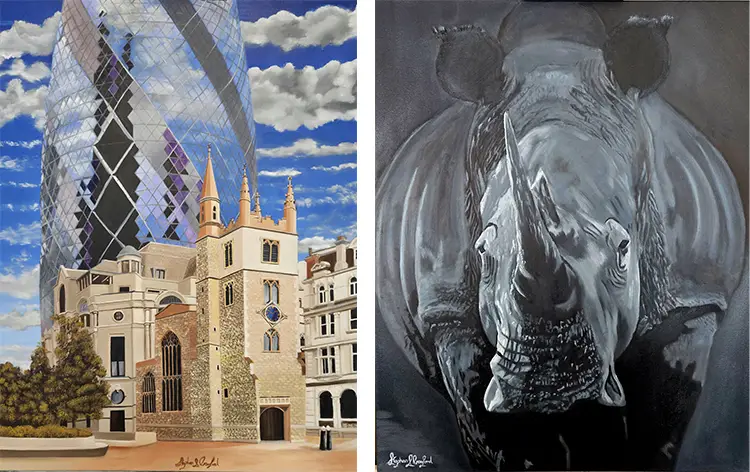
This moment marked the beginning of a profound engagement with wildlife portraiture. Though Clive’s creation remains unique in its intensity, each animal Crawford paints carries a distinct presence. These are not generic depictions of fauna; they are portraits imbued with emotion, story, and dignity. His current project, titled Stepping into the Light, features black-and-white animal portraits that emerge from darkened backgrounds into beams of illumination. This stylistic choice is purposeful. It reflects his desire to bring attention back to the natural world—particularly the wildlife suffering in the shadows of global crises and human indifference. The light becomes not only a compositional tool but also a metaphor for awareness and visibility.
Crawford’s passion for wildlife stems from a childhood moment: receiving a sweater featuring endangered animals from the World Wildlife Fund. That early spark of concern for the animal kingdom has matured into an artistic mission. With each brushstroke, he underscores the silent losses taking place across ecosystems. His animals are never static; they appear to breathe, to think, and in some instances, to grieve. This capacity to animate through paint is what distinguishes his work—not only technically but emotionally. Crawford uses the discipline of realism to evoke not just likeness but presence, crafting portraits that honor life even as they warn of its fragility.
Stephen J Crawford: Landscapes of Memory and Vision
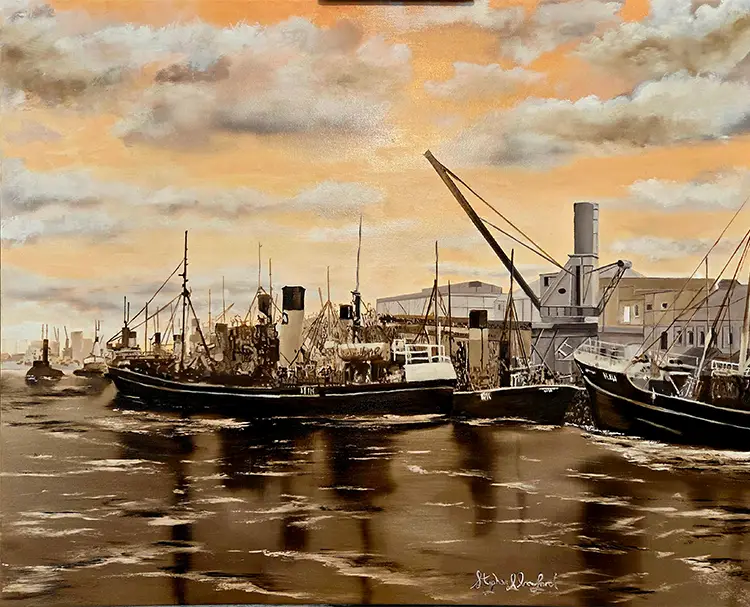
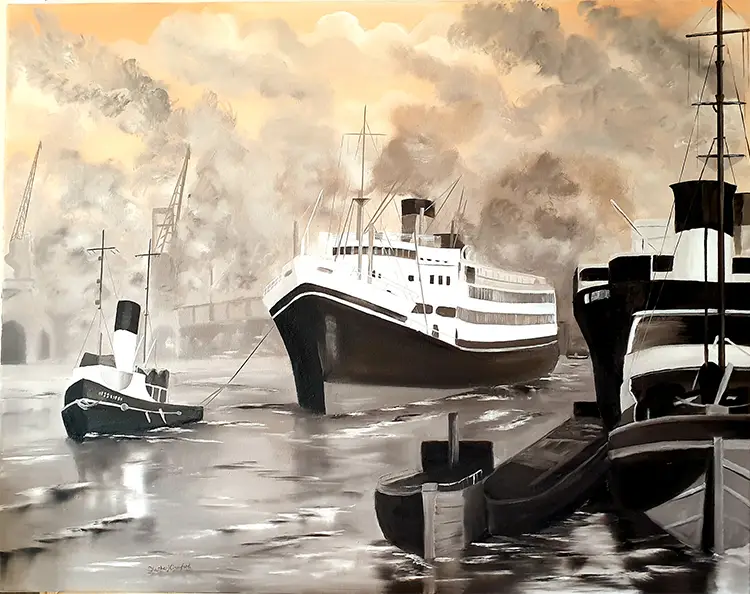
Crawford’s gaze continues to reach beyond the present, often resting on eras past, particularly the post-war landscape of mid-20th century Hull. One of his most ambitious upcoming projects centers around this historical period. The plan involves a series of twelve to thirteen large-scale canvases, each measuring six feet by four feet, which together will depict Hull’s city center as it stood in the early 1950s. Rendered in sepia tones, the series is designed to be experienced as a walkable installation, offering viewers a spatial and emotional journey through a city in transition. The only obstacle keeping this project on pause is the need for a larger workspace.
This immersive series is more than historical tribute; it reflects Crawford’s ongoing interest in memory and transformation. By reimagining Hull at a pivotal moment of change, he connects the physical environment to broader narratives of resilience and renewal. His use of sepia underscores the emotional tone of the work—nostalgic yet unsentimental, grounded in fact but animated by imagination. These canvases are intended to be inhabited, not just viewed. He envisions viewers walking through the scenes as though stepping into a living archive, one where every building and street corner is weighted with story.
Even as he navigates offers, exhibitions, and administrative demands—most notably, an exhibition in Florence, Italy—Crawford’s mind continues to return to what he wants to paint next. Ideas move in and out of his thoughts like visitors, each one waiting its turn. Whether it’s continuing the Stepping into the Light series or realizing his sepia-toned vision of Hull, the unifying thread remains the same: a hunger to create work that resonates across time, space, and emotion. Crawford paints not simply to depict the world, but to understand his place within it—and to invite others to do the same through the quiet, persistent language of oil on canvas.