
“All beautiful things are veiled with a thin layer of sorrow.”
Roots Written in Earth and Silence
Shouhui Iu’s artistic language is inseparable from the land that shaped him, both physically and psychologically. Born in Gansu Province in northwestern China, he grew up surrounded by loess soil, steep mountains, and a climate defined by restraint rather than abundance. Vegetation appeared sparse, yet what survived did so with a stubborn strength that left a lasting impression on him. Raised in a farming household, he experienced early on how survival depended on nature’s unpredictable generosity. These surroundings cultivated an inward-looking temperament, encouraging long periods of quiet observation. Instead of expressing himself through words or social exchange, he learned to study forms, textures, and living organisms around him, especially those modest plants clinging to the arid plateau. This early habit of sustained looking later became a foundation for his visual thinking.
Life followed an uncertain turn during his teenage years. Entering high school brought expectations from his family, yet the structure of formal education proved difficult for him to navigate. Social unease and academic pressure gradually distanced him from the classroom environment. During this period, a simple act of sketching plum blossoms in a notebook became unexpectedly transformative. Drawing offered something no other activity had given him, a channel through which emotions could surface without explanation or justification. These early images were technically unrefined, but they marked the first time he sensed that painting could echo his inner state. Art emerged not as an ambition, but as a necessity, a way to translate what could not be spoken.
A pivotal encounter soon followed when he discovered books featuring Pablo Picasso’s work. The unfamiliar visual logic and freedom within those pages left a profound impact. He had never encountered such a way of seeing or constructing images. That moment reshaped his understanding of what painting could be and quietly set a direction for his future. The decision to leave high school in 2009 soon followed, not as an escape, but as a commitment to pursue a personal path. Returning to his rural hometown, he began teaching himself to paint, copying from art books and practicing whenever farm labor allowed. Fields demanded his hands during busy seasons, while evenings and quiet hours belonged to drawing and experimentation.

Shouhui Iu: A Self-Taught Path Carved by Persistence
Self-education became the structure of Shouhui Iu’s artistic development. Without academic training or institutional guidance, progress relied on repetition, patience, and an ongoing dialogue with art history through books. Each copied image served less as imitation and more as inquiry, helping him understand what painting required from him personally. This period of learning unfolded alongside agricultural labor, reinforcing a rhythm of endurance and discipline. Farming demanded physical commitment, while painting required sustained mental focus. The coexistence of these two forms of work shaped his understanding of effort and time, teaching him that growth often occurs slowly and without immediate reward.
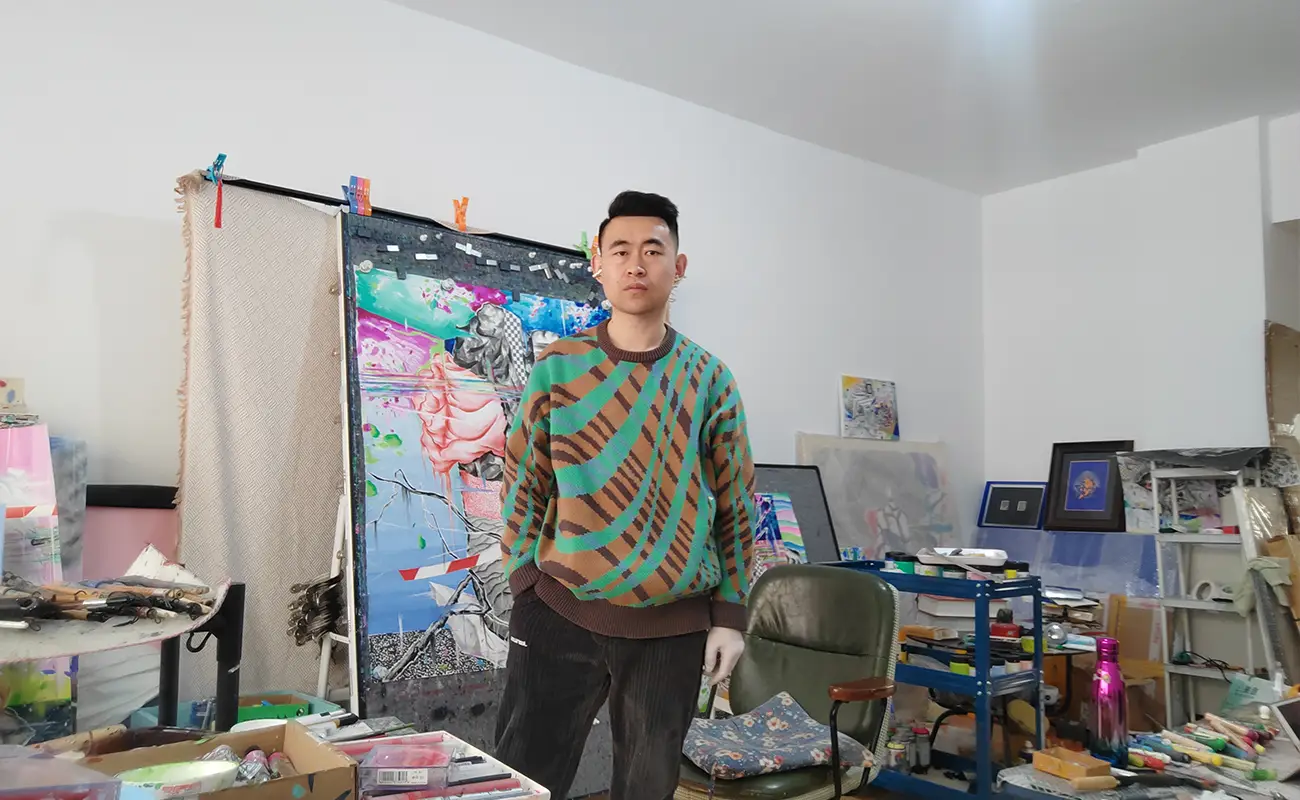
In 2014, a significant shift occurred when he established his first independent studio in a small county town. Measuring roughly twenty-five square meters, the space was modest, yet it represented autonomy and intent. For seven years, he worked within those walls, refining his visual language and building a body of work grounded in lived experience. The limited space influenced how he moved, stored materials, and composed images, reinforcing an intimate relationship between body and surface. Only later, after years of steady creation, was he able to relocate to a larger ninety-five square meter studio. The increased room allowed greater physical freedom and expanded technical possibilities, subtly changing how ideas could be realized.
Despite these changes, his approach to work remained consistent. He prefers daylight hours, valuing physical well-being as essential to sustained creation. Each piece begins with a rough sketch, followed by long stretches of contemplation. There are days when no mark is made at all, moments spent simply looking and reassessing. Periods of creative stagnation recur annually, yet they are treated as part of the process rather than failure. Once commitment to a piece is made, he works with intense focus and resists interruption. Alongside refining earlier methods, he continues to test new materials and techniques, understanding experimentation as a necessary response to fatigue and repetition.

Landscapes as Self-Portraits of Endurance
The imagery within Shouhui Iu’s work consistently returns to elements drawn from his upbringing. Seeds, branches, wild plants, soil, and expansive skies recur not as decorative motifs, but as carriers of lived meaning. Growing up in an environment where rainfall determined survival instilled an acute awareness of vulnerability and persistence. Vegetation in his paintings often appears unconventional in form, standing with an almost defiant presence. These subjects reflect the reality of life on arid land, where existence is fragile yet stubborn. Through these natural forms, he constructs a visual vocabulary that speaks to endurance shaped by hardship rather than triumph.
Influence from Picasso remains significant, though not stylistically explicit. Rather than adopting Cubist aesthetics, he absorbed a philosophical stance toward art, particularly the belief that painting is a way of seeing and thinking rather than reproducing appearances. Repeated readings of Picasso’s writings reinforced this perspective, encouraging independence and trust in intuition. Alongside this intellectual influence, the weight of his personal environment continued to shape his emotional framework. Poverty, constant labor, and the awareness that survival required relentless effort fostered an understanding of life as something earned daily. This awareness surfaces in his imagery through tension, density, and restrained energy.
Many of his works function as indirect self-portraits. By painting the land and its resilient organisms, he reflects his own psychological state and life trajectory. A recurring internal image he references involves a sunflower on a winter hillside, dried and bowed under an unforgiving sun, having endured all seasons. This metaphor encapsulates how he perceives existence, marked by persistence through difficulty rather than comfort. The paintings do not offer escape from suffering, but acknowledgment of it. They propose that identity is shaped by what one withstands, and that beauty often carries the weight of endurance rather than ease.

Shouhui Iu: Seeing Oneself Through Loss and Warning
A pivotal work that encapsulates these concerns is Seeing Oneself, created in 2025. Executed on Xuan paper using ink, traditional Chinese pigments, acrylic markers, and oil pastels, the piece measures 120 by 97 centimeters. Xuan paper features prominently across his practice, valued for its responsiveness and historical resonance. The origins of this work are deeply personal, tied to the death of his father in an accident three years prior. Following local customs, he returned to his rural home to honor the anniversaries of his father’s passing. Wandering through the long-neglected backyard, he encountered a dried, unnamed flower rising over two meters tall among overgrown weeds, its life cycle complete.
That encounter triggered reflection on mortality and transience. The flower, having endured all seasons before withering, became a mirror through which he saw himself and others. Kneeling at his father’s grave resurfaced memories of labor, sacrifice, and a life spent working the land. His father’s existence, marked by relentless effort, ended quietly, much like an animal that had fulfilled its burden. This recognition introduced a sense of sorrow that permeates the work. Beauty, in this context, appears inseparable from grief, carrying a fragile emotional weight. The painting does not isolate personal loss, but extends it outward, suggesting a shared fate within contemporary society.
Visual symbols within Seeing Oneself reinforce this message. Caution tape appears as a signifier of warning and latent danger, while areas of pixelation suggest erasure and concealment. These elements imply that threat exists continuously within human life, often unnoticed until loss makes it visible. The work does not dramatize death, but frames it as an inescapable condition that shadows existence. Through this piece, Shouhui Iu articulates a worldview shaped by endurance, labor, and impermanence. Painting becomes a means of facing these realities directly, offering neither resolution nor comfort, but a clear and honest reflection of what it means to live through time.