
“Survivors of trauma often contort and reconstruct both mind and body to endure and make sense of their experiences.”
Origins Reclaimed Through Line and Intention
A practice shaped by interruption, resilience, and return defines the work of Senescence, an artist whose life has moved between disciplines that are often kept separate. Born in Adelaide, Australia, they began drawing in black and white pencil during childhood, developing a quiet but persistent relationship with image making long before art became a profession. That early engagement with drawing was informal, intuitive, and rooted in observation rather than theory. At eighteen, they entered the visual arts industry, working within commercial graphic arts where clarity, efficiency, and communication were essential. Those early professional years established a strong technical foundation while also placing creative expression within the constraints of client driven outcomes. Even at this stage, visual language served as a tool for conveying meaning rather than decoration, a priority that would later define their personal work. This early period matters not simply as a beginning, but as a reference point, because it represents an unguarded relationship with drawing that Senescence would eventually reclaim under vastly different circumstances.
The trajectory of Senescence’s life soon expanded beyond the arts into academic and medical fields, introducing new ways of seeing the human form and condition. After working in commercial design, they completed a degree in psychology, followed by a medical degree, ultimately specializing in surgical and medical anatomy. Teaching anatomy at the University of Adelaide and later the University of Melbourne, they spent more than fifteen years immersed in the study of the body as both structure and system. This role required precision, repetition, and an intimate understanding of variation, as no two bodies present identically. Daily engagement with future surgeons and medical students reinforced the importance of accuracy, but also highlighted the fragility and adaptability of the human form. Over time, this knowledge became deeply embedded, shaping how Senescence understood embodiment, difference, and survival. Although art was absent from their personal life during these years, visual thinking never disappeared, instead being redirected into diagrams, explanations, and teaching strategies grounded in clarity and care.
A profound turning point arrived when illness interrupted what had seemed like a settled professional life. After more than a decade in academia, and just before the birth of their daughter, Senescence was diagnosed with an inoperable brain tumour alongside other serious health concerns. The diagnosis made a return to teaching impossible, bringing their medical career to an abrupt and painful halt. In the aftermath, drawing re emerged not as a hobby, but as a necessity. Having not produced personal artwork for over twenty years, and never outside commercial contexts, they returned to pencil and paper with a vastly expanded inner landscape. This return was not nostalgic, but transformative, combining lived experience, medical knowledge, and psychological insight into a renewed visual practice. The significance of this moment lies in its circularity, as the artist did not simply resume making art, but rebuilt their creative identity with an urgency shaped by time, health, and responsibility.

Senescence: Anatomy as Experience Rather Than Instruction
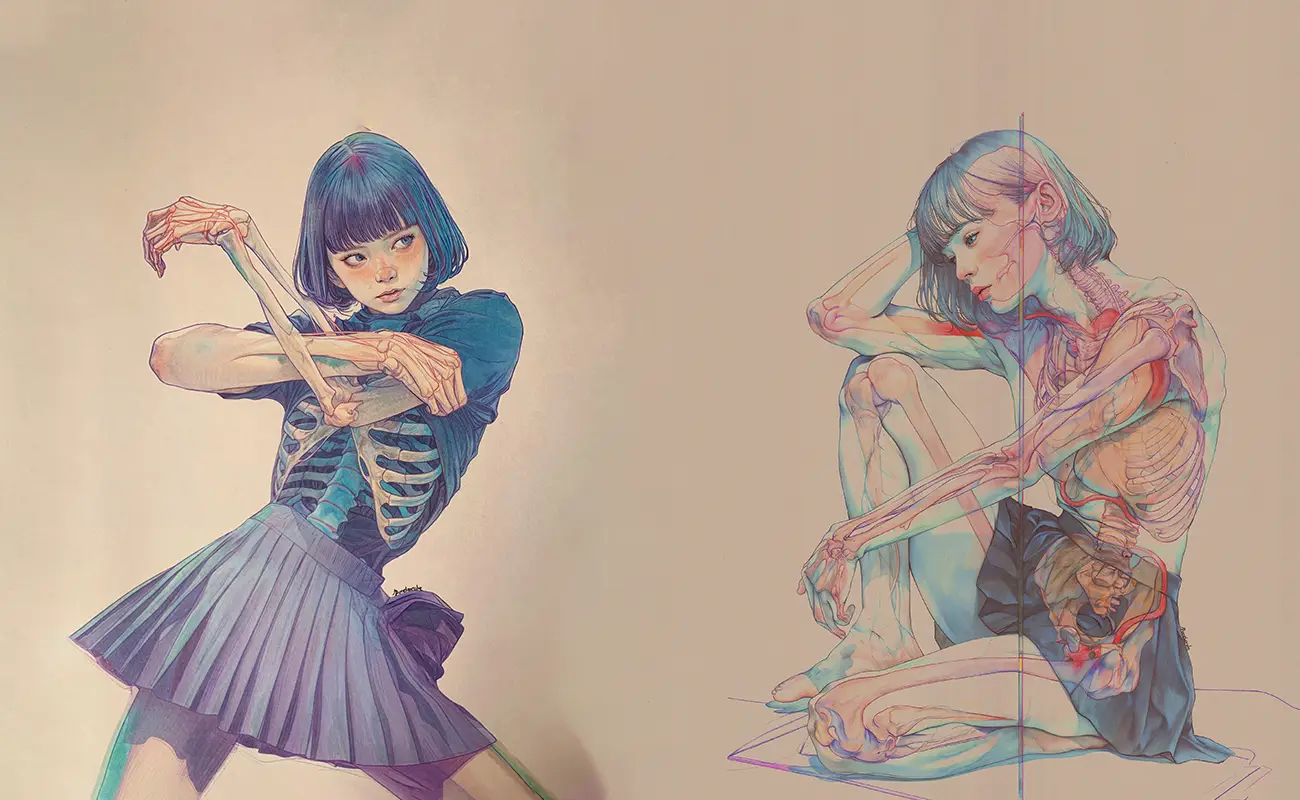
The visual language that now defines Senescence’s work reflects a deliberate shift away from clinical representation toward expressive interpretation. Years of teaching anatomy reinforced the necessity of precision in educational settings, where accuracy can determine outcomes of care and survival. In contrast, their personal artwork intentionally resists sterile exactness, favoring emotion, movement, and conceptual communication. This choice does not reject anatomical knowledge, but reframes it. Internal similarity across human bodies exists alongside countless subtle differences, often described as anatomical variation. In medicine, these variations demand respect and adaptability. In art, they become symbols of lived experience. Senescence uses the body as a site where genetics, history, and psychological states intersect, allowing distortion, emphasis, and alteration to communicate internal realities. Forms may appear warped or exaggerated, not as errors, but as visual metaphors for how experience reshapes perception. The body becomes a record of what has been endured, interpreted through line and composition rather than textbook correctness.
Personal history plays a central role in this approach, particularly experiences of leaving home at an early age and spending time living on the streets. These experiences, alongside abuse endured by the artist and countless others, inform a body of work focused on identity formation under pressure. Trauma, in this context, is not treated as a single event, but as a force that continuously shapes self perception. Senescence’s figures often embody strength, confidence, and defiance, especially through bold female forms that embrace difference rather than conceal it. This focus reflects a commitment to empowering children and survivors of abuse, while also fostering broader public awareness of the scale and impact of such harm. The work seeks dialogue rather than comfort, asking viewers to confront how identity is constructed through both damage and resilience. Influences drawn from Japanese and European surrealism, alongside medicine and transhumanist thought, support this fusion of inner psychology with altered physical form.
Underlying these themes is a consistent concern with how psychological states act as lenses through which reality is filtered. Senescence’s figures rarely present a neutral viewpoint. Instead, they suggest how fear, dissociation, or resolve can compress, stretch, or fracture perception. The concept of variation extends beyond anatomy into consciousness itself, where coping mechanisms alter how the world is seen and how the self is understood. By emphasizing difference rather than uniformity, the work challenges idealized representations of the body and mind. This challenge is not abstract, but grounded in lived knowledge from both medical practice and personal survival. Each piece becomes an assertion that deviation is not failure, and that altered forms can communicate truths that standardized images cannot. Through this lens, art functions as both witness and resistance, asserting the value of individual experience within systems that often demand conformity.

Trauma, Philosophy, and the Body in Transformation
A pivotal articulation of these ideas appears in the artwork titled “Numb I,” a piece that holds particular significance within Senescence’s practice. Created to explore the disconnect between emotional and physical states, the work moves beyond illustrative metaphor into embodied form. Survivors of trauma frequently adapt by separating sensation from feeling, a process that allows endurance but alters self experience. In “Numb I,” this adaptation is translated into composition, where the body appears reconfigured by necessity rather than choice. The figure does not simply represent damage, but survival, presenting an anatomy reshaped by what has been endured and what has been lost. This physicalization of psychological process reflects the artist’s long standing interest in how the mind protects itself. The work proposes that resilience often requires reconstruction, and that this reconstruction leaves visible traces, even when numbness becomes a coping strategy.
The personal importance of “Numb I” deepens through Senescence’s reflections on their own inner life. Throughout their history, they observed a separation between external experience and internal thought, a divide that only later gained clarity. Engagement with psychology, philosophy, and medicine provided language and structure for understanding this division. Stoic and Buddhist philosophies, with their emphasis on observation, endurance, and detachment, shaped how the artist interpreted early experiences. These frameworks offered tools for survival, yet also reinforced a distance between body and mind. Looking back, Senescence recognizes how these philosophies, combined with trauma, contributed to a schism that became normalized. The artwork does not condemn this separation, but examines it with honesty, acknowledging both its protective value and its cost. Through visual form, the piece articulates insights that emerged gradually through study and self reflection.
Further understanding came through focused anatomical study, where parallels between mental adaptation and physical variation became increasingly apparent. The human body, like the mind, responds to pressure by changing shape, structure, and function. In medical contexts, these changes are documented and analyzed. In art, they can be felt. Senescence recognized that clarity and distortion often coexist, both necessary for survival. “Numb I” embodies this balance, presenting a figure that is simultaneously resilient and vulnerable. The work resists simplification, refusing to offer a single reading or emotional response. Instead, it invites recognition of complexity, where healing is not linear and adaptation leaves marks. This approach reinforces the artist’s broader commitment to representing trauma without spectacle, grounding abstraction in lived knowledge and disciplined observation.

Senescence: Working Within Constraint, Time, and Renewal
The creative process behind Senescence’s work reflects a life shaped by unpredictability and physical limitation. Health management affects every aspect of daily existence, from parenting a young child to sustaining an art practice. Illness disrupts planning, making consistency difficult and extended periods of work rare. Within these constraints, the artist has developed a process that values patience and adaptability. Work typically begins with small sketches, where ideas are explored loosely and without pressure. These early drawings function as testing grounds, allowing concepts to emerge gradually. Larger scale line work follows when energy permits, often spread across weeks or months. This extended timeline is not a stylistic choice, but a practical response to circumstance. Rather than resisting limitation, the process incorporates it, allowing the work to evolve in stages that respect the body’s needs.
Once line work is established, Senescence builds compositions through layers, using markers or ink to define broader areas of color before refining surfaces with colored pencil. This method supports incremental progress, as details can be added in short sessions without compromising cohesion. Despite the slow pace, the artist usually holds a clear mental image of the finished piece from the beginning. Translating that vision into material form presents ongoing technical challenges, particularly when physical capacity fluctuates. Ideas remain abundant, while time remains scarce, creating a tension that shapes decision making within the studio. Recently, reflection on visual language has prompted consideration of new directions, suggesting that the practice continues to evolve even within constraint. This openness to change underscores a commitment to growth that persists despite uncertainty.
What emerges from this process is a body of work that embodies renewal without erasing history. Returning to art after decades away required not only technical re engagement, but also a redefinition of purpose. For Senescence, making images now serves as a means of advocacy, reflection, and connection, particularly for children and survivors of abuse. The work seeks to empower by making internal states visible, challenging silence through form rather than declaration. Each piece stands as evidence that creativity can resurface under the most difficult conditions, informed by accumulated knowledge rather than diminished by interruption. Through sustained attention to variation, resilience, and identity, Senescence continues to build a practice that is both deeply personal and broadly resonant, grounded in care for the body, the mind, and those whose stories demand to be seen.