
“Each sculpture is simultaneously a meditation and an attempt to honor the essence of life.”
Form, Origin, and the Silent Intelligence of Matter
Sculpture, in the hands of Radoslav Sultov, becomes a language that communicates without sound, relying instead on proportion, rhythm, and spatial tension. Born in Bulgaria, a country known for its powerful sculptural legacy and deep respect for material tradition, Sultov grew up surrounded by an environment where form carried cultural memory. From an early stage, he gravitated toward three-dimensional expression, sensing that volume and void could articulate ideas beyond words. This early attraction to form was not decorative or illustrative, but intuitive, rooted in a curiosity about how shape holds meaning. His artistic path developed through observation of nature and built environments alike, where stone, gravity, and space exist in constant negotiation. That sensitivity continues to underpin his practice today, positioning sculpture as a living system rather than a static object.
His formal education at the National Academy of Fine Arts in Sofia provided him with a rigorous technical grounding, reinforcing discipline, craftsmanship, and respect for material integrity. Academic training refined his understanding of proportion, balance, and structural logic, while also situating him within the strong lineage of Bulgarian sculpture that reached a significant peak during the late twentieth century. That period, marked by a synthesis between sculpture and architecture, established a benchmark that continues to influence new generations. For Sultov, this inheritance was not something to imitate but something to extend. The academy became a foundation upon which he could build an independent visual language, informed by historical knowledge yet oriented toward exploration and change.
Equally formative were his experiences beyond Bulgaria, particularly through international residencies and sculpture symposia across Europe, Asia, and the Americas, as well as specializations at the University of Castilla-La Mancha, Cuenca in Spain and the University of Gothenburg in Sweden. Working in over 20 countries, including Egypt, Canada, Taiwan, and China, expanded his understanding of how sculpture functions within diverse cultural and spatial contexts. These encounters reshaped his perception of scale, public interaction, and environmental dialogue. Sculpture, he came to realize, exists not only through form and material but also through the way it occupies space, directs movement, and evolves over time. This combination of classical training and global exposure forged a practice grounded in precision while remaining open to transformation.

Radoslav Sultov: Geometry as a Living System
At the core of Sultov’s artistic vision lies an ongoing investigation into the relationship between structure and space. His sculptures examine how internal and external forces coexist, how visible surfaces hint at invisible dynamics, and how material presence can suggest motion rather than stillness. Rather than presenting closed forms, his works invite the viewer to perceive sculpture as a process. Space is not treated as an absence but as an active participant that penetrates, rotates, and reshapes matter. This approach allows his sculptures to operate simultaneously on physical and symbolic levels, where geometry becomes a carrier of philosophical inquiry.
Geometric abstraction plays a central role in defining his style, though it is never reduced to rigid calculation. Mathematical precision is softened by organic flow, producing forms that feel intuitive rather than mechanical. Sultov is drawn to geometry not as an end point, but as a dynamic force that explains how forms emerge, expand, and transform. Patterns appear to unfold rather than repeat, suggesting growth and evolution. His sculptures are visual metaphors for morphosis, where change itself becomes the subject. The viewer encounters not a frozen moment, but an impression of movement that seems to continue beyond the material boundaries of stone or metal.
Among the geometric principles that recur in his work, the spiral has emerged as a defining symbol. For Sultov, the spiral represents a universal structure that connects natural phenomena with human understanding, from microscopic systems to cosmic formations. It bridges science and spirituality, offering a form that is both rational and poetic. By integrating spiral dynamics into solid materials, he challenges conventional distinctions between natural and constructed form. Each sculpture becomes both a meditation and a celebration of transformation, honoring the underlying forces that shape life, matter, and perception.

Influence, Lineage, and the Architecture of Experience
Sultov’s artistic development has been shaped by a deep respect for sculptural lineage and the individuals who helped define it. His professors at the National Academy of Fine Arts in Sofia, along with major figures in Bulgarian sculpture such as Boris Gondov and Krum Damyanov, provided not only technical instruction but also an ethical model of commitment to form. The achievements of earlier generations, particularly their integration of sculpture within architectural and public environments, left a lasting impression. Their work demonstrated how sculpture could shape collective experience while maintaining conceptual rigor.
Over the past two decades, participation in international sculpture symposia and museum exhibitions has further expanded his artistic perspective. Creating large-scale works in public parks and urban settings across five continents exposed him to a wide range of cultural attitudes toward space, monumentality, and community engagement. Encounters with artists such as Adam Henain, Francisco Gazitua, Zeng Chenggang, and Bruce Beasley reinforced the idea that sculpture is a global conversation, shaped by local conditions yet capable of universal resonance. These exchanges encouraged experimentation and reaffirmed the value of dialogue between tradition and innovation.
Beyond human influence, nature remains his most enduring teacher. Sultov draws inspiration from natural systems not for their surface beauty, but for their hidden structures and governing principles. Mathematics, particularly the logic of nested polygons and vortex formations, informs his approach to composition. Artists like M.C. Escher have also influenced his thinking, especially in their ability to challenge spatial logic and perception. Through these combined influences, Sultov has developed a practice that seeks to reveal the invisible frameworks underlying both natural and constructed worlds.

Radoslav Sultov: Sculpture as Continuity and Transformation
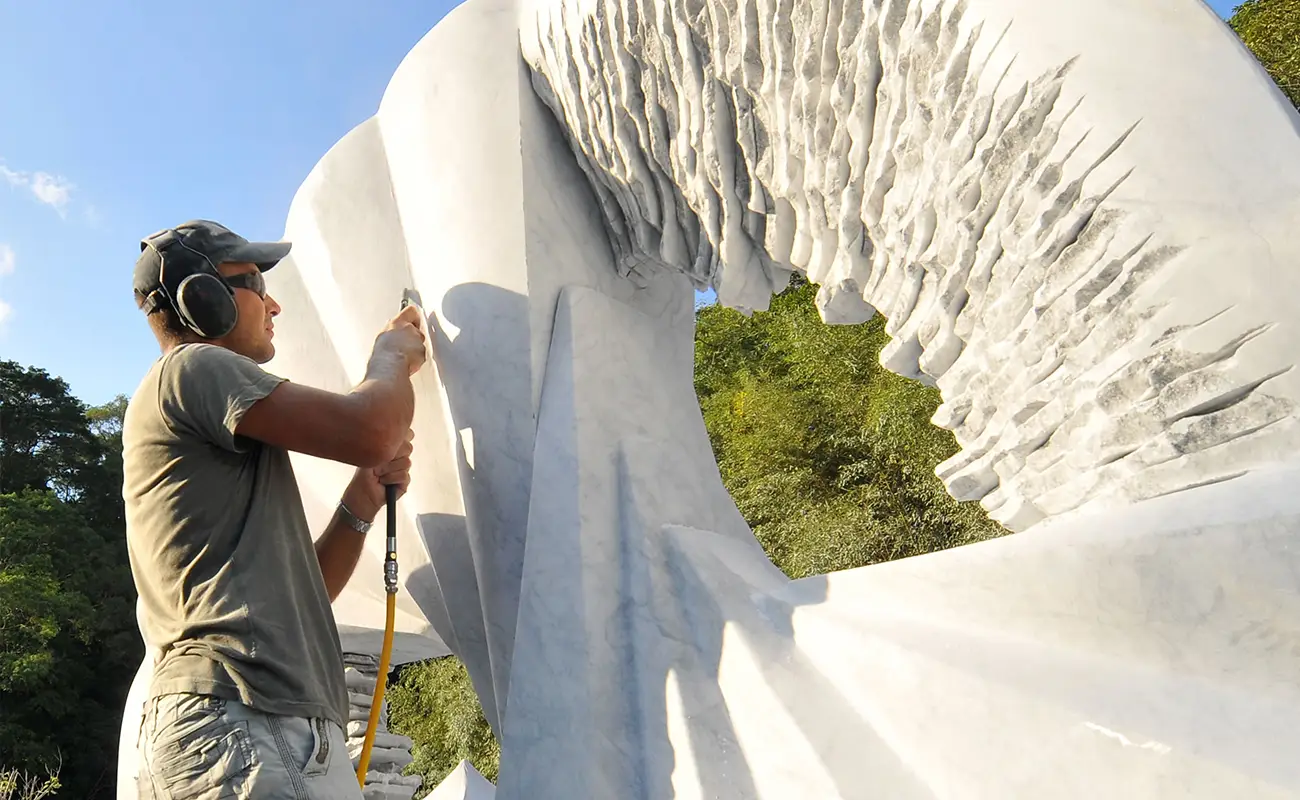
Among Sultov’s many public works, the Cube at the BenQ headquarters in Taipei stands as one of his most iconic achievements. Created in 2010 from Taiwan white marble during the BenQ International Sculpture Workshop, the piece presents a cube balanced on one corner, allowing it to fully engage three-dimensional space. Each face is carved with a layered spiral pattern that converges into a hollow, vortex-like core. Mathematics and artistic intuition merge here, as sequences found in nature inform the structure. The sculpture transforms a traditionally static form into a dynamic presence, inviting viewers to move around it and experience shifting perspectives.
Another deeply meaningful work is Rivergate, created in 2012 for Grand Bay-Westfield in Canada. Carved from a granite boulder sourced from the Hampstead Quarry, the sculpture features a spiraling tunnel that passes through the stone’s core. The pattern begins on one surface, penetrates the interior, and emerges on the opposite side, suggesting motion carved into permanence. The contrast between the rough exterior and the precisely shaped interior reflects the dialogue between chaos and order. Situated within a community setting, Rivergate continues to evolve through seasonal change and public interaction, becoming a lived part of its environment. The bond formed with the local community was so profound that Rivergate was memorialized on a commemorative coin.
Works such as Our Dreams Connect Us further articulate Sultov’s vision by combining figurative fragments with geometric structures and interwoven spirals. Carved from granite, the sculpture explores human interdependence through abstract form, using geometry as a language capable of conveying emotion, tension, and balance.
Sultov’s daily practice begins with analysis, sketching, and pattern study, often informed by digital tools, yet the final encounter between artist and material remains central. Looking ahead, his upcoming monumental project Continuity, composed of octahedral vortex modules, aims to symbolize technological evolution and upward aspiration. Across all these works, sculpture becomes a journey through motion, space, and the laws that quietly shape existence.