

“Change begins when more people become aware and start reflecting on an issue; awareness can inspire action over time.”
Mapping the Personal Landscape
Qi Liu, a multidisciplinary artist currently based in Los Angeles, has carved a unique path through the intersections of photography, installation, and art direction. Born in Beijing, her formative years in China and later studies at CalArts laid the groundwork for a practice grounded in both visual precision and conceptual depth. Her transition from Photography and Media to Scenic Design expanded her artistic lexicon, allowing her to navigate spatial dynamics and narrative frameworks with fluency. These overlapping fields have not only sharpened her storytelling skills but have also enriched her ability to engage viewers on multiple sensory levels.
Liu’s work frequently draws from her lived experiences, with recurring themes centered on gender roles, family dynamics, and societal expectations. She is particularly interested in how personal identity is shaped by social environments and collective norms. Projects such as QiQi Chairs Fair act as visual inquiries into these relationships, examining how individuals—particularly women—navigate roles imposed upon them by tradition and culture. Her background as an Asian artist and the nuances of her personal identity are woven into her creative process, offering authenticity and clarity to the subjects she explores.
This deeply observational approach is a cornerstone of Liu’s methodology. Rather than focusing on grand, sweeping narratives, she turns her lens toward the intimate, the overlooked, and the everyday. The ordinary becomes a vessel for critical engagement, where the familiar is reframed to reveal complex undercurrents. In doing so, Liu bridges personal memory with broader social commentary, creating work that is both intimate in its origins and expansive in its implications.
Qi Liu: Conversations Through Objects and Space
Photography served as Liu’s initial gateway into the art world, offering her a way to document and reflect on the lives around her. While her early practice focused on capturing reality through the lens, it was her training in Scenic Design that expanded her vision, introducing new spatial and material possibilities. This shift prompted an evolution toward immersive installations and sculptural forms, where ideas are not merely seen but physically experienced. Liu’s signature style now blends concept-driven design with tactile media, inviting audiences to engage both visually and emotionally.
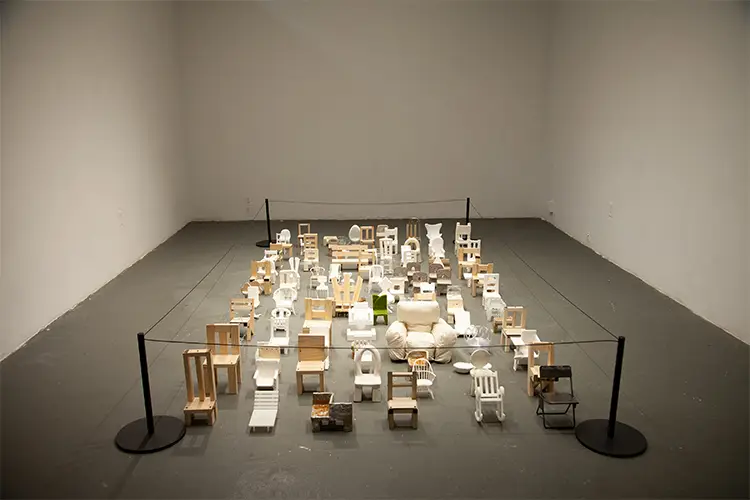
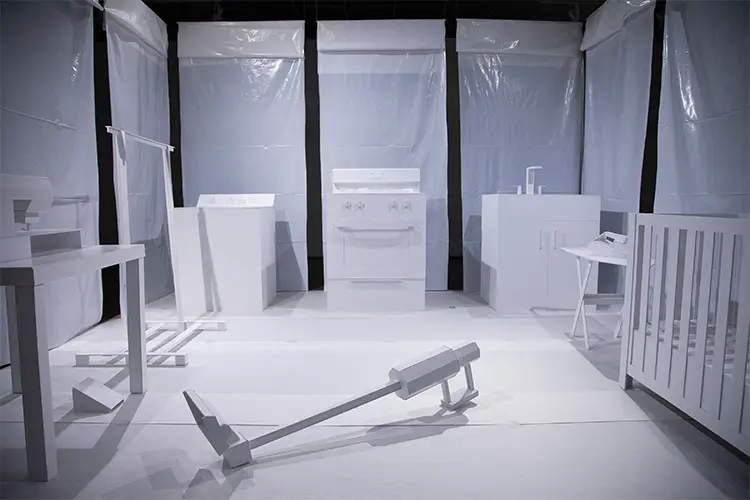
One early work, Blind Spot, laid the foundation for her thematic concerns. The project examined invisible domestic labor and the societal disregard for women’s unacknowledged contributions within the home. Building upon this, Liu developed QiQi Chairs Fair, an expansive installation of 100 stylized chairs, each representing an individual woman. The chairs serve as metaphors for the traits often demanded of women—docility, agreeableness, self-sacrifice—bringing abstract social norms into tangible form. Through such works, Liu constructs environments that translate social dynamics into physical experiences, emphasizing the often-unseen forces that govern identity.
Integral to Liu’s process is the audience’s interaction with her installations. She designs her spaces not just for passive observation but for active engagement, prompting viewers to confront their assumptions and emotions. This focus on experiential interpretation reveals her concern with how perception is shaped—not just by what is presented, but by how it is encountered. Through spatial arrangement, material selection, and symbolic layering, Liu crafts environments that resonate long after the viewer has left, quietly challenging their understanding of societal roles and personal identity.
Material Witness: Women, Memory, and Social Expectation
Qi Liu’s work is heavily influenced by the women in her life, whose lived experiences have provided a wellspring of insight into the subtle burdens and societal pressures they face. Her grandmother, mother, aunt, and female friends have all contributed—often unintentionally—to the conceptual framework of her practice. Their everyday conversations, quiet frustrations, and personal reflections have shaped her understanding of gender roles, prompting her to translate their realities into visual narratives. These deeply personal connections infuse her work with sincerity and urgency, transforming private dialogue into public art.
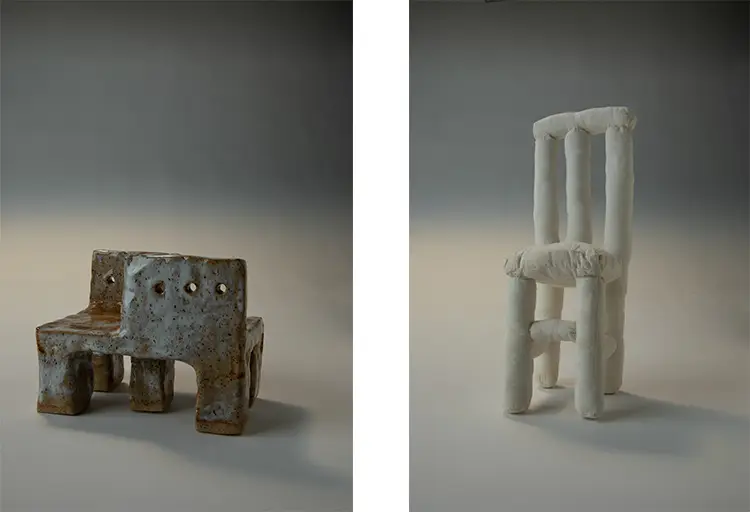
This thread is most apparent in QiQi Chairs Fair, a project that holds particular significance in Liu’s career. Each of the 100 chairs in the installation is uniquely crafted, reflecting both individuality and conformity. Collectively, they form a dense, contemplative environment that encourages viewers to slow down and consider the many ways society molds women’s identities. The choice of chairs—a domestic and utilitarian object—underscores the connection between societal expectation and physical form. Liu’s careful attention to material, color, and structure creates a layered experience where visitors can feel the weight of these imposed roles through space itself.
Beyond gender, Liu draws from broader social and environmental observations, using the personal as an entry point to collective reflection. Her photographic series Silence of Ages, for example, explores natural landscapes not just for their aesthetic qualities but for their symbolic resonance with human resilience and change. Here, the quiet persistence of nature becomes a metaphor for endurance in the face of social constraints. By linking personal observation with environmental motifs, Liu creates works that speak to both individual and shared experiences, reinforcing the interconnectedness of identity, society, and the spaces we inhabit.
Qi Liu: Dialogues in Motion, Silence, and Form
Daily practice for Liu is an open-ended investigation, shaped by conversations, material play, and close observation of her surroundings. She approaches art-making as a dialogue—both with herself and others. Through listening and exchanging stories, she gains insight into lives and perspectives beyond her own. These exchanges are not incidental but foundational, as they often reveal hidden social dynamics that become central to her installations and photographic work. Liu’s art emerges from these interpersonal moments, reflecting a collective voice channeled through individual experience.
Nature also plays a recurring role in Liu’s practice. She finds inspiration in the organic forms, rhythms, and silences of the natural world. In Silence of Ages, these elements take center stage, as natural imagery becomes a vessel for exploring human emotional states and broader social conditions. By aligning the stillness of nature with societal quietude around certain issues, Liu creates a visual metaphor that invites deeper contemplation. This attention to natural forms adds another dimension to her installations, grounding conceptual themes in physical and environmental realities.
Looking forward, Liu remains committed to creating work that raises awareness and encourages reflection. Her artistic philosophy rests on the belief that meaningful change often begins with quiet introspection. By provoking thought through carefully crafted spaces and symbolic objects, she seeks to foster a ripple effect—where engagement leads to dialogue, and dialogue to transformation. Whether through future installations, photo series, or experimental sculpture, Liu continues to pursue projects that invite audiences to confront social norms, reexamine personal roles, and connect more thoughtfully with the world around them.