
“During a moment of stillness and quiet, the pandemic gave me the strength and courage to dare to change.”

Carving Identity Between Mountains and Memory
Matthias Verginer lives and works in Ortisei, a village set within the dramatic landscape of the Dolomites in northern Italy, where geography and culture shape daily life in equal measure. This alpine region carries a layered identity shaped by Ladin culture, alongside Italian and German influences. Ladin, Verginer’s mother tongue, is a native language rooted in the Dolomites and predates the other two, forming a deep cultural foundation that permeates language, customs, and artistic expression. Within this environment, wood carving has been practiced continuously for more than three hundred years, forming not merely a profession but a shared cultural backbone. For generations, the craft centered largely on sacred sculpture, supplying churches and devotional spaces with carved figures that balanced technical precision and spiritual purpose. Growing up in this context, Verginer absorbed a deep respect for material, process, and continuity, all of which continue to inform his work today.
Early exposure to this tradition provided him with a foundation that extended beyond technique. The act of carving wood was never isolated from its surroundings; it was tied to community, belief systems, and a sense of responsibility toward inherited knowledge. Verginer learned to understand wood not only as a raw material but as a living substance marked by growth, tension, and history. These early lessons proved essential when he later shifted toward contemporary art, where traditional skills were no longer an endpoint but a starting point. The precision required for sacred sculpture offered him a visual discipline that could be reoriented toward more personal and exploratory forms of expression.
This grounding in tradition allowed Verginer to approach innovation without severing ties to the past. Rather than rejecting inherited practices, he translated them into a contemporary language that values introspection and emotional nuance. The mountains surrounding Ortisei, constant and imposing, mirror this balance between permanence and change. They serve as a silent backdrop to a practice that remains rooted in place while continuously evolving. Through this dialogue between environment, tradition, and personal inquiry, Verginer established a sculptural identity that speaks both to where he comes from and to where his work continues to move.

Matthias Verginer: Inheritance, Education, and the Will to Evolve
Verginer’s relationship with sculpture began long before formal education, shaped by daily proximity to his father’s workshop. His father, himself an artist and sculptor, worked primarily as a craftsman producing sacred sculptures, and the workshop functioned as both workplace and playground. Time spent there fostered familiarity with tools, materials, and processes at an age when most children encounter art only through observation. This environment normalized artistic labor and framed sculpture as a viable and meaningful profession. From an early stage, Verginer was encouraged to experiment, carving small forms and developing an intuitive understanding of wood through touch and repetition.
Formal training further refined this early exposure. He attended an art high school with a focus on graphics and sculpture, ultimately choosing sculpture as his primary discipline. During these years, he was guided to balance commissioned works of a sacred nature with individual artistic projects, a dual path that sharpened both discipline and creative independence. This encouragement to pursue personal ideas alongside traditional assignments allowed him to test boundaries without abandoning technical rigor. Over time, his work gained confidence and clarity, particularly through a series of sculptures depicting strong, self-assured female figures often accompanied by animals. These works emphasized solidity, energy, and presence, becoming a defining feature of his practice for fifteen years.
A decisive shift occurred in 2020 during the COVID pandemic. After years of refining this sculptural language, Verginer reached a point where further development within that framework felt impossible. The global pause created by the pandemic offered an unexpected opportunity for reflection. In the quiet and isolation of that period, he found the courage to let go of a mature and successful body of work in favor of uncertainty. This turning point marked not an abandonment of skill, but a redirection of focus, opening space for vulnerability, introspection, and a renewed sense of artistic risk.

Lines of Emotion and the Architecture of Inner Life
Verginer’s current work centers on the internal states of individuals, addressing emotions, perceptions, anxieties, and aspirations that often remain unspoken. Rather than presenting idealized strength, his figures now explore fragility and psychological depth. Sculpted in a naturalistic manner, these bodies maintain anatomical clarity while serving as vessels for inner experience. The surface of each sculpture becomes a site of intervention, where color appears not as decoration but as a conceptual tool. Through lines that traverse the form, Verginer introduces a visual language that suggests movement, division, and connection within the human psyche.
These linear elements are created through two distinct methods, each rooted in careful preparation. In some works, the wooden block is cut into lamellae, with strips of colored fabric inserted and glued between the slices before reassembly. This process embeds color within the structure itself, allowing lines to emerge organically from the material. In other cases, the lines are drawn directly onto the surface using colored pencils, emphasizing immediacy and gesture. Horizontal and vertical orientations intersect the figure, evoking emotional tensions, personal boundaries, and shifting perspectives without relying on literal narrative.
What distinguishes this phase of Verginer’s practice is its openness to uncertainty. The sculptures do not offer fixed interpretations but invite viewers to reflect on their own inner landscapes. Influences enter this process gradually and often unconsciously. Images encountered online, museum visits, and moments spent with family or during leisure time all accumulate over time. Ideas arrive unexpectedly, like brief flashes of recognition whose origins become clear only much later. This slow, layered absorption mirrors the physical construction of his sculptures, where meaning is built incrementally through patience, observation, and trust in intuition.

Matthias Verginer: Voice, Process, and the Discipline of Continuity
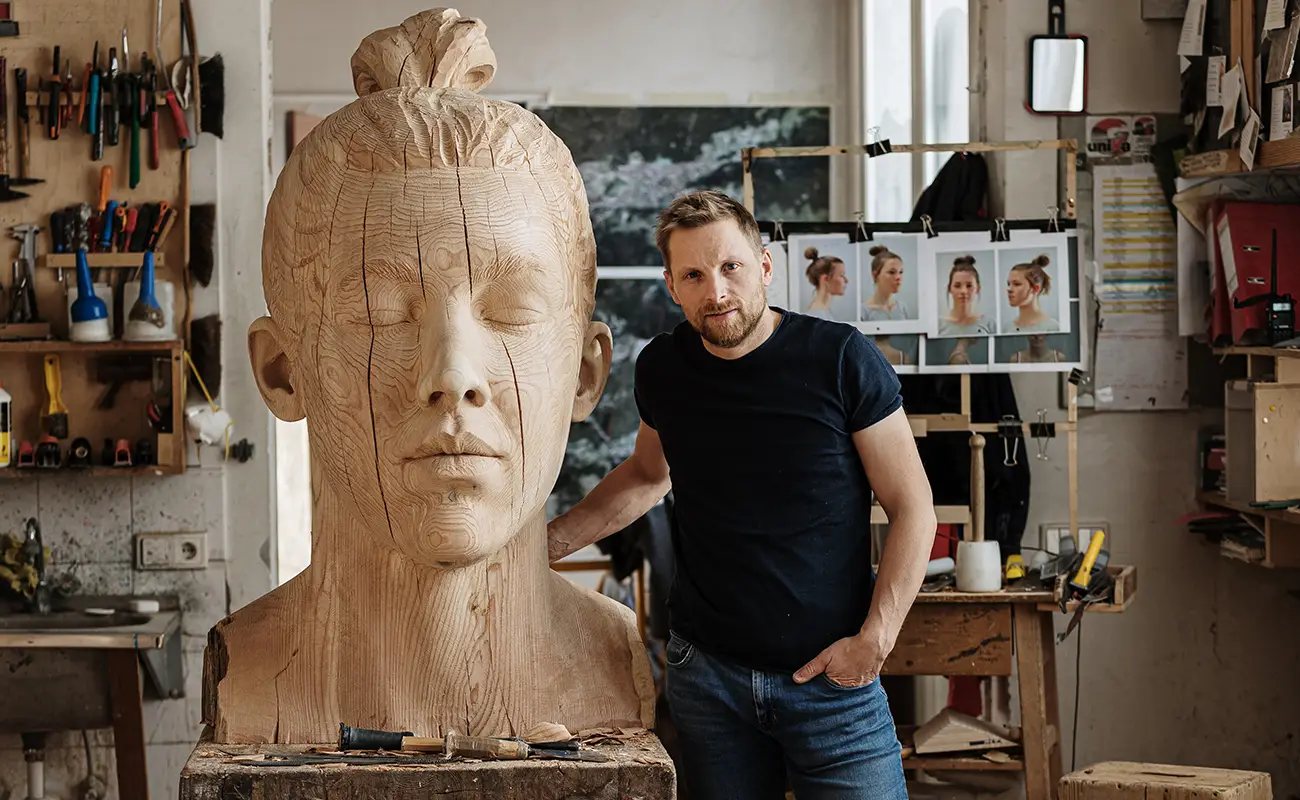
Selecting a single work as the most significant is, for Verginer, an ever-changing assessment. However, the large-scale head sculpture titled Voice from Deep holds particular importance within his body of work. Created in the context of the pandemic, it carries autobiographical weight, reflecting a period marked by introspection and decisive change. The sculpture embodies the act of listening inwardly, acknowledging internal prompts that urged him toward transformation. Looking back, Verginer recognizes this piece as a marker of personal and artistic honesty, capturing a moment when he chose to trust his inner impulses rather than established success.
Technically, Voice from Deep exemplifies a process that Verginer describes as straightforward for him, though it demands significant preparation. The work began with the construction of a large wooden block, layered with two colors of fabric embedded within. After this labor-intensive stage, he sculpted the head using a model, scaling the form to four times life size. The resulting presence is both imposing and intimate, combining physical mass with subtle emotional resonance. The embedded fabric lines cut through the surface, reinforcing the idea of internal voices pressing outward through material and form.
Verginer maintains a disciplined daily routine, working five full days a week and dedicating his weekends to family and leisure time, which he considers essential sources of inspiration. His professional calendar is shaped by exhibitions, gallery collaborations, and international art fairs, where his work is presented through the galleries that represent him. These include events such as Miami Art Week, Luxembourg Art Week, and Art Karlsruhe, with preparation often beginning months in advance. Alongside these commitments, he is currently developing new works for an exhibition scheduled in Montreal in September 2026. This ongoing cycle of creation, experimentation, success, and failure defines his practice. Through consistency and openness to change, Verginer continues to shape a sculptural language that remains grounded, responsive, and deeply personal.