
“It’s the beauty of simplicity that appeals to me. Less is more.”
Patterns as a Lifelong Language
Visual rhythm has shaped Marleen Hulst’s creative life long before she identified herself as an artist. Growing up in the Netherlands, she developed an early sensitivity to repeated motifs, surface decoration, and the subtle order hidden in everyday objects. This sensitivity did not emerge through formal art training but through observation, collection, and curiosity. Patterned paper, packaging, and napkins became treasured items, saved and reused in scrapbooks where repetition and variation could be studied intuitively. These early habits reveal how deeply pattern recognition is embedded in her way of seeing the world. Even today, that instinctive attraction continues to guide her work, anchoring it in familiarity while allowing space for experimentation.
Several years later, this fascination found a new outlet through zentangle drawing. Filling sketchbooks with intricate repeated lines, Hulst explored how simple marks could grow into complex visual structures. Although these drawings were based on existing designs rather than original inventions, they offered her long stretches of focused making and visual satisfaction. Over time, however, repetition alone was no longer enough. She began to feel the need for a more personal visual language, one that reflected her own sense of restraint, balance, and calm. That internal shift marked an important turning point, moving her away from imitation and toward authorship.
Today, Hulst balances her creative practice with a part time role in finance administration, an experience that quietly informs her artistic approach. Structure, order, and consistency play a significant role in both worlds; yet her art offers a softer, more intuitive counterpoint. Pattern making becomes a space where control and spontaneity coexist, allowing her to step away from rigid systems while still honoring clarity and logic. This duality gives her work its quiet confidence, positioning her within contemporary pattern art as someone who values simplicity not as limitation, but as possibility.
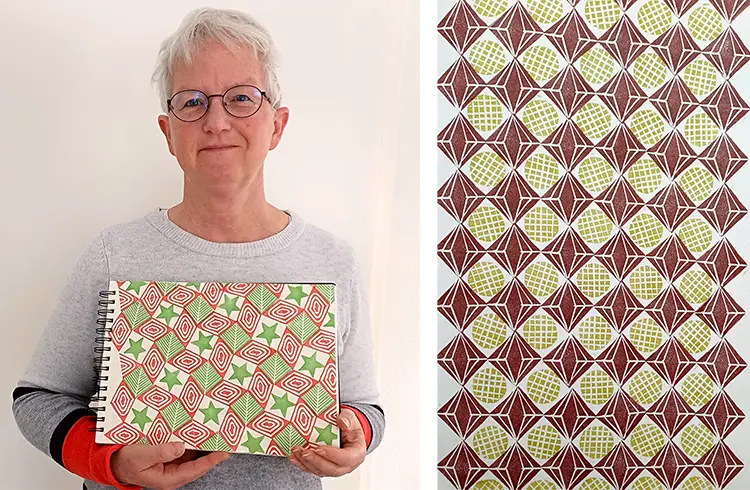
Marleen Hulst: Discovering Freedom Through Stamp Carving
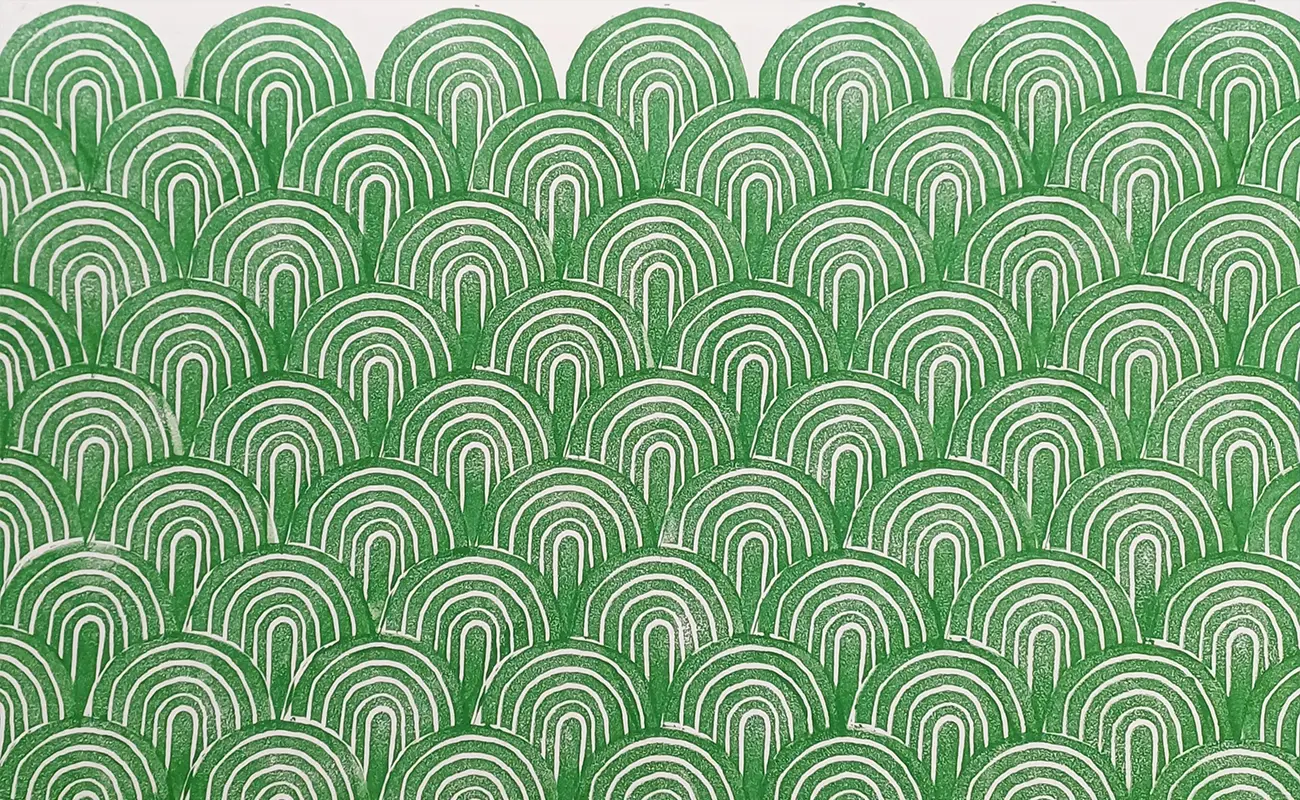
A defining moment in Hulst’s artistic development arrived in the summer of 2024 through an online video about carving stamps. The process immediately captured her attention, offering a tactile and accessible way to create patterns without unnecessary complexity. She began with basic geometric forms such as circles, squares, and rectangles, sometimes adding stripes or subtle variations in scale. These small stamps became her primary tools, proving that limited shapes could generate an endless range of visual outcomes. This discovery reinforced her belief that strong work does not require excess, but rather thoughtful repetition and balance.
Once she started printing, the process became almost irresistible. Armed with a modest sketchbook and a selection of ink pads, Hulst allowed intuition to guide her. Patterns emerged organically as she tested combinations, spacing, and color interactions. There was no pressure to plan or perfect each outcome. Instead, the act of printing itself became the focus, offering both calm and excitement. Through this hands-on approach, her visual identity became clearer. Clean compositions, rhythmic spacing, and a confident use of negative space now define her style.
Her exploration expanded further through handmade paper. After attending a paper making workshop, Hulst invested in her own mold and deckle, embracing the slow, physical nature of the process. Creating paper at home requires patience and attention, qualities that align naturally with her pattern work. Printing on sheets she produced herself added a deeper layer of meaning, merging material and image into a single expression. Alongside this, she began reusing brown shopping bags, appreciating their texture and occasional typography. These choices reflect a respect for materials and an interest in giving overlooked surfaces a renewed purpose.

Everyday Surfaces and Quiet Sources of Inspiration
Inspiration for Hulst’s work is grounded firmly in daily life. Rather than looking exclusively to galleries or formal art spaces, she notices patterns embedded in ordinary surroundings. Tea towels, shower curtains, cushions, clothing, and ceramic flower pots all offer visual prompts. These familiar objects demonstrate how pattern operates as both decoration and structure, shaping environments without demanding attention. By drawing from such sources, Hulst ensures her work remains approachable, rooted in shared visual experiences rather than distant concepts.
Museums also play a role, though often in subtle ways. A single piece glimpsed during a visit can spark an idea that lingers long after. Online platforms further expand her visual library. Browsing the internet and using Pinterest allows her to collect impressions rather than direct references. These images function as gentle triggers, encouraging new combinations and interpretations rather than imitation. The result is a practice that absorbs influence quietly, filtering it through personal intuition and restraint.
This approach supports her preference for working without rigid plans. When she sits down to create, usually once or twice a week, she allows the process to unfold naturally. Selecting one or two stamps and a color, she begins printing without overthinking. Patterns often seem to appear on their own, guided by subconscious decisions rather than deliberate strategy. This method preserves a sense of discovery and keeps the work from becoming mechanical. It also reinforces trust in her instincts, an essential element of her artistic confidence.

Marleen Hulst: Meaningful Milestones and Future Directions
Among the many patterns Hulst has created, one holds particular personal significance. Printed on handmade paper, the piece titled Summer Vibe occupies a place in her living room, framed and displayed on a table rather than hidden away. This work marked a major milestone when it was selected for a Billboard Showcase in central London in August 2025. Seeing her art presented beyond Instagram for the first time felt unreal, opening the door to further showcases and features. Despite these later opportunities, that initial experience remains especially meaningful, symbolizing a quiet breakthrough moment.
Naming her patterns is rare, which makes Summer Vibe stand out even more. The decision to title it reflects how deeply connected she feels to the piece and the moment it represents. It stands as proof that her understated practice can resonate far beyond its humble origins. Recognition did not alter her approach, but it did affirm the value of staying true to her instincts. The work continues to serve as a reminder that consistency and authenticity can gradually build visibility without compromising artistic integrity.
Looking ahead, Hulst is drawn to projects that extend her patterns into new forms. Greeting cards are a natural next step, especially given her personal connection to paper and card making. After her mother’s passing in 2025, she inherited a large collection of colored paper, cardstock, and envelopes. Her mother had always created cards by hand, and Hulst sees this project as a continuation of that tradition in her own visual language. Collage also attracts her interest, particularly the challenge of combining printed patterns with layered imagery. These future explorations reflect an artist who evolves gently, honoring memory, material, and the enduring appeal of simple forms.