
“Each work is the result of a prolonged confrontation between the body and the paint, between control and collapse.”
Painting as Confrontation and Becoming
The work of Marc Gonz stands as a powerful assertion that painting can be an act of physical endurance and existential inquiry rather than simple representation. His practice arises from an intense, almost combative engagement with the canvas, where surface becomes terrain and pigment becomes substance charged with memory. Instead of composing images that describe the visible world, he approaches painting as a site to be worked, pressed, scraped, and burdened with time. Each piece carries the imprint of sustained effort, revealing a process shaped by friction between intention and resistance. Over the years, his trajectory has moved steadily toward reduction and essence, refining gesture and material presence until painting itself becomes an embodiment of lived experience. In this context, the canvas is not a window but a field of action, where matter accumulates and erodes, and where the artist’s body enters into direct negotiation with color, density, and gravity.
This evolution did not originate in a sudden decision to become an artist, but rather in a gradual realization that painting offered a necessary outlet for internal tensions and physical memory. Creative identity emerged through repetition, through confrontation with uncertainty, and through the slow recognition that images were less important than processes. For Marc Gonz, painting became a space where the self could fracture, expand, and reconfigure. The act of working the surface allowed him to externalize emotional pressures and explore states of collapse and reconstruction. Over time, the emphasis shifted away from depicting recognizable scenes toward embracing transformation itself as the core subject. What matters is not what is shown, but what occurs between hand and material. This commitment has shaped both his artistic language and his way of inhabiting the world, grounding his practice in persistence, endurance, and a search for authenticity through matter.
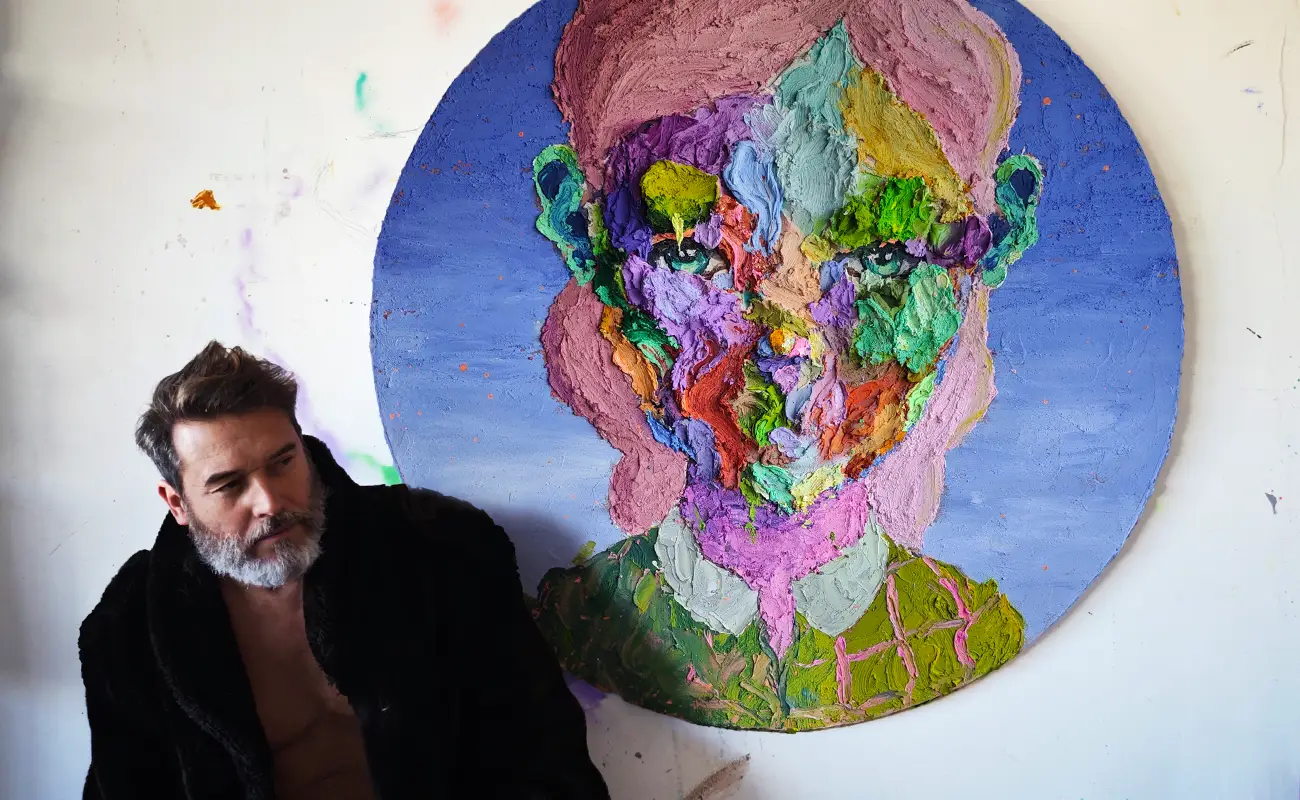
His current style is defined by a dense, sculptural use of oil paint, where impasto layers build organic and tectonic structures across the canvas. Color is not applied to illustrate form but to generate it, accumulating in thick strata that suggest geological pressure and bodily force. Themes such as fragmented identity, the tension between figure and environment, and the fragile balance between destruction and genesis recur throughout his work. The human face appears repeatedly, yet it resists psychological portraiture. Instead, it becomes an emotional landscape shaped by concealment and exposure. Through this material language, Marc Gonz aligns himself with a lineage of painters who understand art as physical presence rather than illusion. His canvases insist on weight, on texture, and on the undeniable fact that painting can still demand time, proximity, and sustained attention.

Marc Gonz: The Surface as Living Territory
To encounter a painting by Marc Gonz is to face a surface that seems to pulse with accumulated gestures. Layers of pigment rise from the canvas in heavy formations, suggesting that each work has been built through repeated acts of addition, compression, and revision. At first glance, the profusion of color may evoke spontaneous action, yet closer observation reveals a deliberate orchestration of weight and balance. Thick oil paint is mixed directly on the canvas, allowing hues to interact in real time and to solidify into textured reliefs. Brushstrokes and knife marks remain visible, affirming the physicality of the process. This approach extends the historical tradition of impasto, once used to heighten the illusion of volume in Baroque portraiture and later embraced by modern painters seeking emotional intensity. Marc Gonz reclaims this technique not to enhance realism, but to assert that paint itself can become structure, almost architectural in its presence.
The resulting works appear less like flat images and more like condensed remnants of an artistic struggle. Pigment gathers into protrusions that resemble organic growths, as though the canvas were generating matter from within. Such density transforms painting into something close to low relief sculpture, occupying space rather than merely covering it. Through this accumulation, Gonz challenges the boundary between two dimensional representation and physical objecthood. The surface becomes seismic territory where cracks, ridges, and folds record the passage of time and the pressure of the artist’s hand. Each layer speaks of negotiation between control and surrender, between shaping and allowing collapse. By insisting on material resistance, he restores gravity and tactility to contemporary painting, encouraging viewers to sense the weight of color and to recognize the embodied labor embedded in every inch of the canvas.

The Eye Beneath the Avalanche of Color
Among the most significant works in Marc Gonz’s practice are those in which a human face emerges almost entirely submerged under thick accumulations of oil paint, leaving only the gaze visible. In these paintings, he applies impasto directly and generously, blending pigments on the surface itself until facial features dissolve into vibrant masses. Noses, lips, and ears may be partially discernible, yet they are engulfed by cascades of color that resemble both celebration and obliteration. The eye, however, remains intact, piercing through the excess with quiet insistence. This minimal yet irreducible presence functions as a point of resistance within the composition. It suggests consciousness surviving beneath layers of concealment, a self that persists despite fragmentation. These works condense many of the tensions that define his artistic language, including the interplay between identity and mask, vulnerability and aggression, revelation and disguise.
The recurrence of youthful male faces, sometimes hinted at through titles that suggest origin or character, reinforces the theme of anonymity and projection. Covered in exuberant pigment that can evoke frosting or theatrical makeup, these figures oscillate between innocence and estrangement. The comparison to clowns or tragicomic performers is not incidental. Such characters historically embody the paradox of laughter and sorrow, spectacle and solitude. In Gonz’s paintings, the colorful burden that obscures the face reads as both protective camouflage and imposed weight. The solitary eye becomes a silent communicator, engaging the viewer in a subtle exchange that feels intimate and unsettling at once. This dynamic echoes his fascination with spiritual and oneiric atmospheres, as well as cinematic references where the uncanny coexists with tenderness. Through these buried faces, he invites viewers to confront their own impulse to look, to uncover, and to interpret.

Marc Gonz: Toward a Painting That Occupies Space
The daily rhythm of Marc Gonz’s studio practice is slow, physical, and cumulative. Works are constructed in successive layers, each allowed to settle, crack, or interact with what lies beneath before the next intervention occurs. He does not begin with a fixed image to reproduce; instead, he permits the material to dictate decisions, accepting accidents and resistance as generative forces. This approach transforms painting into a dialogue between intention and contingency. The body becomes an instrument that pushes, spreads, and compresses pigment, while the canvas responds with its own limitations and possibilities. Over time, this sustained engagement has reinforced his conviction that the process holds equal importance to the finished object. What remains visible on the surface is not only color and texture, but the memory of duration and repeated contact between hand and support.
Looking ahead, Marc Gonz seeks to intensify the relationship between painting and volume, expanding into larger formats where works can be experienced as environments rather than images. His ambition is to create pieces that demand physical proximity and temporal investment, resisting quick consumption. By amplifying scale and material presence, he aims to bring painting closer to sculptural territory, encouraging viewers to navigate around and before it. Such aspirations remain consistent with his broader commitment to density, resistance, and embodied perception. In an era dominated by rapid visual circulation, his work insists on slowness and on the necessity of sustained encounter. Through weight, texture, and the enduring gaze that peers from beneath layers of paint, Marc Gonz continues to affirm that painting can still challenge, unsettle, and endure.