
“Chicken Street embodies what I’m trying to do with all my work: eternalize stories and experiences in paint, creating visual records of identity that transcend geography and time.”
Between Origins and Horizons
Manaz Raiszadeh stands as a compelling voice in contemporary abstract painting, offering work that resonates through emotion, memory, and cultural complexity rather than literal depiction. Based in San Diego, she brings together multiple lived and inherited experiences into visual compositions that feel both personal and universal. Born and raised in Normandie, France to parents from Kabul, Afghanistan, her life has unfolded across geographies shaped by contrast, migration, and adaptation. These influences surface throughout her practice, not as direct narratives, but as layered impressions that speak to belonging, displacement, and self-definition. Her paintings communicate stories that language often struggles to contain, relying instead on color, movement, and texture to convey meaning. Within today’s art landscape, her work holds particular relevance for audiences seeking authenticity and emotional honesty rooted in real experience rather than trend or spectacle.
Her artistic voice is deeply informed by a multicultural upbringing that refuses simplification. A French visual sensitivity shaped by European art history coexists with the warmth, openness, and brightness she associates with life in California. Interwoven with both is the emotional intensity she attributes to her Afghan heritage, which fuels the expressive charge within her work. Rather than compartmentalizing these identities, she allows them to coexist and interact on the canvas. This dynamic tension becomes a driving force, allowing each painting to operate as a site of negotiation between past and present, inheritance and self-authorship. Through abstraction, she constructs spaces where these identities meet without hierarchy, offering viewers an entry point into experiences that mirror broader conversations about cultural hybridity.
The significance of Raiszadeh’s practice lies in its ability to transform deeply personal history into a shared visual language. Her paintings do not instruct or explain, yet they invite reflection through their openness and emotional accessibility. The sense of place embedded in her work extends beyond geography, addressing the internal landscapes shaped by migration, memory, and storytelling. Each composition suggests continuity rather than resolution, reflecting the ongoing nature of identity formation. By grounding her work in lived experience while maintaining abstraction, she creates paintings that remain fluid and expansive. This balance positions her as an artist whose work contributes meaningfully to contemporary discussions around identity, home, and the emotional architecture of belonging.

Manaz Raiszadeh: Intuition, Gesture, and the Language of the Surface
Raiszadeh’s path into art developed outside formal academic structures, guided instead by instinct and sustained curiosity. Identifying as a self-taught intuitionist abstract painter, she approaches each work without rigid planning, allowing emotion and physical engagement to lead the process. This openness fosters a direct relationship between the artist and the surface, where decisions emerge in response to what unfolds rather than predetermined outcomes. Her practice values presence and responsiveness, qualities that shape both the visual energy of her paintings and the authenticity they convey. The absence of formal constraints has enabled her to develop a distinctive language that prioritizes feeling over formula, resulting in work that feels immediate and alive.
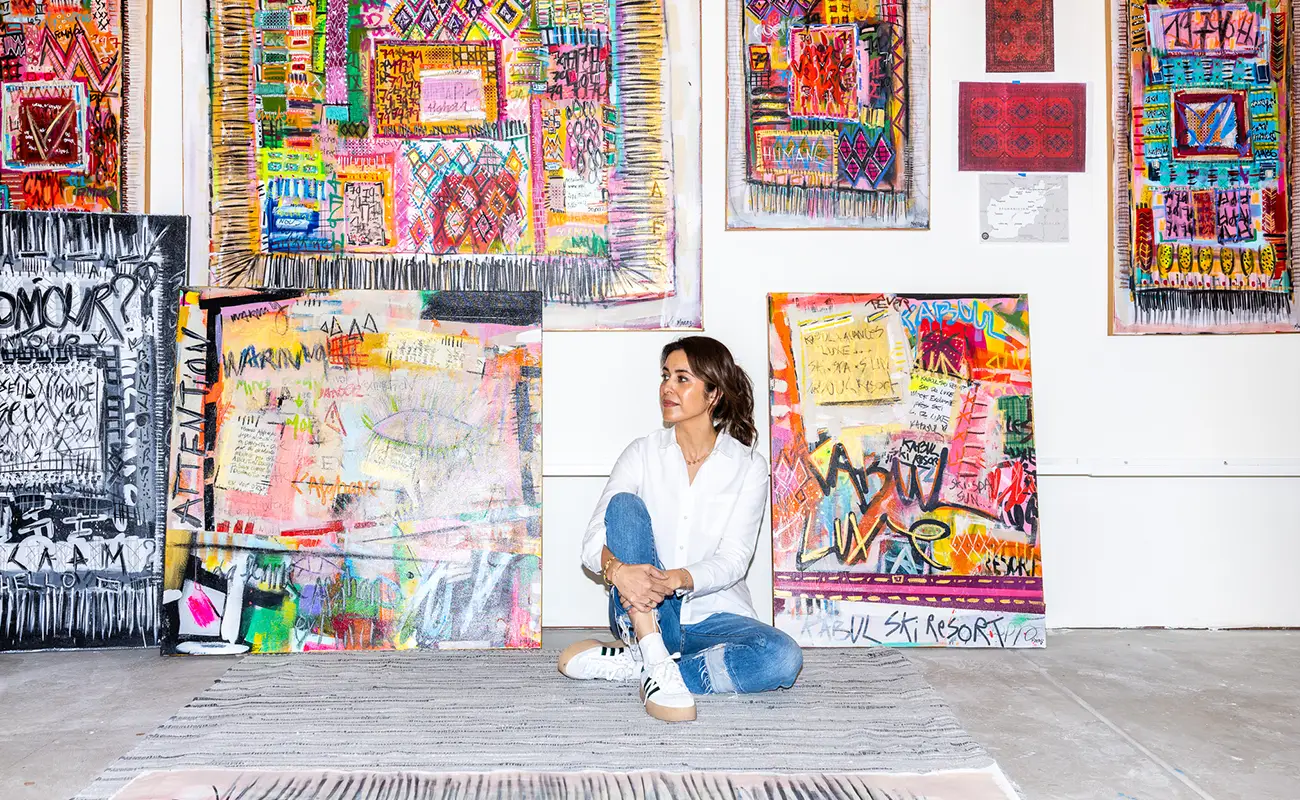
Visually, her style is marked by gestural, hand driven lettering forms, bold chromatic relationships, and layered compositions that suggest architectural depth. Influences from street art and urban environments are evident in the way surfaces appear scraped, built up, and reworked over time. Acrylic paint, oil pastels, paper collage, and mixed media interact to create density and texture, producing compositions that resemble abstracted cityscapes or weathered walls. These surfaces feel inhabited, carrying traces of revision and memory. Rather than aiming for polish, she allows imperfections and revisions to remain visible, reinforcing the idea that identity, like the city, is continuously shaped by experience and interaction.
At the core of this visual language lies a commitment to exploring cultural identity and the immigrant experience. Her paintings examine how stories are carried across generations and landscapes, and how heritage influences perception and belonging. The concept of home emerges not as a fixed location but as a layered construction shaped by memory, movement, and imagination. Through abstraction, she avoids singular narratives, offering instead a space where multiple histories can coexist. This approach allows viewers from varied backgrounds to find resonance within the work, connecting their own experiences of place and identity to the emotional cues embedded in each composition.

Inheritance, Influence, and the Weight of Lived Experience
The most profound influence on Raiszadeh’s work stems from her parents’ journey from Afghanistan to France, a story that shaped her understanding of history, loss, and resilience from an early age. Growing up in Normandie while hearing stories of Kabul created a dual awareness that continues to inform her visual thinking. These inherited narratives introduced her to places she had not physically inhabited, yet knew intimately through memory and storytelling. This tension between presence and absence surfaces repeatedly in her work, where imagined spaces carry as much weight as lived ones. The emotional residue of these stories becomes a source of creative energy, guiding her toward themes that extend beyond personal biography.
Alongside family history, urban environments play a critical role in shaping her aesthetic sensibility. City walls, layered with marks, repairs, and traces of time, offer a visual metaphor that parallels her approach to painting. She is drawn to how surfaces accumulate meaning through repetition and change, reflecting the ways identities evolve through experience. This influence is evident in her use of layered materials and text like gestures that suggest communication without literal language. The city becomes both subject and method, informing how she builds and revises each composition. These influences ground her abstraction in tangible experience, even when the imagery remains nonrepresentational.
Lived experience continues to shape her practice in deeply personal ways. Motherhood, spiritual reflection, and meditation inform not only her subject matter but also her working rhythm and mindset. Meditation supports access to an intuitive state where decision making feels fluid rather than forced. Immigration narratives and ongoing conversations around belonging remain present as thematic undercurrents, informing the emotional tone of her work. Rather than isolating these influences, she allows them to intersect organically, reinforcing her belief that art emerges most powerfully when personal truth and openness guide the process.

Manaz Raiszadeh: Eternalizing Memory Through Material and Meaning
Among Raiszadeh’s body of work, the painting titled Chicken Street from 2020 holds particular personal significance. Created using acrylic, collage, and pastels on canvas, the piece references a historic marketplace in Kabul known through her parents’ stories rather than her own direct experience. This distance between memory and imagination becomes central to the work’s meaning. The painting operates as a visual reconstruction of inherited history, honoring a place that exists vividly in narrative while remaining geographically distant. Through layered textures and architectural suggestions, the piece captures how memory is assembled through fragments rather than complete images.
The surface of Chicken Street reflects the process by which Raiszadeh has come to understand her Afghan heritage. Layers are built, obscured, and revealed, mirroring the way cultural knowledge is gathered over time through stories, emotions, and partial understandings. Architectural elements anchor the composition, referencing streets and structures that symbolize continuity and rootedness. These visual cues offer stability within abstraction, suggesting that place can remain influential even when experienced indirectly. The material choices reinforce this idea, allowing collage and pastel to interact with paint in ways that echo accumulation and preservation.
This painting embodies the broader intention behind Raiszadeh’s practice, which centers on preserving stories through visual means. She seeks to create lasting records of identity that transcend geography and temporal boundaries. Chicken Street occupies a deeply personal space, holding enough meaning that it remains in her home rather than circulating publicly. Its significance lies not only in what it represents, but in how it reflects her commitment to honoring heritage while transforming it into contemporary visual language. Through works like this, she positions painting as a bridge between generations, cultures, and lived experience, reinforcing art’s capacity to hold memory with care and resonance.