
Systems on the Brink: Structure, Repetition, and Material Strain
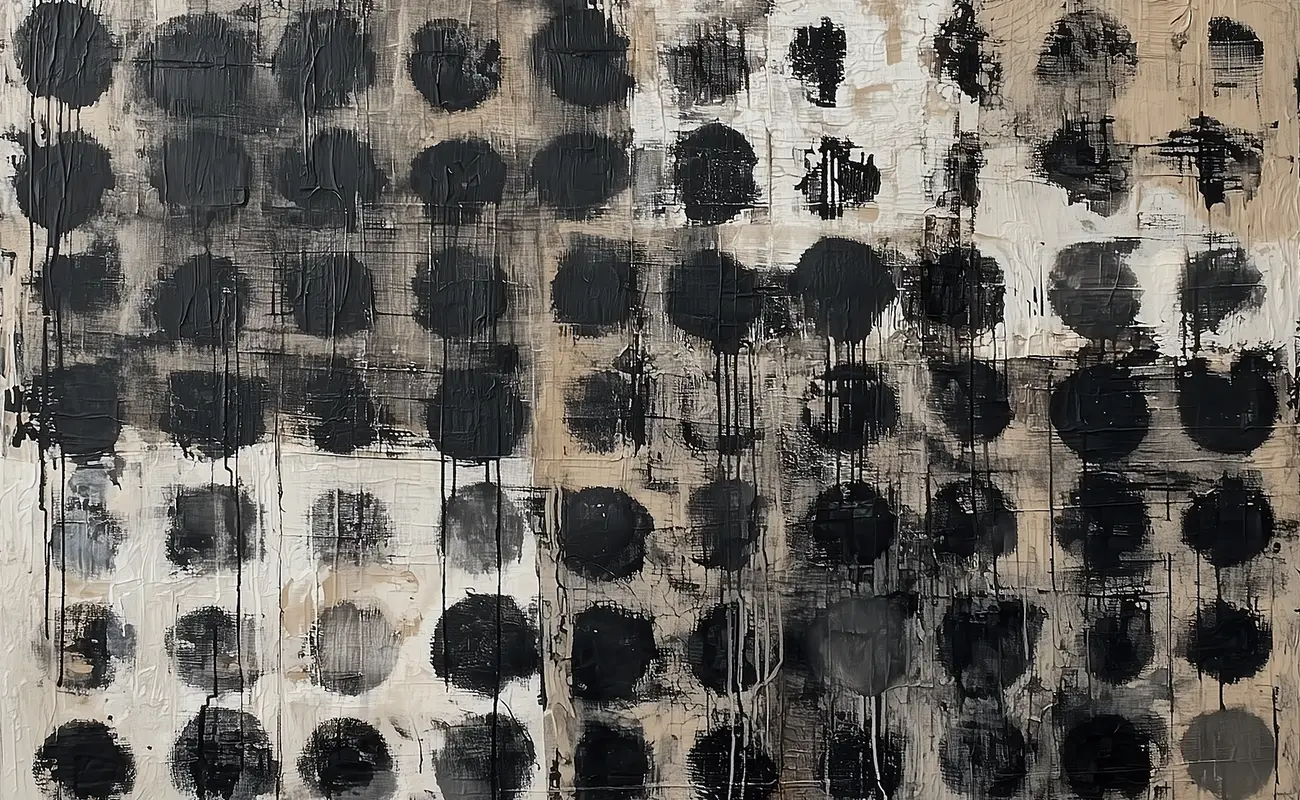
Within the current discourse of abstract painting, Maks Shevchenko positions himself at a charged intersection between geometry and dissolution. Working in acrylic, ink, and charcoal on unprimed canvas, he constructs ordered systems only to submit them to material instability. The grid of black circles, the regimented rows of X marks, and the recurring circular forms rendered in stark black and white all establish an initial sense of coherence. Yet this coherence is persistently undermined by drips, stains, abrasions, and sedimented layers of pigment. The unprimed surface absorbs and destabilizes each gesture, allowing paint to bleed and spread beyond intention. What begins as a declarative structure soon appears vulnerable, as if already compromised by the forces acting upon it. This tension between planning and collapse becomes the central visual drama.
Close observation reveals a deliberate orchestration of density and erosion. In the works dominated by polka dot configurations, black circles sit within a faintly gridded field, their edges imperfect and sometimes feathered by absorption. Vertical drips descend from many of these forms, stretching them downward into elongated trails that suggest gravity’s quiet insistence. In others, particularly the darker compositions, diagonal scratches and splintering white lines cut across the black surface, creating a dynamic counterpoint to the static circle. The textured ground, scraped and layered, bears the trace of repeated interventions. Paint is not applied for smoothness; it is dragged, pressed, and allowed to accumulate. These tactile decisions foreground process, making visible the friction between artist and material.
The X motif in the ochre and black canvas introduces a sharper, almost confrontational geometry. Here, the crosses are dispersed across a thickly built surface of warm pigment, their edges rough and slightly frayed. Long vertical drips intensify the sense of downward pull, as if the marks themselves are succumbing to gravity. The background, heavily worked and striated, records earlier layers beneath the visible plane. Order remains legible, but it is never pristine. Instead, it feels provisional. This quality aligns the series formally: every system is established with clarity and then placed under pressure. The viewer is invited to witness not a static composition but a field of forces where stability and breakdown coexist.

Maks Shevchenko: Entropy as Method and Philosophy
Shevchenko’s stated focus on entropy and systematic destruction finds clear articulation in these paintings. Rather than treating entropy as metaphor alone, he approaches it as procedural fact. The unprimed canvas is not merely a support but an active participant, absorbing pigment unpredictably and producing stains that exceed calculated edges. By setting up grids and repeated gestures, he creates conditions for visible failure. The circle dissolves at its perimeter, the X bleeds into surrounding space, and the grid buckles under accumulated layers. These outcomes are not decorative accidents but integral to the conceptual framework. Entropy here is not romanticized chaos but the inevitable transformation of ordered systems.
The historical references he acknowledges provide a meaningful framework for interpretation. The trembling grids of Agnes Martin resonate in the repeated circle patterns, though Shevchenko replaces Martin’s ethereal restraint with a heavier, more material presence. The gestural accumulation recalls Cy Twombly’s temporal inscriptions, yet the marks here are more architectonic, initially disciplined before they fracture. A structural logic akin to Sol LeWitt’s conceptual systems underpins the repeated motifs, but instead of delegating execution, Shevchenko allows the material to perform the deviation. An affinity with Anselm Kiefer appears in the emphasis on surface weight and physical presence. However, Shevchenko’s work remains distinct in its insistence on entropy as physical law rather than narrative allegory.
Crucially, the paintings do not illustrate entropy; they enact it. The viewer encounters the breakdown of control in real time, preserved within the layered surface. The black and white circular composition, with its thick halos and dripping white rings, demonstrates this vividly. Some circles appear almost obliterated by excess pigment, while others retain a fragile outline. The result is a visual record of competing impulses: containment and dispersal, repetition and erosion. The philosophical underpinning, grounded in the second law of thermodynamics, lends intellectual rigor. Yet the success of the work depends on whether this rigor translates into perceptible tension. In these pieces, the conceptual intention remains legible because the structural scaffolding is never fully erased.

Material Honesty and the Edge of Decoration
A key question raised by Shevchenko concerns whether the work risks becoming merely decorative. The repetition of circles and crosses carries inherent visual appeal; pattern invites aesthetic pleasure. However, the paintings resist pure ornament through their insistence on abrasion and irregularity. The surfaces are scarred, layered, and uneven. Drips are not cleaned or refined but allowed to accumulate. The chromatic restraint, primarily black, white, and earth tones, reinforces the seriousness of the inquiry. These choices prevent the motifs from settling into graphic simplicity. Instead, they hover between design and decay, forcing the viewer to confront instability rather than rhythm alone.
The success of this strategy is most evident in the darker, near monochrome composition intersected by diagonal lines. Here, the absence of overt pattern shifts focus to atmosphere and disruption. White splatters punctuate the black ground like distant points of light, while scratched lines cut through the field with a sense of urgency. The work feels less systematized and more volatile. This variation across the series strengthens the overall conceptual approach by demonstrating multiple modes of breakdown. Entropy is not confined to one visual language; it manifests differently depending on the system established at the outset.
Still, the challenge of restraint remains central. Because the process embraces layering and accumulation, the risk of overworking is inherent. In several pieces, the density approaches saturation, where the original grid becomes difficult to discern. While this aligns with the logic of collapse, it can reduce the perceptual tension that arises when structure is still partially visible. The most compelling works are those where the grid or motif remains perceptible yet undeniably compromised. In these moments, the viewer can trace the arc from order to disintegration. That trace is where the conceptual and formal dimensions converge most powerfully.

Maks Shevchenko: Positioning Entropy in Contemporary Abstraction
Within the broader field of contemporary abstraction, Shevchenko’s practice aligns with a renewed interest in material process and systemic critique. Many artists engage repetition and grid structures, yet fewer foreground the inevitability of breakdown with such explicit philosophical framing. By anchoring his approach in physical law rather than purely aesthetic exploration, he situates his work within a lineage of conceptually driven abstraction. The recent presentation at Espacio Gallery in London indicates that this language resonates within institutional contexts attuned to process-based painting.
Market relevance often hinges on recognizability, and Shevchenko’s recurring motifs provide a cohesive visual identity. The circle, the X, the grid, these elements function as signatures while remaining flexible enough to sustain variation. The restrained palette enhances coherence across the body of work, allowing collectors and curators to perceive a sustained investigation rather than isolated experiments. At the same time, the emphasis on entropy differentiates the practice from purely formalist abstraction. The works carry intellectual weight that extends beyond surface appeal, positioning them within conversations about instability, systems theory, and material truth.
Ultimately, the tension between control and chaos is clearly legible in these paintings. The unprimed canvas, with its absorptive unpredictability, contributes significantly to the conceptual framework rather than detracting from it. Material behavior becomes evidence of the argument. The physical process carries sufficient gravity to support the philosophical premise because it is visible, insistent, and unresolved. Shevchenko succeeds in presenting entropy not as spectacle but as condition. The viewer stands before structures that are failing yet still standing, caught in the precise moment when order has not vanished but can no longer sustain itself.