
“The work matters because it holds time within it. It carries who I was then and who I am now, and allows both to exist without contradiction.”
A Practice Shaped by Movement, Absence, and Return
Lize Krüger stands as an artist whose work resists easy categorization, shaped by a life marked by transition, interruption, and quiet persistence. Working primarily with digital collage and mixed media, she brings together formal fine art training with years spent living beyond institutional art spaces. This distance from continuous practice was not an absence of creativity, but a period in which lived experience accumulated depth and urgency. Having moved across countries and cultures, Krüger developed an acute awareness of dislocation, loss, and the slow process of finding ground again. These experiences inform her work not as narrative illustration, but as emotional infrastructure. Her images feel lived in, as though shaped by time rather than urgency. Within the contemporary art landscape, her practice occupies a space that values restraint, emotional clarity, and ethical attention to subject matter. Rather than chasing novelty, her work emphasizes continuity, returning repeatedly to questions of memory, endurance, and shared human vulnerability.
The foundations of Krüger’s practice rest on a belief that personal history can open pathways toward collective recognition. Her background includes rigorous fine art training, yet she speaks just as strongly to the knowledge gained through motherhood, migration, and extended periods away from professional artmaking. This combination produces work that is technically assured but never detached. Her images suggest that identity is layered, shaped by what is carried forward and what is left unresolved. Living in different cultural contexts sharpened her sensitivity to how belonging can feel provisional, and how the body itself becomes a site where these tensions are stored. Rather than presenting these ideas through overt symbolism, Krüger allows them to surface gradually through form, texture, and repetition. The resulting works communicate quietly, asking viewers to slow down and remain present. Her art becomes a space where the private and the shared meet without hierarchy, offering recognition rather than explanation.
Returning to practice after a long pause marked a significant shift in Krüger’s intentions as an artist. Earlier stages of her career included training and exhibition, yet life’s demands redirected her focus for many years. When she resumed making work, aesthetic resolution alone no longer felt sufficient. The urgency had changed, shaped by loss and survival rather than ambition. This return brought a deeper commitment to meaning, where each image needed to justify its existence emotionally and ethically. Her background, therefore, is not a linear progression but a series of interruptions that sharpened her clarity. The works that emerge from this process feel considered and patient, refusing spectacle while remaining emotionally resonant. In this way, her practice reflects a broader understanding of creativity as something that can pause, transform, and reemerge with renewed purpose.

Layered Symbolism and the Language of the Body
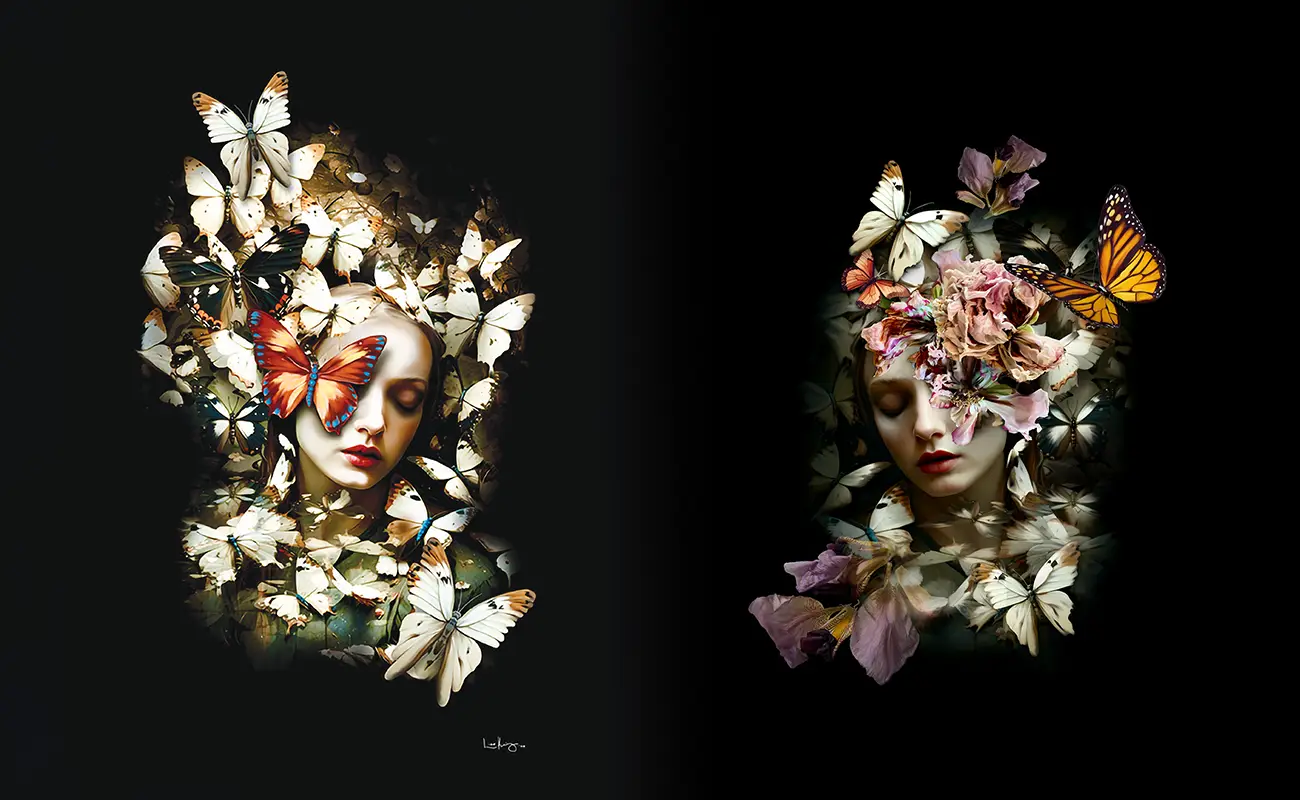
Krüger’s visual language is defined by density, translucence, and a symbolic structure that unfolds through accumulation rather than declaration. Her digital collages and mixed media works often position the human figure at the center, yet these figures are never isolated. Faces and bodies appear partially obscured, merged with botanical forms, birds, lace, cartographic lines, and painterly marks. These elements inhabit the figure rather than surrounding it, suggesting that memory, history, and grief are internalized states. The imagery moves between clarity and fragmentation, allowing forms to surface and recede in ways that echo recollection itself. Darkness plays a foundational role, functioning as a generative field from which light and form gradually emerge. Through this approach, Krüger creates images that feel remembered rather than observed, shaped by emotional truth instead of visual certainty.
Color and texture carry significant expressive weight within her practice. Muted earth tones often dominate, interrupted by visceral reds that signal rupture, tenderness, or emotional exposure. These chromatic shifts reinforce the tension that runs through her work, balancing care and fracture without privileging either. Layers accumulate with intention, resembling sediment rather than decoration. Photographic realism is softened through erosion, while sharp contrasts are filtered through translucent veils. This visual strategy mirrors the way experiences are carried within the body, altered over time but never erased. Botanical motifs suggest cycles of growth and decay, while birds and skeletal references point toward fragility and transition. Domestic and archival materials such as lace, maps, and text fragments introduce questions of inheritance, displacement, and belonging. None of these symbols offer fixed meanings, remaining open to interpretation and emotional entry.
What ultimately distinguishes Krüger’s style is her ethical restraint. Even when addressing profound grief and psychic rupture, her work avoids excess or theatricality. Pain is present, yet it is held with care, contained within compositions that feel deliberate and attentive. This restraint creates space for the viewer, allowing recognition to arise without coercion. Her images do not demand empathy; they offer it as a possibility. By refusing to sensationalize suffering, Krüger transforms deeply personal material into a shared visual language. Vulnerability becomes a site of endurance rather than collapse, and stillness becomes an active force. Through this balance, her work functions as a form of visual witnessing, giving shape and duration to experiences that resist resolution.

Influence, Silence, and the Weight of Lived Experience
The most profound influence on Krüger’s work is lived experience itself. Motherhood, love, loss, and the quiet moments that reshape a life form the emotional core of her practice. These influences are not illustrated directly, but they inform the tone and structure of her images. She approaches artmaking as a process of holding space for what cannot be easily articulated. Among artistic influences, the South African artist Judith Mason left a lasting impression, particularly through her ability to balance tenderness and brutality within a single frame. Mason’s ethical approach to history and the female body resonated deeply with Krüger, shaping her understanding of responsibility in image making. This influence is evident in Krüger’s refusal of spectacle and her commitment to emotional honesty.
Silence also plays a crucial role in shaping her work. Not silence as absence, but silence as a presence that carries weight and meaning. Krüger is attentive to what remains unspoken, to the spaces between images and gestures. This sensitivity allows her work to breathe, offering viewers room to bring their own experiences into the encounter. Rather than closing down interpretation, her compositions remain porous, inviting slow engagement. Life outside the studio continues to inform her choices, reinforcing the idea that art is not separate from living but deeply entwined with it. Each piece becomes a site where accumulated experiences are held in balance, neither resolved nor abandoned.
Her influences extend beyond individuals to the broader conditions of being human. Experiences of displacement, re-rooting, and endurance shape how she understands form and content. Having lived across different cultural contexts, she recognizes how identity is shaped by movement and interruption. These insights translate into works that resist fixed narratives, favoring instead a sense of ongoing negotiation. The body becomes both archive and witness, carrying histories that exceed language. Through this approach, Krüger positions her work within a lineage of artists who prioritize ethical engagement over declaration, allowing complexity to remain intact.

Holding Time Through Medium and Process
One of the most significant works in Krüger’s practice is THE FRAGILITY OF THE HUMAN PSYCHE, a piece that embodies her relationship to time, medium, and memory. The work began as a large-scale oil painting created shortly after the passing of her son. For seventeen years, the painting remained unchanged, carrying an emotional weight she was not ready to confront or transform. It functioned as a vessel, holding grief during a period when direct engagement felt impossible. In 2025, Krüger returned to the work through digital exportation and layering. This decision was not about replacing the original, but about extending its life and meaning. The shift allowed her to introduce repetition, transparency, and new visual elements, opening the work into a broader conversation about fragility, endurance, and remembrance.
The transition from oil to digital media mirrors a change in perspective, moving from raw survival toward reflection. Digital processes offered a way to engage with the original without erasing its history, allowing multiple temporal states to coexist. The work now holds who she was at the time of its creation and who she has become since, without forcing reconciliation. This approach reflects Krüger’s broader philosophy, where contradiction is allowed to remain visible. THE FRAGILITY OF THE HUMAN PSYCHE matters because it contains time within its structure, demonstrating how art can serve as a living archive. It stands as an example of how medium can expand meaning rather than limit it, reinforcing her belief in art as an evolving conversation.
Her day-to-day practice reflects this same attentiveness. Although she works digitally, Krüger approaches each piece as if constructing it by hand, spending time researching, gathering fragments, and allowing ideas to settle before taking form. Intuition guides the process, balanced by reflection and patience. Looking ahead, she expresses a desire to reintroduce more traditional media into her work, continuing to expand her material vocabulary. This openness to change underscores a practice rooted in responsiveness rather than certainty. Through careful process and ethical consideration, Krüger continues to build a body of work that honors memory, resilience, and the complexity of human experience.