
Between Stillness and Motion
Kostas Papakostas occupies a distinctive position within contemporary art through a practice that moves fluidly between painting and video, balancing opposing states of stillness and motion with unusual clarity. Born in Athens and based in London, he has developed a multidisciplinary language that reflects both the intensity of urban life and a sustained attentiveness to quieter, often overlooked moments. His work is rooted in observation and presence rather than spectacle, inviting viewers to slow down and encounter subtle shifts in energy, rhythm, and perception. Whether working with moving images or large-scale paintings, Papakostas is consistently concerned with time, impermanence, and the fragile balance between intention and release. These concerns situate his practice within a broader conversation about the human condition, while remaining deeply personal and process-driven. Through international exhibitions and inclusion in private and corporate collections, his work has reached audiences across Europe, Asia, and the United States, establishing a global dialogue around abstraction, intuition, and lived experience.
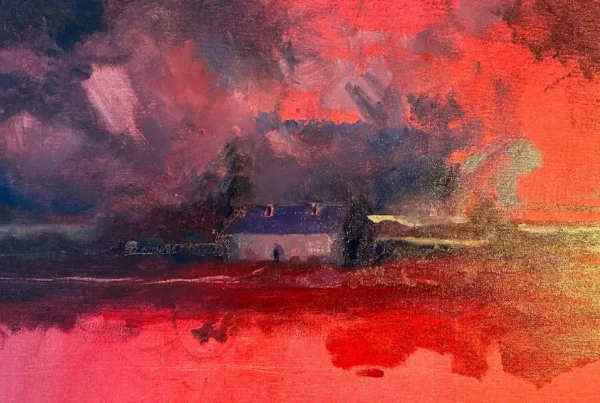
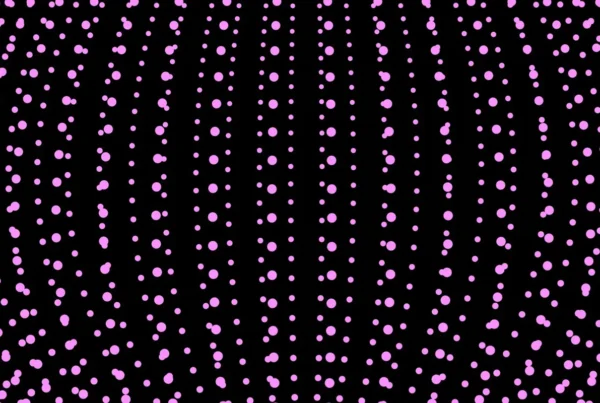
The duality within Papakostas’ practice becomes particularly evident when comparing his video work to his paintings. His videos are static, restrained, and observational, often directed outward toward the world rather than inward toward personal narrative. They focus on ordinary scenes, natural phenomena, or extended moments that might otherwise pass unnoticed, gradually transforming the everyday into something meditative. Time is allowed to unfold without interruption, encouraging contemplation rather than consumption. In contrast, his paintings emerge from a highly physical and emotionally charged process. They are not composed through planning or preliminary sketches, but through direct engagement with the surface, the body, and the present moment. This contrast is not a contradiction but a deliberate tension, one that mirrors the oscillation between control and surrender that runs throughout his work. Together, these approaches reveal an artist deeply invested in how meaning arises through attention, restraint, and embodied action.
Papakostas’ international profile reflects the adaptability and resonance of this approach across different cultural contexts. His work has been presented at major art fairs including Art Miami with HOFA Gallery, ART021 Shanghai, Art Central Hong Kong, and Contemporary Istanbul, as well as in commercial galleries throughout Europe and Asia. Solo exhibitions such as “In Flux” at Hang Up Gallery in London in 2025 and presentations in Seoul including “Secrets of the Sea” and “One Stroke” have further defined his artistic trajectory. Beyond gallery spaces, his paintings have been commissioned for architectural and hospitality environments, including Aston Martin Headquarters in the UK, Four Seasons Hotels in London, The Palazzo in Las Vegas, and Hilton Arlington. These placements highlight the ability of his work to operate across contexts while maintaining conceptual integrity, offering viewers moments of reflection within spaces often defined by speed, luxury, or function.

Kostas Papakostas: The Body as Instrument
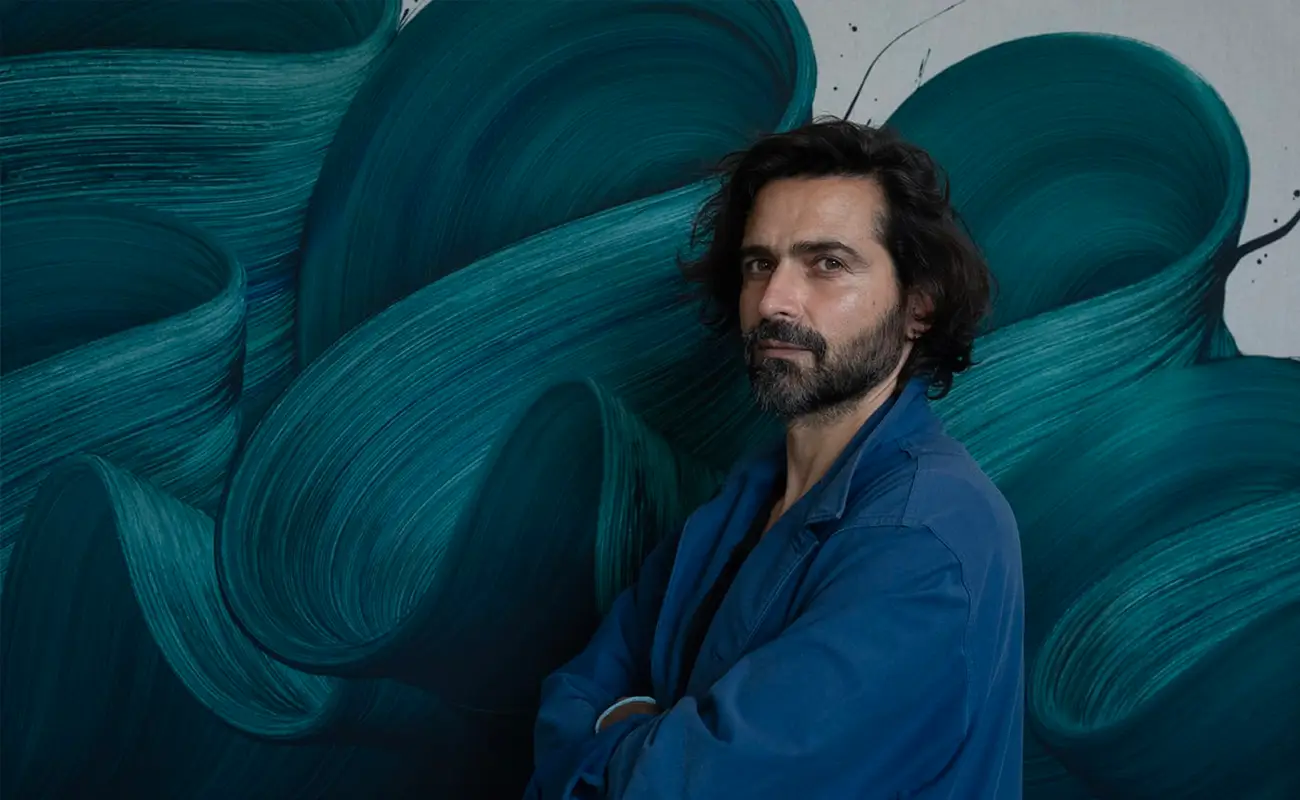
At the core of Kostas Papakostas’ painting practice lies a commitment to physical engagement and intuitive decision-making. He enters the studio without predetermined outcomes, allowing awareness and emotion to guide the work as it unfolds. The canvas is placed on the floor, transforming painting into a full-bodied act that involves circling, leaning, stepping back, and bending close to the surface. This proximity fosters an intimate relationship between artist and material, where distance and hierarchy dissolve. Each painting is constructed through a series of singular gestures, executed one brushstroke at a time from beginning to end. There are no corrections, no layering, and no revisions. If a stroke fails to carry the necessary clarity or energy, it is removed entirely, and the process begins again. This discipline demands patience, restraint, and a willingness to accept loss as part of creation.
Central to this method is an acute sensitivity to timing and breath. Papakostas waits for moments when physical readiness, emotional alignment, and intention converge, allowing the gesture to occur with precision and honesty. The resulting brushstrokes function as records of these fleeting alignments, capturing a specific instant that cannot be replicated. One of the most significant developments in this process emerged during a period of grief while attending an artist residency. Without a clear direction, he began working with black ink and industrial paper rolls, producing continuous sweeping marks as the paper unspooled. The action became meditative, prioritizing movement over outcome. Within weeks, this approach culminated in a single work stretching over a mile in length, a raw and unfiltered exploration of endurance, repetition, and emotional release. This piece marked a turning point, revealing how even the slightest variation within a line could carry profound emotional weight.
Rather than attempting to communicate a fixed message or narrative, Papakostas approaches painting as an exercise in presence. He seeks moments when the work can move beyond his conscious control and assert its own direction. This relinquishing of authority is not passive but deeply attentive, requiring him to listen closely to what the painting suggests at each stage. Chance plays an active role here, not as randomness but as responsiveness. Accidents and deviations are treated as opportunities for discovery, often revealing aspects of the work that could not have been planned. Through this balance of discipline and openness, Papakostas frames painting as a dialogue rather than a declaration. The finished works stand as traces of intuitive choreography, embodying movement, tension, and flow while resisting closure or resolution.

Monochrome, Memory, and the Passage of Time
A restrained use of color is a defining feature of Papakostas’ paintings, with monochrome palettes serving as a means of sharpening focus rather than limiting expression. By reducing chromatic complexity, he allows movement, texture, and spatial tension to come to the forefront. Gesture becomes the primary carrier of meaning, while subtle tonal variations create depth and resonance within the surface. Colors are selected in advance, minimizing decision-making during the act of painting and enabling full immersion in the physical process. Often, multiple tones are mixed directly on the canvas, allowing the brush to carry both pigment and motion in a single, continuous act. This approach emphasizes immediacy and responsiveness, reinforcing the sense that each mark exists in direct relation to the one before it.
Thematically, Papakostas returns repeatedly to ideas of flow, transformation, impermanence, and the passage of time. These themes are informed by both personal experience and broader social conditions, reflecting an awareness of instability and transition on multiple levels. Living in London, a city defined by constant change, provides a daily reminder of motion and uncertainty. At the same time, extended periods spent in nature, often by the sea, offer a contrasting rhythm that informs his sensitivity to cycles, erosion, and renewal. Inspiration also emerges from memory, social shifts, and the accumulation of lived moments, all of which subtly shape how he responds to the surface. His paintings do not attempt to fix these experiences in place, but instead acknowledge their transient nature, allowing them to surface briefly before moving on.
Influences from outside the visual arts further enrich this sensibility. Papakostas has spoken of the lasting impact of poets and writers such as Rainer Maria Rilke, Hermann Hesse, Kahlil Gibran, and T.S. Eliot, whose reflections on inner life and transformation resonate with his own concerns. Music also plays a vital role in shaping rhythm and atmosphere within the studio. Minimalist composers like Philip Glass and Steve Reich, alongside Max Richter and Nils Frahm, provide structures that echo repetition and gradual variation, while shifts between genres mirror the fluidity of his working process. Within the visual arts, the meditative pacing of Bill Viola and the elevation of the everyday found in Martin Parr’s work have offered important reference points. These influences converge not as direct quotations, but as parallel explorations of time, attention, and human vulnerability.

Kostas Papakostas: Practice, Place, and Ongoing Evolution
Papakostas’ artistic path is shaped by a combination of formal training and professional experience beyond the studio. He graduated with First Class Honours in Art and Design from Hull School of Art and Design in 2000, before spending many years working as an art director in London. During this period, he developed and led global campaigns for major brands including Sony PlayStation, Apple, MTV, and Christian Dior. The fast-paced demands of this industry sharpened his visual instincts and conceptual clarity, but by 2018 he felt compelled to pursue a more personal and introspective mode of expression. This return to fine art marked an important shift, allowing him to reorient his creative energy toward processes that prioritized authenticity over outcome. The discipline and awareness cultivated during his design career continue to inform his studio practice, particularly in his sensitivity to composition, rhythm, and restraint.
Residencies and sustained studio routines have played a crucial role in refining his approach. Experiences at Studio Kura in Japan and AIR Bali offered environments conducive to reflection and experimentation, reinforcing the importance of focus and repetition. In his London studio, Papakostas maintains a steady rhythm that balances practical responsibilities with periods of quiet observation. Mornings often begin with administrative tasks, followed by walks along the nearby canal or time spent reading and writing. Gradually, he engages with works in progress, allowing space for the mental and physical conditions necessary for painting to emerge. Music helps establish tempo, while custom-made brushes and a distraction-free environment support concentration. The challenge, as he describes it, lies in remaining fully present while also stepping aside, creating conditions where the work can unfold on its own terms.
In recent years, Papakostas has observed a deepening relationship with his practice, marked by greater trust in process and an expanding sense of dialogue between action and outcome. His paintings have become extensions of how he perceives the world, reflecting both personal growth and an ongoing openness to change. Studio walls filled with test works, experiments, and gathered objects attest to a sustained curiosity and a refusal to finalize ideas prematurely. Looking ahead, following the strong response to his recent London solo exhibition, he has taken time in nature to restore balance before beginning a new body of work and exploring future collaborations. This forward momentum underscores a commitment to continued evolution, ensuring that his practice remains responsive, questioning, and alive to the uncertainties that first drew him to paint.