

“I love the freedom of expressionist works where I can paint whatever I feel and just get lost in the process.”
From Clay to Canvas: A Journey Through Unconventional Pathways
Kate Hessling, an Australian abstract expressionist painter, has carved a distinctive space in contemporary art through a fusion of scientific precision and raw, emotive spontaneity. Living in a semi-rural part of Brisbane, surrounded by native flora and wildlife, Hessling draws energy and inspiration from the natural world without becoming beholden to its literal forms. Her creative upbringing, filled with familial explorations in writing, sculpture, painting, and hands-on crafting, planted the seeds for an imaginative practice that would later blossom in unexpected directions. Though none of these pursuits were professional, their omnipresence in her formative years provided a fertile backdrop for her evolution into a serious artist. Hessling’s works are not born of formal art school traditions but of lived experience, persistent exploration, and a refusal to conform to artistic orthodoxy.
Before committing to painting, Hessling’s creative path took her through various tactile and visual mediums. She experimented with clay hand-building, embracing imperfections and asymmetry, and later delved into the luminous fragility of glass fusing. These early forays were more than technical exercises; they reflected a deep-seated resistance to perfection and an affinity for the organic, the slightly off-kilter. Her transition to painting was initially rooted in abstracted watercolor landscapes, a gentle entry point that soon gave way to the bolder, more emotionally charged language of acrylic-based abstract expressionism. Today, while her focus remains in this expressive mode, she occasionally revisits landscape and pattern-based works, allowing older threads of her creativity to resurface with new context and vigor.
The progression from structured scientific thinking to freeform visual improvisation is central to Hessling’s artistic identity. With a background in science and technology, her early professional life was guided by logic, systems, and concrete outcomes. Yet, even within those confines, she found herself offering imaginative solutions that didn’t always follow linear expectations. This duality—rigor paired with rebellion—now underpins her creative process. Her paintings demonstrate an instinctive fluency, a fluidity of gesture and feeling, but also a compositional awareness that reflects the problem-solving discipline of her earlier career. Rather than contradicting each other, these influences coexist in her work, forming a uniquely resonant balance between intuition and structure.

Kate Hessling: Emotion in Every Stroke, Freedom in Every Choice
At the heart of Hessling’s practice lies a deep commitment to emotional authenticity. Her process begins not with a plan but with a feeling, a mood that sets the tone for the work’s evolution. Whether quiet and introspective or lively and effervescent, her internal state shapes the direction of the painting before a single stroke is made. Color plays an immediate and fluid role in this intuitive flow, often being mixed directly on the canvas rather than in a palette. This improvisational technique ensures that the artwork grows organically, with unexpected shifts and emotional pivots woven into its very fabric. Hessling resists the constraints of predetermined composition, allowing the work to unfold as a visual reflection of her present emotional terrain.
She rarely uses reference images, except perhaps as a distant starting point for palette ideas or loose compositional anchors. Once immersed in the act of painting, Hessling lets go of external guides entirely. The canvas becomes a space of immersion, where thought gives way to instinct and each mark is a response to the last. Some pieces emerge with greater structure and clarity, while others embody pure gestural release. Both extremes coexist within her broader body of work, offering a spectrum of energies from meditative restraint to vibrant abandon. What remains constant is her commitment to staying true to the act of feeling through the brush, rather than following visual conventions or expectations.
Her preference for imperfection extends across all mediums she has explored. Even in her earlier clay and glass pieces, symmetry was never the goal. Instead, she gravitated toward work that felt irregular, slightly off-center, and more expressive for it. This resistance to the polished or overly refined reveals an ethos that values the genuine over the ideal. In embracing the unfinished and the raw, Hessling positions her art as a mirror to human emotion in all its fluctuating, unpredictable beauty. Each painting becomes less a depiction and more an emotional landscape—one that invites viewers not to decode but to feel.

Spontaneity as Structure: Creating in the Moment
Hessling’s painting process is guided by instinct, not instruction. Her studio, set within a natural Australian setting, is as much a place of contemplation as it is of creation. Rather than adhering to a fixed schedule or daily routine, she allows external factors—like the weather or her mood—to dictate her artistic rhythm. The semi-tropical climate of Brisbane adds another layer of natural unpredictability to her already spontaneous practice. Time spent painting is only part of the creative equation; administrative tasks like photographing artwork, editing images, and managing online portfolios and social media platforms also consume significant attention.
Despite these logistical demands, Hessling continues to evolve her practice. She envisions upcoming series that lean even more heavily into bold expressionist techniques, where emotion drives both content and form. Simultaneously, she’s drawn to revisiting abstracted interpretations of the Australian outback, captivated by its distinctive palette of reds, ochres, and olive greens. These color stories hold a particular resonance for her, echoing the earthy, sun-drenched tones of her surroundings. They also present an opportunity to bridge the external with the internal—to translate a physical landscape into an emotional topography, layered through color, gesture, and improvisation.
This blending of external inspiration and internal emotion is especially evident in how Hessling allows each piece to evolve in real time. She begins with gestures—sometimes scribbles, sometimes deliberate strokes—and lets the work find its form through continued engagement. There is no commitment to symmetry or realism; instead, Hessling welcomes the emergence of ambiguity and the fluidity of interpretation. She regards her works not as final statements but as open invitations for reflection. In this way, every canvas becomes a collaboration between artist, environment, and viewer—a space where nothing is fixed and everything is alive with possibility.

Kate Hessling: Painting the Interior Landscape
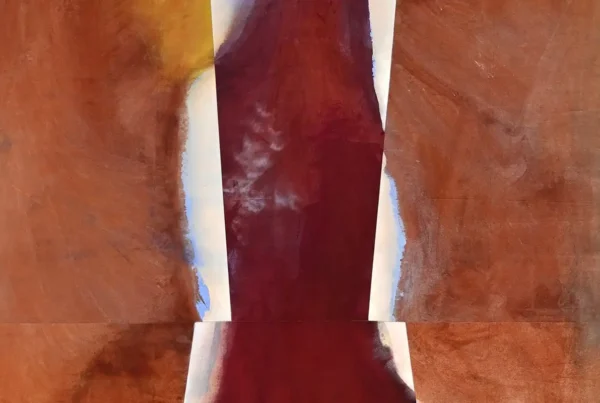
Among Hessling’s recent works, Topography of a Mindscape stands out as a vivid encapsulation of her artistic philosophy. It began with instinctive marks—colored scribbles on a large, unstretched canvas. Without a defined subject in mind, the piece gradually morphed into something evocative of natural forms: hills, valleys, lakes, rivers, and open plains. Despite these suggestions of terrain, the painting remains entirely abstract. What distinguishes it is not its adherence to visual realism but the way it conjures a sense of spatial memory and psychological mapping. For Hessling, the work’s abstracted geography serves as a metaphor for mental exploration, hence the title. It is a visual representation of thought, mood, and imagination converging in a single expressive act.
The piece deviates slightly from her typical style in its peculiar and slightly jagged construction, characteristics that Hessling finds particularly appealing. These distortions—irregular shapes, uneven rhythms, unexpected color transitions—create a charged energy that resonates on a personal level. The painting feels simultaneously familiar and disorienting, structured yet free-floating. This tension speaks to the complexity of emotional and cognitive experience, and the way abstract art can give form to sensations that resist verbal expression. In Hessling’s view, works like this achieve a kind of emotional honesty that more representational pieces often cannot reach. They offer an interior truth rather than an external likeness.
Topography of a Mindscape also exemplifies Hessling’s belief in the power of open interpretation. Viewers bring their own perspectives, memories, and emotions to the piece, and what they see may change depending on their mood or moment in life. This mutable quality is, for her, one of abstract art’s greatest strengths. It refuses to impose a single narrative and instead invites countless ones. Through this piece, and through her wider practice, Hessling affirms that abstract expressionism is not about escaping reality but about engaging it more deeply—through intuition, emotion, and the infinite landscape of the mind.