
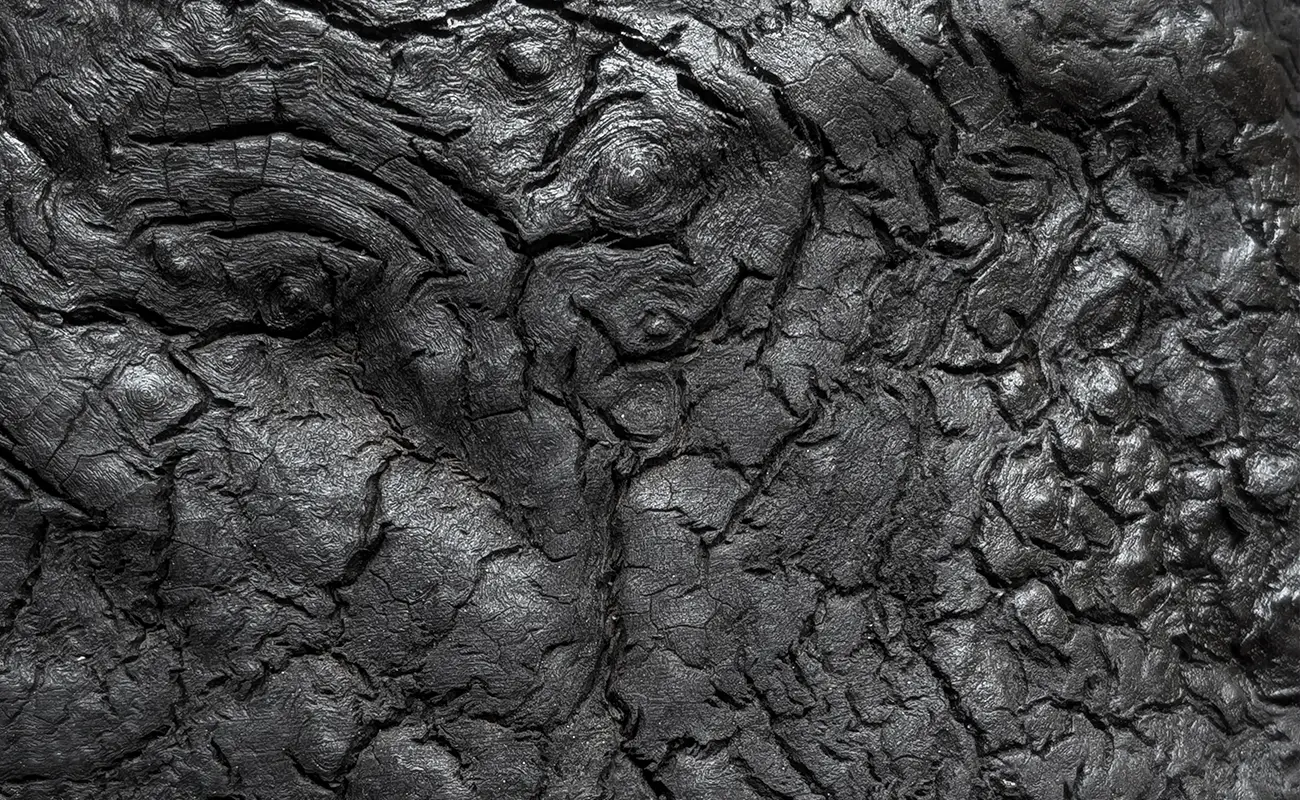
“By burning the surface of wood that would otherwise degrade, I was able to preserve the soul.”
Shaped by Place, Material, and Early Curiosity
Juliane Brandt’s sculptural practice emerges from a lifelong relationship with material, place, and observation. Born in Berlin, a city internationally recognized for its cultural intensity and artistic plurality, she grew up surrounded by diverse creative impulses that quietly informed her path from an early age. Exposure to art, design, and experimental thinking did not arrive as a single defining moment but accumulated gradually, shaping her sensitivity toward form and expression. This environment encouraged exploration rather than specialization, allowing her to move freely between creative disciplines while developing a strong intuitive understanding of visual language. Over time, this openness laid the groundwork for a practice rooted in curiosity, patience, and sustained attention to physical process rather than instant results.
Material exploration became central during her education, where she tested a wide range of techniques before discovering clay as her most natural means of expression. Working with clay introduced a direct physical dialogue between hands and form, encouraging an attentiveness that aligned with her growing interest in the human body. Through sculpting figures and experimenting with posture, she became increasingly attentive to body language and facial expression as carriers of emotion and meaning. This shift marked an important turning point, as the contrast between two-dimensional work and three-dimensional form revealed new possibilities. Depth, angle, and spatial presence offered a complexity that resonated deeply, gradually transforming curiosity into commitment.
Although art initially remained a personal pursuit, demand for her work expanded organically over time. This gradual transition allowed her to refine her voice without pressure, fostering a practice grounded in authenticity. A pivotal influence emerged during a school exchange year in Australia in 1999, where she encountered a dramatically different landscape and ecological rhythm. Witnessing bush fires and their aftermath introduced her to the regenerative power of nature, particularly the way certain plants depend on heat to survive and renew. This experience profoundly influenced her material focus, leading her to work predominantly with clay and charred wood as a way to reflect the parallel evolution of human life and the natural environment.

Juliane Brandt: From Creative Industry to Sculptural Identity
The journey toward fully embracing life as an artist unfolded gradually for Juliane Brandt, shaped by time, professional experience, and personal resolve. Confidence in presenting work publicly did not arrive immediately but developed over decades of study, experimentation, and self-reflection. Her formal education in graphic design in London provided valuable insight into the realities of creative labor, emphasizing both discipline and adaptability. Working professionally within the creative industry offered stability and growth, yet it also clarified the distinction between applied creativity and personal artistic expression. This period was not a departure from art but a foundational chapter that strengthened her understanding of visual communication and conceptual clarity.
Years spent in corporate creative roles sharpened her skills while simultaneously revealing a growing desire to reconnect with tactile processes. Screen-based work gradually felt limiting, prompting a return to physical materials and slower methods of making. This shift was not abrupt but intentional, guided by a longing to create without external briefs or predefined outcomes. The difference between fulfilling a client’s vision and cultivating an independent artistic voice became increasingly apparent. Surrounded by other creative professionals, she found both grounding and motivation, recognizing that comparison can be both challenging and productive when it fuels ambition rather than conformity.
Acknowledging herself as an artist marked a significant personal milestone, transforming her practice from a private endeavor into a committed professional path. This transition required patience, travel, continued study, and a willingness to embrace uncertainty. Once she reached this stage, her work began to coalesce around a clear thematic focus informed by lived experience. Transformation, resilience, and renewal became central ideas, shaped by environments in constant flux. For Brandt, sustaining an artistic life remains a privilege, one that demands dedication and adaptability. Her sculptures reflect this understanding, embodying the belief that growth often emerges from pressure and that change, while demanding, carries the potential for strength and continuity.

Nature, Humanity, and the Language of Form
Environmental awareness and human interaction form the conceptual backbone of Juliane Brandt’s sculptural work. Inspiration arises not from a single influence but from an accumulation of experiences that highlight how landscapes and people continuously shape one another. Nature’s capacity to adapt, recover, and transform provides a recurring point of reference, mirrored in the ways individuals respond to time and circumstance. These observations are embedded within her sculptures, which often suggest both vulnerability and endurance. The connection between human presence and environmental change is not presented as conflict but as an ongoing relationship defined by mutual influence.
Rather than aligning herself with one artistic lineage or methodology, Brandt draws from a wide spectrum of creative and lived experiences. Her education, combined with years of observation and travel, encouraged an appreciation for diversity in form and interpretation. A defining aspect of her work lies in humanizing abstract shapes, allowing recognizable elements to coexist with ambiguity. This approach invites viewers to engage actively, bridging personal perception with shared human experience. The sculptures resist fixed narratives, instead offering space for reflection shaped by the viewer’s own emotional and cultural framework.
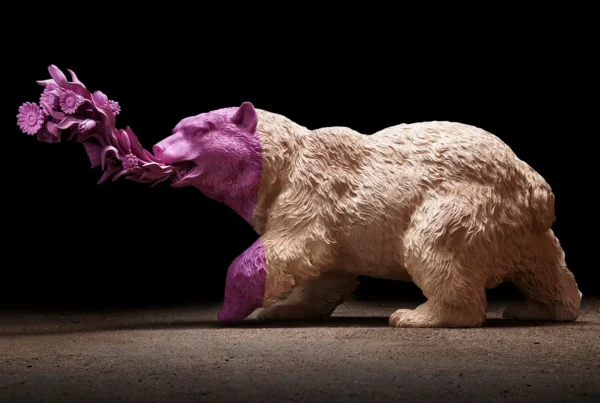
At the core of her practice exists a dialogue between realism and abstraction. Realistic elements provide familiarity and emotional access, anchoring the work in the human experience. Abstraction, in contrast, introduces openness, encouraging imagination and personal interpretation. This balance allows her sculptures to communicate across boundaries without prescribing meaning. The interplay between precision and freedom mirrors the natural processes that inspire her, where structure and unpredictability coexist. Through this dynamic, Brandt’s work reflects an understanding that identity, like nature itself, is continuously formed through interaction, adaptation, and time.

Juliane Brandt: Fire, Symbolism, and the Ongoing Practice
Among Juliane Brandt’s most significant works are her oversized matchstick sculptures, which serve as a foundational exploration of material symbolism. The matchstick, often perceived as a simple and uniform object, undergoes a dramatic transformation once ignited. This shift introduced her to a powerful visual language centered on change of character and impermanence. Through this motif, she began developing figurative sculptures that combine clay and charred wood, two natural materials deeply affected by fire. The act of burning wood, rather than destroying it, becomes a means of preservation, creating a hardened surface that protects what lies beneath. This process embodies a belief that hardship can strengthen rather than diminish.
The symbolic resonance of these works extends beyond material transformation. Charred wood becomes less flammable after exposure to fire, a physical reality that mirrors emotional resilience in human life. Brandt uses this parallel to explore how individuals are shaped by adversity, emerging with greater endurance and depth. Clay, equally responsive to heat, complements this narrative by emphasizing malleability and permanence. Together, these materials allow her to express a vision of nature and humanity as interconnected forces, capable of change while retaining an essential core. Each sculpture carries themes of prospect, wonder, and strength without relying on overt storytelling.
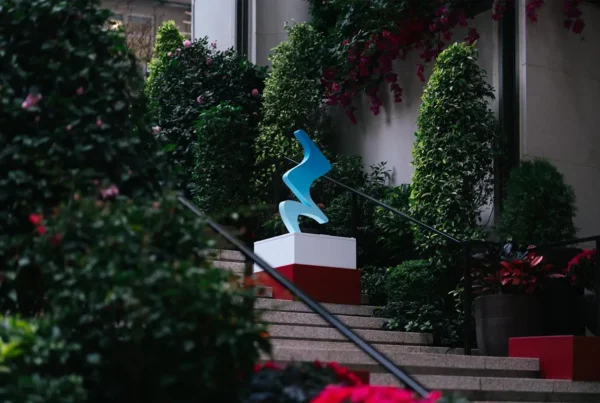
Her daily practice remains closely aligned with natural cycles, particularly in South Australia where seasonal fire restrictions limit the periods available for burning wood. This rhythm influences her workflow, with clay sculpting continuing year-round while wood firing occurs during permitted times. Brandt works from a shared studio in the City of Adelaide alongside more than fifty artists across disciplines, an environment that fosters exchange and creative challenge. Having already completed several outdoor sculptures, she looks toward realizing another public artwork in the future. Such projects reflect her ongoing interest in placing sculptural narratives within shared spaces, allowing her exploration of resilience and transformation to engage directly with the broader community.