
“One day you will paint with oil paint.”
Born of Sea Light and Inner Awakening
The abstract paintings of Joke Minnaar emerge from a deeply personal journey shaped by memory, landscape, and an enduring sensitivity to color and form. Born in 1951 in the Dutch coastal town of Vlissingen, she grew up surrounded by the expansive presence of the sea, an environment that quietly instilled in her a lifelong fascination with horizon lines, shifting skies, and the rhythmic vastness of water. These early visual impressions continue to echo throughout her canvases, where luminous blues and open spatial arrangements evoke maritime light and atmospheric clarity. Painting eventually became not merely a creative pursuit but the central axis of her life, a vocation guided by intuition and emotional responsiveness rather than strict adherence to representational conventions.
Her path toward painting unfolded gradually and somewhat unexpectedly. At the age of seventeen, after completing her high school examinations, she realized that drawing would no longer be part of her formal education. This realization left a profound sense of absence, yet she moved forward into further studies and the uncertainties of adulthood. Shortly afterward, she recalls hearing an inner voice suggesting that she would one day paint with oil. The thought faded into the background of daily life until two decades later, when a spontaneous decision altered her direction entirely. Returning home from a winter holiday in Austria, she found herself struck by the stark contrast between brilliant snow-covered mountains and the gray, rain-soaked atmosphere of the Netherlands. Acting on impulse, she purchased oil paints, unknowingly setting the foundation for her artistic future.
Her earliest experiments with the medium involved painting a still life of flowers and attempting portraiture, yet these efforts did not resonate with her desire for creative freedom. A pivotal evening arrived when she began working intuitively with color and shape, allowing forms to arise without predetermined subject matter. The result was her first abstract painting, warmly received by a close friend whose enthusiasm affirmed Minnaar’s instinctive direction. From that moment onward, she continued to paint without interruption, gradually shaping a distinctive visual language rooted in bright tonal contrasts, simplified geometry, and the emotional landscapes that exist between visible reality and inner perception.

Joke Minnaar: The Language of Abstract Balance
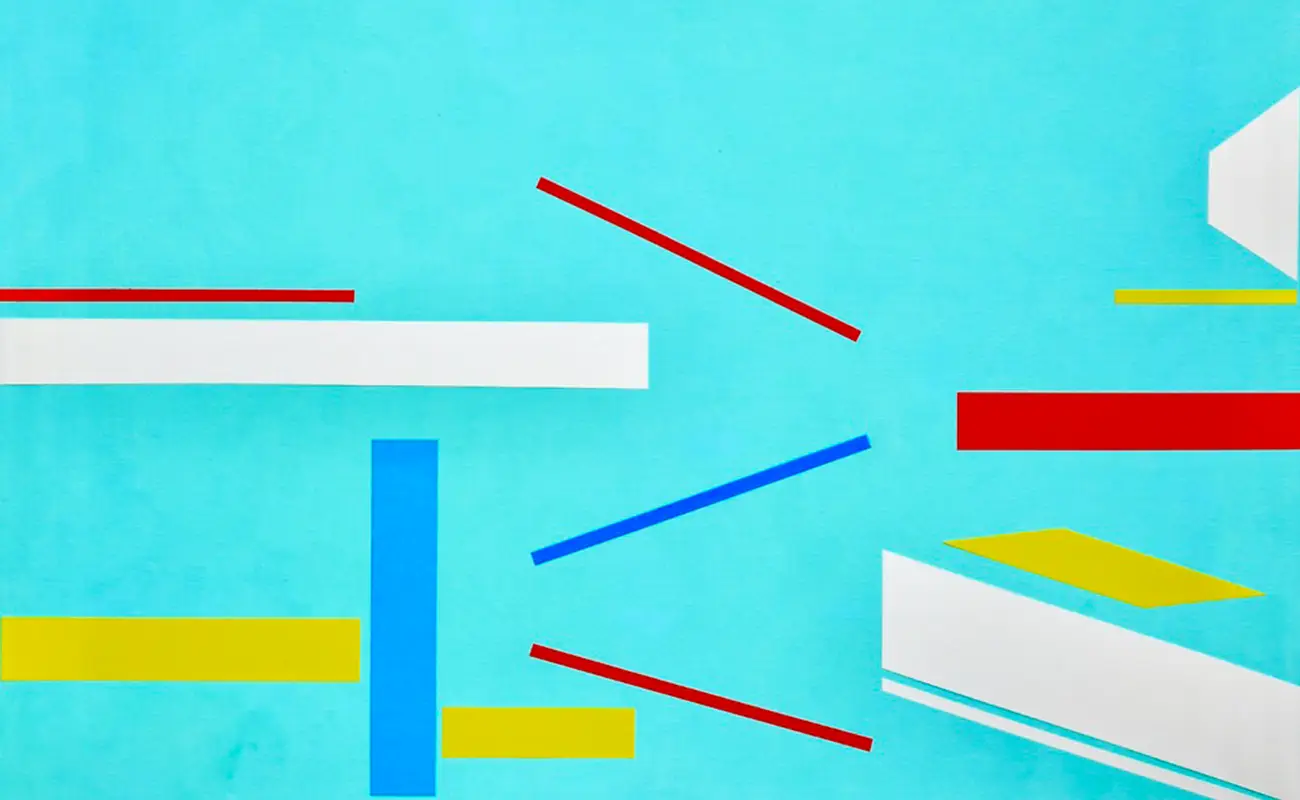
Minnaar’s mature style articulates a visual vocabulary that balances lyrical spontaneity with an understated architectural clarity. Her compositions often feature elongated bars, floating squares, circular accents, wavering lines, and occasional star-like configurations that appear to drift across the canvas with gentle autonomy. These elements seldom convey rigidity. Instead, they seem animated by subtle internal currents, aligning or separating within luminous fields of saturated reds, radiant blues, and sunlit yellows. Such dynamic interplay suggests an artist deeply attuned to spatial relationships, where intervals between forms possess expressive power equal to the forms themselves. This approach reflects her enduring interest in translating experiential sensations into visual equilibrium.
Color functions in her work less as a descriptive tool and more as an emotional climate. High-key palettes composed of clear primaries and softened gradients create atmospheres of buoyancy and openness reminiscent of coastal light and expansive skies. Even when compositions grow structurally complex, chromatic harmony sustains a sense of serenity and cohesion. Surfaces often reveal delicate transitions, brushed with sensitivity to prevent geometric elements from appearing overly severe. Flowing contours that resemble horizon lines traverse many canvases, counterbalancing rectilinear structures and introducing a sense of temporal movement. These gestures evoke natural rhythms such as tides, shifting winds, or the quiet progression of daylight across open water.
Spatial organization within Minnaar’s paintings resists conventional illusionistic depth. Instead of constructing recession through perspective, she cultivates layered flatness where shapes hover in ambiguous proximity, encouraging contemplative viewing. Organic motifs resembling branching stems or constellations occasionally surface, hinting at a poetic synthesis of remembered landscapes and introspective vision. This meditative abstraction aligns her practice with broader currents in modern art, yet her sensibility remains distinctly personal. Influences from Egyptian gold art, Fra Angelico, numerous impressionists, Paul Klee, Amedeo Modigliani, Joan Miró, Henri Matisse, Mark Rothko, Alexander Calder, Kenneth Snelson, and Etel Adnan provide points of resonance rather than models to imitate. Through this dialogue with artistic predecessors, she continues to cultivate an independent path shaped by freedom and sustained exploration.

The Quiet Studio and the Rhythm of Creation
At the heart of Minnaar’s daily life stands a garden studio situated near her home, a sanctuary where concentration and imagination intersect. She works there almost every day, maintaining a disciplined yet fluid routine that reflects her deep commitment to painting. The physical properties of oil paint play a decisive role in shaping her process. Because the medium requires extended drying time, she develops several canvases simultaneously, shifting her attention from one surface to another while waiting for layers to settle. This cyclical rhythm introduces a contemplative pace that allows ideas to mature gradually, reinforcing the reflective character evident throughout her work.
Inspiration arises when she encounters moments that stir her emotionally, whether through something she has seen, heard, or read. She describes this impulse as inspiration of the soul, an internal spark that must be awaited rather than forced. When such inspiration arrives, an image begins to form in her mind, serving as the foundation for a preliminary design. That design initiates the act of painting, yet it never determines the final outcome. While working, forms evolve, colors intensify or soften, and spatial relationships shift in response to intuition. Each painting therefore becomes a dialogue between intention and discovery, repeating a pattern of emergence and transformation that defines her creative methodology.
Over the years, this sustained engagement has led to noticeable developments in her visual language. Increasing tranquility entered her compositions as depictions grew more abstract, allowing forms to detach from recognizable references and inhabit their own internal logic. In her recent works, shapes appear to move more freely within the pictorial field, establishing relationships that feel independent and self-organizing. The painting titled “In Motion” exemplifies this progression, presenting forms that seem to glide through space with gentle autonomy. Despite these shifts, certain constants remain. Bright color harmonies and the pursuit of balanced imagery continue to anchor her evolving practice, providing continuity within change.

Joke Minnaar: Pathways of Meaning and Continuity
Among Minnaar’s many works, the painting “The Road to It” holds particularly deep personal significance. Its title refers to a memorable walk along the chalk cliff coastline of Normandy in France, an experience that combined physical movement through landscape with introspective reflection. Within the abstract composition, the notion of a path unfolds on multiple levels. On one hand, it recalls the sensory impressions of sea air and luminous horizons. On the other, it gestures toward a broader metaphor of life’s ongoing journey, suggesting the continuous pursuit of purpose and destination. Through such layered meaning, the painting exemplifies how external experiences and internal contemplation merge within her artistic vision.
Titles play an important role in clarifying these resonances. Often, Minnaar discovers the significance of a work only gradually, after the visual elements have settled into coherence. Naming a painting becomes a moment of recognition, when the emotional or philosophical dimension reveals itself with clarity. This reflective approach underscores the strong interaction between inner life and surrounding environment that characterizes her practice. The visible world offers stimuli, yet the transformation of those impressions into abstract form requires attentive listening to intuition. Each completed canvas stands as evidence of this union, embodying both personal response and universal suggestion.
Looking toward the future, Minnaar expresses a heartfelt desire to continue painting and refining her creative voice. She considers painting the most important work in her life, a lifelong commitment sustained by curiosity and gratitude for the freedom she has enjoyed in shaping her own direction. Standing on the foundations laid by earlier generations of artists, she continues to pursue new visual relationships and emotional nuances. Her evolving body of work reflects persistence, openness, and the enduring influence of sea, sky, and memory. Through radiant color, balanced composition, and quietly kinetic form, Joke Minnaar constructs pictorial spaces that invite viewers into moments of contemplation and luminous connection.