
Systems of Vision and Abstract Order
The work of John Zoller occupies a distinctive position within contemporary abstraction, where visual precision meets immersive experience. Based in Miami and working primarily in painting and installation, Zoller has developed a practice that centers on the viewer’s perception of space, motion, and structural tension. His compositions immediately command attention through disciplined geometry and high-contrast color relationships, yet their impact unfolds gradually as the eye adjusts and begins to sense depth and movement within the surface. These works do not rely on expressive gesture or narrative imagery. Instead, they operate through carefully calibrated systems that invite prolonged looking and perceptual engagement, situating the viewer within an active visual exchange rather than a passive encounter.
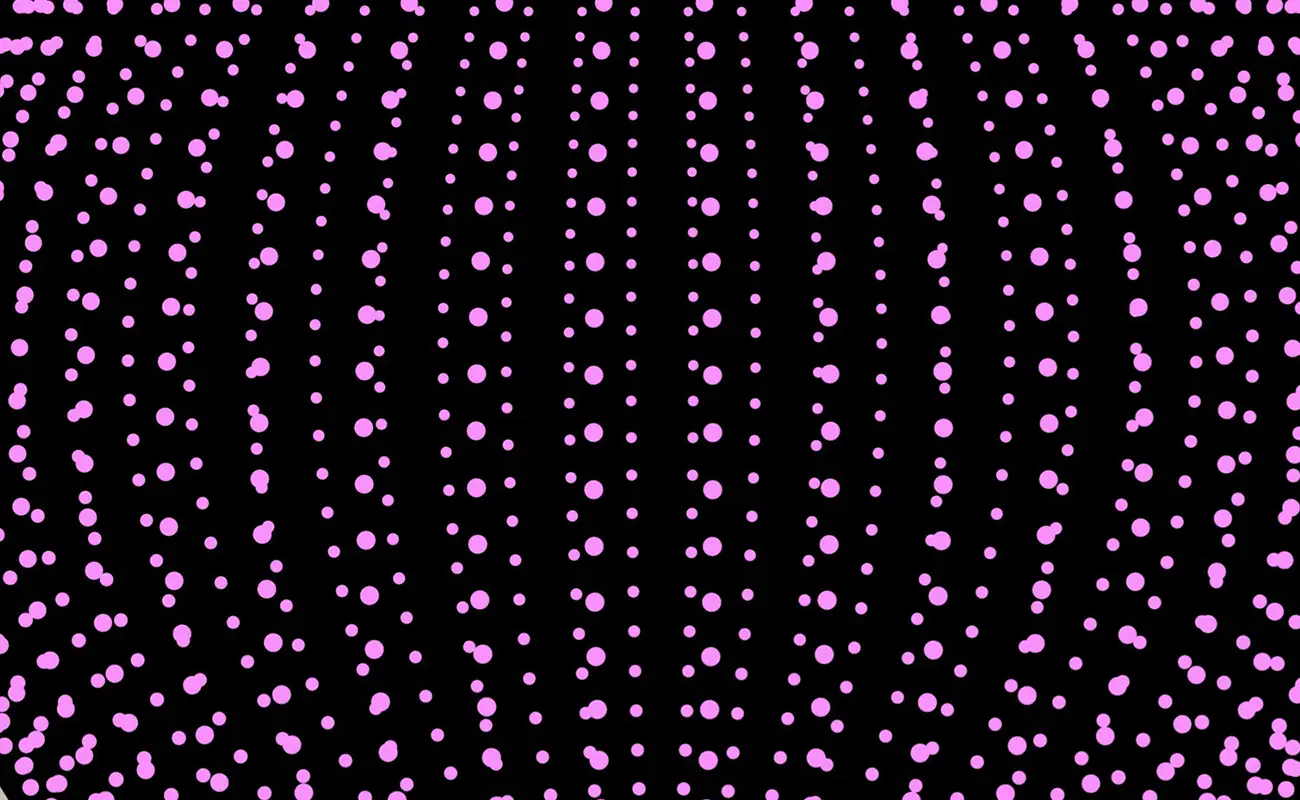
Zoller’s paintings are rooted in Op Art traditions, yet they are informed by a contemporary awareness of scientific systems and visual cognition. Using simple elements such as lines, dots, grids, and repeated shapes, he constructs compositions that appear to vibrate, curve, or expand beyond the flat plane of the canvas. The apparent motion arises not from illusionistic shading but from the strategic alignment of forms and contrasts. This approach transforms minimal components into complex visual events, where the surface seems to oscillate between two-dimensional structure and implied volume. The resulting experience is hypnotic without being decorative, demanding attention through clarity rather than excess.
Underlying this visual impact is a commitment to order and restraint. Zoller’s work demonstrates how limitation can generate intensity. By restricting his vocabulary of forms and colors, he heightens their perceptual effect and sharpens the viewer’s awareness of subtle variation. Each painting functions as a self-contained system, governed by internal logic and balance. This emphasis on structure aligns his practice with a broader lineage of optical abstraction while establishing a platform for deeper conceptual exploration grounded in science and perception.

John Zoller: The Celestial Mechanics Series
At the core of Zoller’s practice is his ongoing series titled Celestial Mechanics, begun in 2017 and now comprising more than one hundred paintings. This body of work translates principles drawn from physics and astrodynamics into abstract visual structures. Rather than depicting astronomical phenomena directly, the paintings evoke the forces and systems that govern motion, gravity, and spatial relationship. Concentric circles, radiating lines, and wave-like patterns recur throughout the series, suggesting orbital paths, energy dispersion, and invisible fields that shape the physical universe. These references remain intentionally indirect, allowing the viewer to sense scientific ideas through perception rather than illustration.
The visual language of Celestial Mechanics relies on mathematical clarity and repetition. Lines extend from central points, grids bend across curved formats, and repeated units accumulate into dense optical fields. These elements work together to create the impression of depth and movement, even though the surface remains physically flat. The eye is drawn inward, then pushed outward, caught in a continuous process of adjustment. This perceptual instability reflects the dynamic systems that inspired the series, reinforcing the connection between visual experience and scientific thought without reducing the work to didactic explanation.
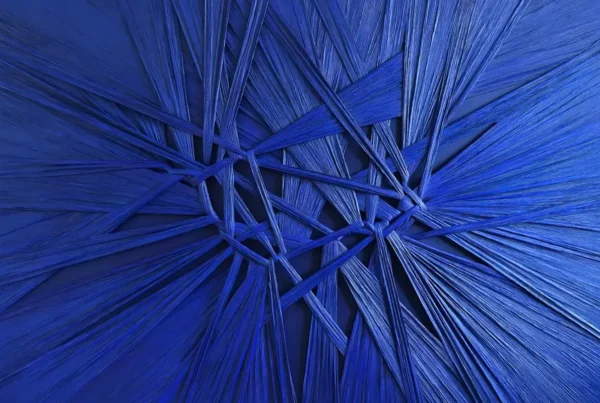
Color plays a crucial role in reinforcing these effects. Zoller frequently employs monochromatic or tightly controlled palettes, often using saturated blues, primary hues, or stark contrasts between light and dark. This restraint amplifies optical vibration and sharpens spatial ambiguity. Within Celestial Mechanics, color is not decorative but structural, guiding the viewer’s perception and intensifying the sense of motion. Through this disciplined approach, the series achieves both visual coherence and conceptual depth, positioning it as a sustained investigation into how abstract systems can be experienced viscerally.

Optical Lineage and Contemporary Expansion
Zoller’s work is deeply connected to the historical development of Op Art, drawing clear parallels to artists such as Victor Vasarely, Bridget Riley, Carlos Cruz-Diez, and François Morellet. These figures established a visual language in which geometry and repetition activated the viewer’s perception, most notably in the influential 1965 exhibition The Responsive Eye at the Museum of Modern Art. Zoller extends this legacy by maintaining the emphasis on optical engagement while situating his work within a contemporary framework shaped by data, systems thinking, and scientific abstraction.
What distinguishes his approach is the way perceptual effects are tied to conceptual reference. Geometry in his paintings is not used solely to destabilize vision, but to suggest underlying order and structure. Patterns appear to pulse or curve according to rules that feel consistent, even when they resist immediate comprehension. This balance between visual intensity and structural logic gives the work a sense of credibility and focus. The viewer is not overwhelmed by chaos but invited into a controlled environment where perception becomes the subject of inquiry.
This positioning allows Zoller’s work to resonate within current conversations around abstraction and cognition. His paintings engage the body and the mind simultaneously, encouraging viewers to recognize their own role in completing the visual experience. By merging the perceptual strategies of Op Art with contemporary interest in scientific systems, his practice bridges historical abstraction and present-day concerns, demonstrating how optical painting can remain relevant and exploratory.

John Zoller: Installation, Scale, and Spatial Experience
Beyond the canvas, Zoller’s exploration of perception extends into installation, where scale and environment become active components of the work. A notable example is the Dwarf Star painting installation in Palm Beach, Florida, which brings the principles of Celestial Mechanics into a shared physical space. In this context, the paintings interact with their surroundings and with each other, encouraging viewers to move, adjust their position, and experience shifting visual relationships. The installation transforms optical effect into a spatial event, reinforcing the idea that perception is dynamic and contingent.
The transition from individual works to installation underscores Zoller’s interest in immersion. When encountered collectively, the paintings generate a heightened sensory field, where repetition and variation amplify optical response. Distance and proximity alter the experience, revealing new patterns and intensifying the sensation of depth. This spatial dimension strengthens the conceptual framework of his practice, aligning the act of viewing with the physical laws that inspired the work. The viewer becomes part of the system, navigating visual forces rather than observing them from a fixed point.
Through installation and sustained series development, Zoller demonstrates a commitment to expanding the possibilities of geometric abstraction. His work continues to investigate how simple forms can produce complex perceptual outcomes when organized with precision and intent. By uniting painting, installation, and scientific reference, he constructs an artistic practice that remains focused, immersive, and rigorously controlled, offering a compelling vision of contemporary Op Art grounded in perception and structure.