
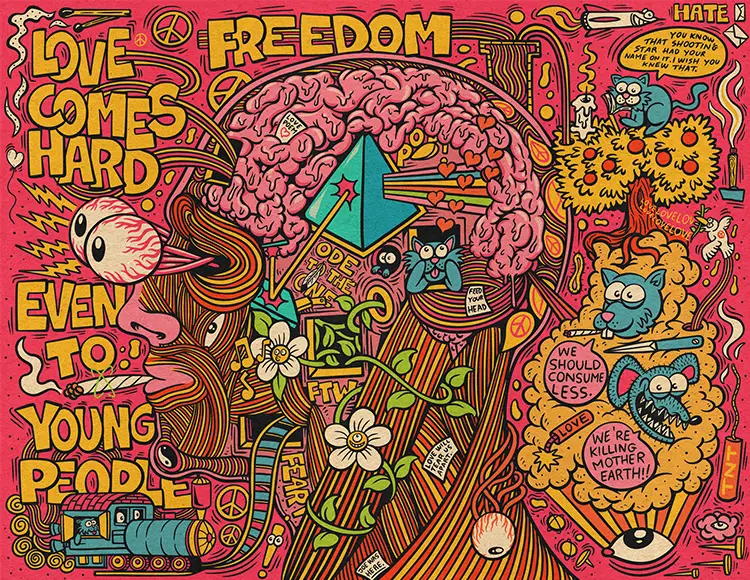
“I’ve spent a lot of time trying to make a mix between my aggressive, punk rock side and the psychedelic trippy one—it’s something I still do today.”
Skateboards and the Start of Something Bigger
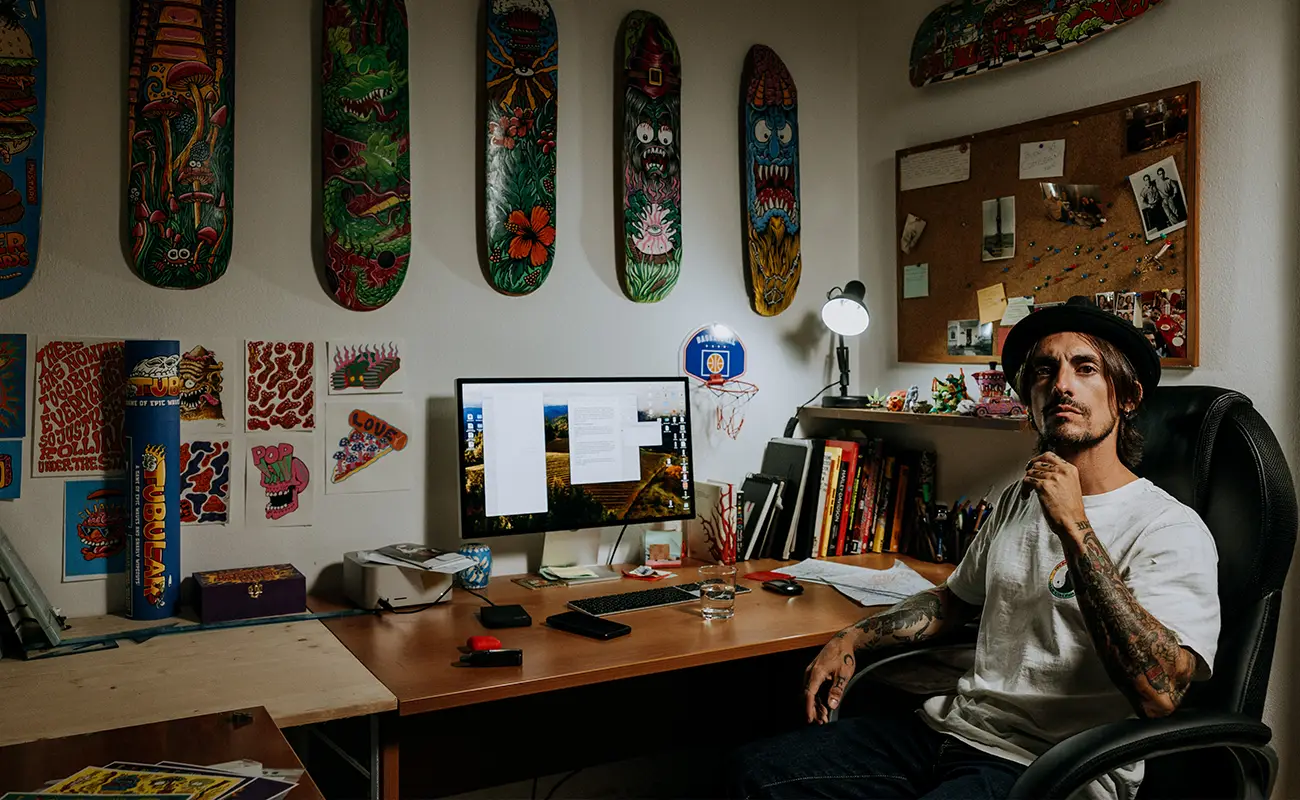
When Joe Tamponi picked up a skateboard in 2002, he had no idea it would eventually guide the direction of his artistic life. Yet the subcultures that surrounded skateboarding — the music, the streetwear, the irreverent and gritty design — became the backbone of his creative identity. Growing up captivated by the bold visual aesthetics of brands like Zero, Mystery, Fallen, and Toy Machine, Tamponi absorbed a raw and aggressive visual language that would later influence his style as an illustrator. These brands didn’t just decorate decks; they communicated subversion, humor, and rebellion — ideas that resonated with him deeply as a teenager navigating adolescence through punk rock and kickflips.
His fascination with imagery extended beyond board graphics. Early sketches he drew as a kid, often depicting stick figures skating, reflected his interest in stylized chaos and dynamic movement. A pivotal influence at the time was M.C. Escher, whose intricate illusions and endless staircases planted a conceptual seed in Tamponi’s imagination. Though drawing took a backseat during his later teenage years as he experimented with photography and videomaking, his instinct to create never left him entirely. Instead, it simmered beneath the surface, waiting for a new outlet to emerge — and it eventually did through tattoo art.
That reawakening came around 2011, when Tamponi found himself captivated by the traditional motifs of American tattooing. He spent countless hours copying historic flash sheets from artists like Sailor Jerry and Paul Dobleman, appreciating their direct symbolism and clarity of form. This immersion was about more than technique — it was a gateway into a new visual language that married his love of bold linework with iconography rooted in subcultural lore. His involvement in launching a streetwear brand, Oldprow, which combined punk aesthetics with nautical tattoo motifs, marked an early fusion of his interests and was a stepping stone toward his transition into a full-time freelance illustration career in 2017.

Joe Tamponi: Between Punk Shadows and Psychedelic Light
The tension between opposing forces — darkness and color, satire and sincerity, control and chaos — is central to Joe Tamponi’s artistic evolution. His initial body of work, produced during a black-and-white phase, reflected the harsh tonality of the blackened hardcore punk he was listening to. That period pushed him into the world of dark art, where compositions grew more detailed, themes took on a heavier psychological weight, and color was entirely absent. Tamponi’s tools were stark and his message was raw, mirroring the abrasive energy of the music and social commentary that drove him.

Eventually, a shift occurred. Tamponi found himself drawn back to a visual tradition that had fascinated him in childhood: the psychedelic poster movement of the 1960s. He began studying the work of visionaries like Wes Wilson, Victor Moscoso, and Stanley Mouse, intrigued by their use of distortion, electric color, and type-as-image approaches. This research reinvigorated his approach to composition and palette. The hallucinogenic brightness and surreal elasticity of those posters stood in stark contrast to his earlier monochromatic period, but rather than replace it, it added another layer. The collision of punk’s raw edge with the elasticity of psychedelic design formed the core of his visual identity.
The shift wasn’t just stylistic; it was philosophical. Tamponi started exploring how to use humor, absurdity, and satire more prominently in his illustrations. Whether working traditionally with pencil and ink or digitally coloring complex scenes, his process became about twisting reality — often beginning with real people or moments and exaggerating them into grotesque caricatures or ironic visual gags. The intent was never merely to amuse but to provoke, to challenge, and to make viewers pause. This dual commitment to entertainment and confrontation has come to define Tamponi’s distinct visual voice.

Nightmare Logic and Consumer Myths
Among Joe Tamponi’s many works, one stands out as especially personal and conceptually charged: Nightmare Factory, a chaotic composition created in 2021. This piece emerged during a time when Tamponi was channeling his thoughts directly onto the page, crafting what he describes as stream-of-consciousness illustrations. In Nightmare Factory, various symbols burst out from a human head, crowding the page with disturbing yet darkly humorous imagery. It is an attempt to capture a fractured internal landscape shaped by societal contradictions and consumer fatigue.

What makes Nightmare Factory particularly compelling is how it turns economic critique into visual allegory. Within the composition, a skull receives a conveyor belt through its mouth, upon which ride surreal objects tagged with absurd price points: a sinful apple for 99 cents, intelligence in a jar priced at $1,000, cigarettes for $5, and a humble carrot for $50. Each item was selected with intention, using satire to highlight how modern society devalues wisdom and nature while subsidizing harm and indulgence. The image, dense and deliberately uncomfortable, reflects Tamponi’s frustration with a system that confuses worth with cost and encourages disconnection from genuine human values.
More than just a critique, the work represents a larger philosophy embedded in Tamponi’s illustrations. It’s not enough for his art to be aesthetically interesting — it has to grapple with discomfort, absurdity, and moral inversion. Nightmare Factory exemplifies his belief that illustration can be both playful and profound, weaving together humor, despair, and insight into a visual style that resists easy categorization. For Tamponi, this approach is a way of navigating a world that often feels upside-down, using his craft not to escape from it, but to reflect it more truthfully, no matter how bizarre the result may be.

Joe Tamponi: Sewer Rats and Surfboards in Dystopia
Tamponi’s most ambitious project to date, Smelly Rob, brings together years of artistic development and ideological questioning into a graphic novel that is equal parts adventure story and social satire. At the heart of the narrative is Rob, a rat with a love for surfing, who grows up in a natural paradise beneath an abandoned pier. The rats live in balance with their environment, forming a simple but supportive society — until humans arrive. With the rise of construction, tourism, and environmental devastation, the rats are displaced and forced underground into the sewers, where they begin reconstructing a society that, ironically, mimics the very one that destroyed them.

What makes Smelly Rob more than a dystopian fable is its layered critique of modernity. The narrative uses anthropomorphic rats not just for comedic effect, but as a mirror to reflect human behavior at its most contradictory. In their attempt to rebuild, the rats unknowingly adopt the same systems of corruption, inequality, and disconnection that humans live by. Through Rob’s journey, Tamponi examines themes of environmental exploitation, societal conformity, and the paradox of progress. The book is funny, yes — filled with visual gags and absurd moments — but it carries a deep undercurrent of sadness for what we’ve lost and how little we seem to care.
Smelly Rob 1 – The Escape, now available in both English and Italian, marks the beginning of what Tamponi hopes will be a longer saga. It is a natural extension of his previous work, blending punk aesthetics, underground comic traditions, and razor-sharp satire. His characters are drawn with expressive exaggeration, their environments pulsing with surreal detail. Tamponi uses their world not just to entertain, but to invite readers into uncomfortable questions about their own. The rats, in all their silliness and struggle, become vessels for an artist’s unfiltered take on a society he finds increasingly absurd, disconnected, and in desperate need of self-reflection.