
“In conception lies talent; in execution, art.”
Between the Visible and the Veiled
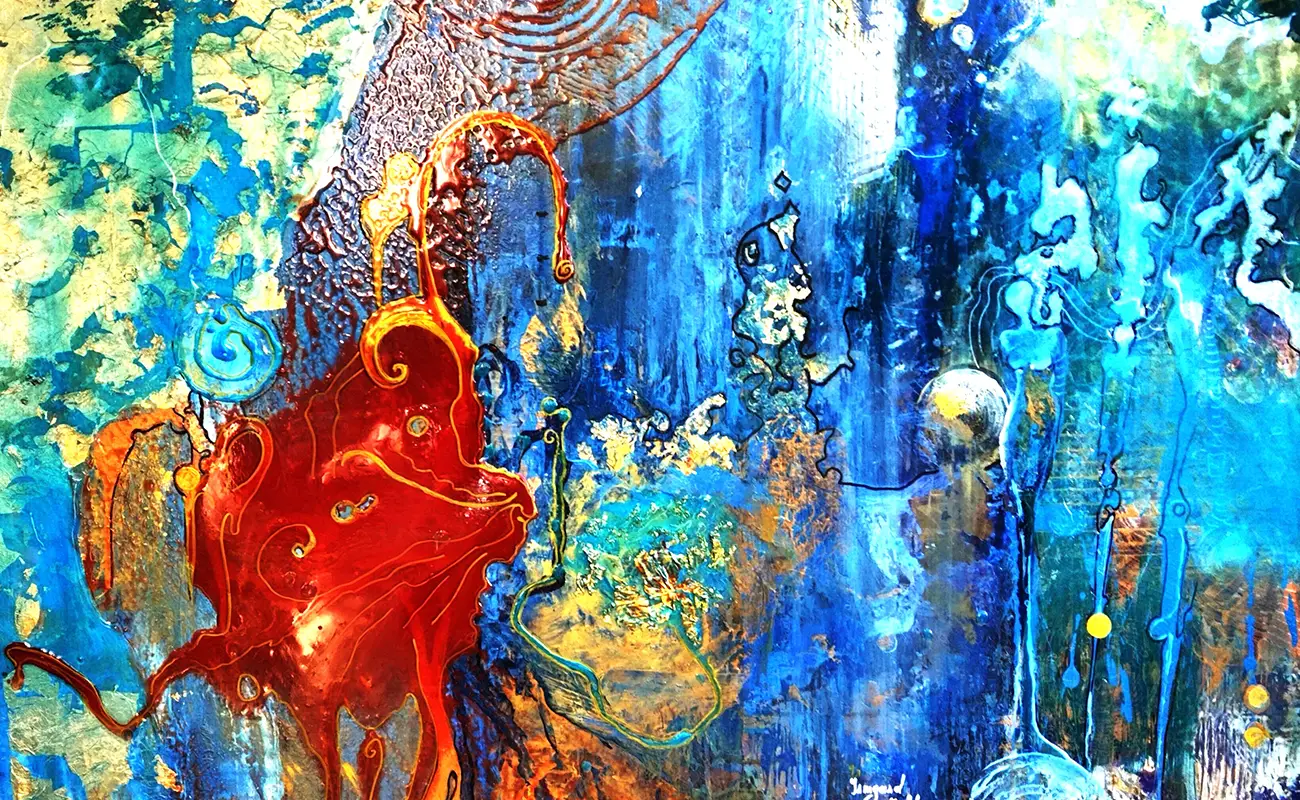
Irmgard Mehlman’s paintings open portals into a visual language shaped by introspection, emotional nuance, and the continuous interplay between abstraction and figuration. Based in Vienna, Austria, she has cultivated a distinctly personal artistic voice, one that resists confinement within traditional categories. Her self-guided beginnings, later refined through formal training at the Painting Academy of Lower Austria between 2017 and 2019, laid the foundation for a style that thrives on contrast: spontaneity paired with precision, fluidity tempered by structure. Each canvas she produces becomes a site for internal negotiation, where gestures, color, and texture fuse to express what words cannot.
At the core of Mehlman’s visual world lies a fascination with the shifting borders of perception. Her works do not impose fixed meanings but instead offer open-ended spaces in which viewers are encouraged to wander. Figures emerge from layers of color, then recede again, leaving behind spectral imprints that feel more emotional than literal. This dynamic of emergence and dissolution reflects Mehlman’s larger preoccupation with the blurred boundaries between the conscious and unconscious. Influences from Symbolist and Surrealist legacies may linger in her compositions, but her abstract language remains entirely her own—grounded in contemporary practice and shaped by personal exploration.
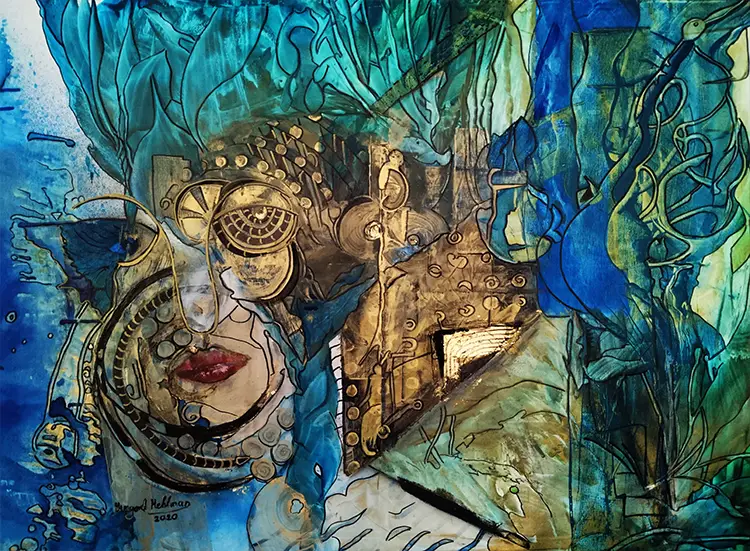
What truly defines Mehlman’s work is its emotional charge, carried by her signature use of vibrant, harmonized color. Her palette, often rich with golds, turquoises, and deep siennas, is not merely decorative but communicative. It conveys mood, depth, and internal states. These hues operate with deliberate tension, evoking moments of harmony, disruption, and renewal. As the eye moves across the canvas, the viewer is drawn into a dialogue between surface and depth, material and meaning. In Mehlman’s hands, color does not sit still; it resonates, vibrates, and breathes, revealing the subtle shifts of human feeling embedded in every brushstroke.
Irmgard Mehlman: The Body as Elemental Presence
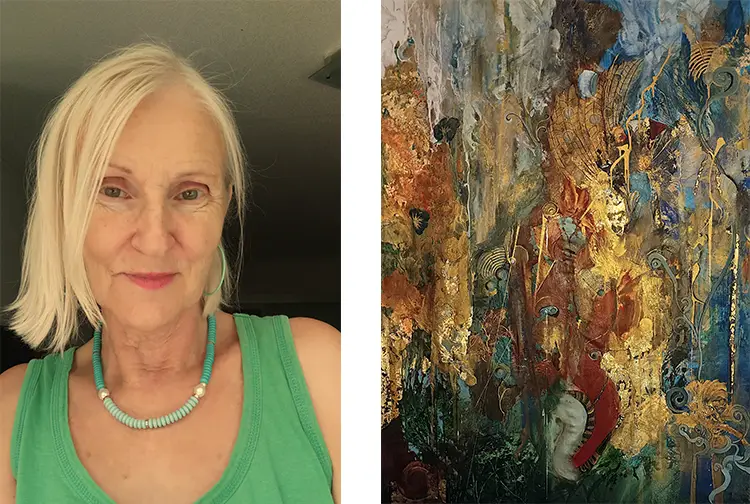
Across her body of work, Irmgard Mehlman frequently returns to the human form—not as a static figure but as a mutable symbol of inner transformation. In her paintings, stylized faces and silhouettes often appear to dissolve into surrounding textures, becoming indistinguishable from their environments. These visual choices reposition the feminine figure not as a subject to be observed, but as an active force that channels both vulnerability and strength. Rather than presenting women as detached muses or idealized icons, Mehlman merges them with the elements, suggesting a profound interdependence between the human body and the rhythms of nature.
The influence of Frida Kahlo is evident in this approach—not only in terms of visual impact but in the emotional transparency that permeates the work. Like Kahlo, Mehlman draws from personal experience, yet she translates those emotions into abstraction rather than narrative. Her women do not stare back at the viewer with biographical specificity; instead, they exist as emotional topographies—expressions of cycles, identities, and moments of becoming. The materials she employs, such as gold leaf and layered pigment, elevate these figures into mythic presences, bridging the intimate and the universal. In doing so, Mehlman offers an alternative to traditional figurative painting: one where identity is fluid, not fixed.
Color plays an integral role in shaping this symbolic interplay. Mehlman often gravitates toward mineral hues—shimmering metallics, cool blues, earthy browns—that evoke natural formations and psychological states alike. Her use of gold is particularly resonant, not as ornament but as a transformative agent that imbues the canvas with a sense of sacredness. These tones blur the divide between physical form and emotional landscape, making each composition feel like a visual ritual. In her treatment of the feminine, Mehlman replaces static representation with continuous metamorphosis, creating works that feel simultaneously grounded and transcendent, intimate and expansive.
Material as Memory
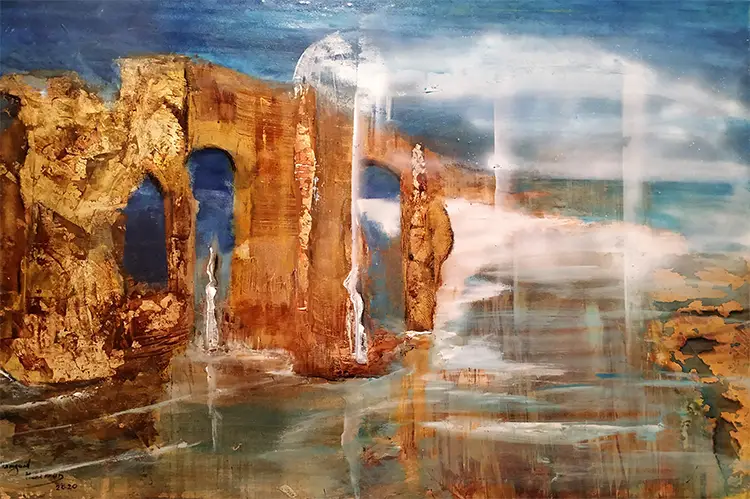
In Irmgard Mehlman’s practice, the act of painting is inseparable from the process of transformation. She approaches the canvas as a living surface—one that records gestures, revisions, and decisions as part of its final expression. Destruction plays a key role in this development; elements are often scraped away, washed over, or reworked until a new form emerges. This willingness to deconstruct is not about negation but about opening space for new possibilities. The resulting surfaces carry visible traces of their history, much like scars or memories, suggesting that each painting is the result of lived experience translated into visual form.
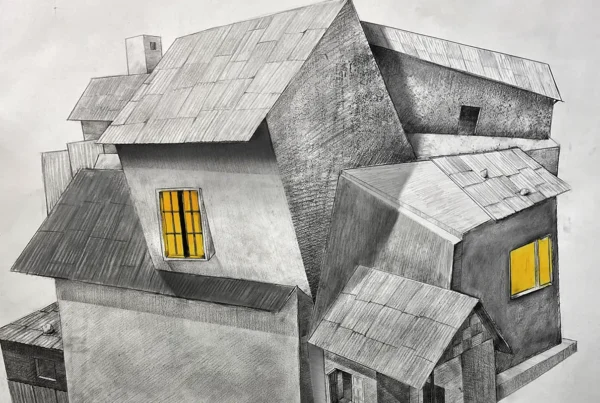
Her abstract compositions, rich with gestural marks and dynamic linework, evoke movement and rhythm. Echoes of lyrical abstraction and Art Informel can be felt in her approach, yet Mehlman distinguishes herself through her subtle structuring of chaos. While her paintings often seem spontaneous, they are underpinned by careful compositional choices. Organic curves interact with geometric patterns, creating a visual balance that guides the eye without dictating interpretation. This equilibrium allows for fluid associations, giving viewers space to experience the works as emotional or meditative landscapes rather than conceptual puzzles.
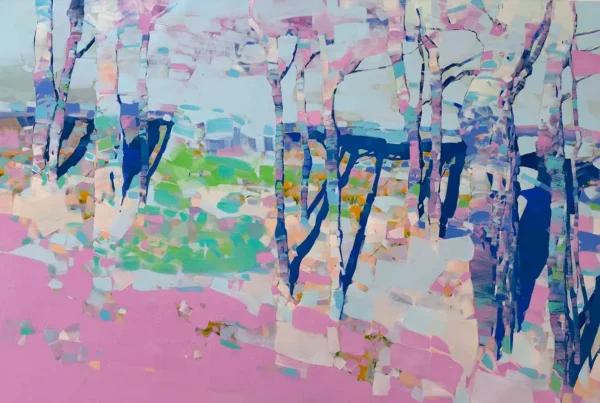
In her most abstract pieces, where figurative references are entirely absent, Mehlman reaches a kind of visual purity. These works suggest forces larger than the individual—tectonic shifts, celestial movements, or energetic flows that transcend the personal. The interplay of opacity and translucence, gloss and matte, reinforces the idea that nothing is static. Materials are used not to conceal but to expose the tension between permanence and change. Through this painterly process, Mehlman transforms canvas and pigment into an expressive medium for existential reflection, demonstrating how the materiality of painting can mirror the fluid nature of memory, time, and self.
Irmgard Mehlman: Painting as Living Dialogue
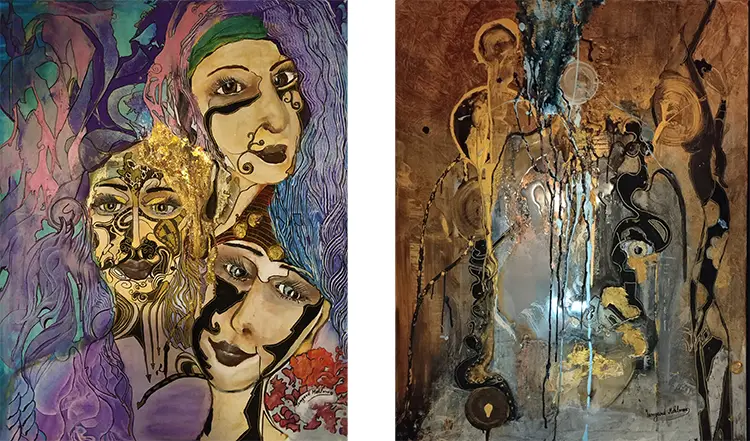
What sets Irmgard Mehlman’s work apart in today’s artistic landscape is her belief in painting as a responsive and evolving form. For her, each canvas becomes a conversation—between intention and accident, silence and expression, the artist and the viewer. Her creative process rejects rigid plans in favor of intuition. Rather than imposing technique, she allows each piece to determine its own direction. This openness fosters a rare authenticity, evident in how her surfaces feel inhabited, not constructed. Light moves across them like thought, and color shifts like emotion, inviting a slow, contemplative engagement.
A key component of this responsiveness lies in her choice of materials and their interaction with light. Gold leaf often glimmers beneath translucent layers, functioning as both visual anchor and symbolic presence. This element, shimmering beneath the surface, alludes to the possibility of inner illumination—a light that emerges only through time, scrutiny, and patience. These paintings do not offer immediate gratification. Instead, they require viewers to pause, to let perception adjust, and to experience the work as something that is constantly becoming. In doing so, Mehlman draws attention to the act of seeing itself as a transformative experience.
In positioning her work within contemporary abstraction, Mehlman resists the detachment often associated with conceptual art. Her paintings do not aim to explain but to evoke. They are neither diaristic nor purely formal, but occupy a space where personal history, sensory experience, and material experimentation intersect. This integration allows her to speak to broader human concerns—resilience, change, introspection—without relying on narrative or overt symbolism. Irmgard Mehlman’s paintings stand as quiet affirmations of painting’s enduring power: to connect, to transform, and to remind us that meaning is not fixed but constantly unfolding.