
Origins, Education, and the Formation of an Artistic Voice
Gregory Logan Dunn’s artistic journey begins in Upland, California, where he was born in 1968, and extends across decades of sustained observation, disciplined study, and lived experience. Raised primarily in Silver Spring, Maryland after his family relocated to the Washington, D.C. area in the mid 1970s, Dunn grew up surrounded by one of the most significant concentrations of public art institutions in the United States. From an early age, drawing was not a pastime but a constant presence, reinforced through years of sketchbooks and a youthful fascination with comic books and graphic novels. This early visual engagement gradually expanded into a broader awareness of figurative painters and expressionist traditions, shaped by repeated visits to the Smithsonian museums, the National Gallery of Art, and the Hirshhorn Museum. These formative encounters cultivated a deep visual literacy long before formal academic training began.
Dunn did not immediately pursue painting as his primary medium, instead arriving at it through a circuitous and deliberate path. He enrolled at Montgomery College in Rockville, Maryland, focusing on studio art with an emphasis on both painting and sculpture, ultimately earning an Associate of Arts degree in Studio Art in 1996. During this period, his interests were still materially diverse, and sculpture occupied a significant portion of his practice. His transfer to the Maryland Institute College of Art in Baltimore marked a decisive shift, even though his portfolio at the time leaned heavily toward three dimensional work. Immersed in an environment that encouraged conceptual rigor and sustained inquiry, Dunn gravitated toward painting with increasing intensity. Independent studies became central to his education, allowing him to dedicate extended time exclusively to the act of painting and the problems inherent within it.
By the time he received his Bachelor of Fine Arts in General Fine Arts in 1998, painting had become the foundation of Dunn’s creative identity. Abstract painting, in particular, offered a structure flexible enough to accommodate psychological depth, philosophical inquiry, and formal experimentation without the constraints of representation. This transition was not merely academic but internal, reflecting a growing need to articulate experience through color, texture, and movement rather than through literal imagery. His educational years established a framework that continues to support his practice today, combining technical discipline with openness to uncertainty. These early foundations remain evident in the seriousness with which he approaches the painted surface and the intellectual responsibility he assigns to each work.

Gregory Logan Dunn: Professional Experience and Expanding Visibility
Following his formal education, Gregory Logan Dunn developed a multifaceted professional life within the art world, gaining experience that extended beyond the studio and into institutional and commercial contexts. His work at The Phillips Collection and the National Museum of African Art placed him in close proximity to historically significant collections and curatorial practices, further refining his understanding of how artworks function within public discourse. These roles reinforced his appreciation for historical continuity and cultural responsibility, while also offering insight into the operational realities of museums. In parallel, Dunn established himself as an art appraiser, a role that sharpened his analytical skills and deepened his awareness of artistic value from both aesthetic and market perspectives.
Exhibition history has played a crucial role in expanding Dunn’s visibility and reinforcing the seriousness of his practice. His work has been shown extensively throughout the United States, with solo exhibitions in Washington, D.C., Virginia, Maryland, and New York City, as well as group exhibitions in Miami, London, and New York City. Beyond these locations, his work has appeared physically and digitally in the United Kingdom, Italy, Spain, and Monaco, signaling an international reach grounded in sustained output rather than novelty. Representation by Yudian Art Gallery in Hangzhou, China has further extended his presence into China, Macao, and Hong Kong, situating his paintings within a global contemporary dialogue. These exhibitions reflect not only geographic breadth but also a consistent commitment to maintaining a coherent abstract language across diverse contexts.
Recognition has followed this steady expansion, culminating in notable awards that underscore the impact of his work. In 2024, Dunn received the Future Global Masterpiece of Art Award from Contemporary Art Curator Magazine, along with the Persona Art Honor from Contemporary Art Station. These distinctions acknowledge both the conceptual ambition and technical strength of his paintings. In 2022, he was awarded a studio residency at the Torpedo Factory Art Center in Alexandria, Virginia, enabling him to transition into full time studio practice. This residency provided a public facing workspace that supported daily engagement with viewers, collectors, and fellow artists until its conclusion in October 2023. During 2024, Dunn worked from several different studio locations before establishing a new studio in Ruther Glen, Virginia in 2025, where he continues his practice today. Working from this studio while maintaining connections to the broader Alexandria and Washington, D.C. art communities, Dunn occupies a position that integrates professional credibility, institutional trust, and artistic independence.

Painting Process, Energy, and the Architecture of the Surface
At the core of Gregory Logan Dunn’s practice lies a process that balances careful preparation with openness to unpredictable outcomes. Each painting begins with a single color applied across the entire canvas, chosen not for symbolic intent but as a necessary starting point that establishes the chromatic foundation for everything that follows. This initial layer serves a critical structural role, eliminating the distraction of exposed canvas and ensuring that every subsequent mark interacts with a unified field. From this point forward, the painting develops through accumulated layers, each contributing to a visible history embedded within the surface. Dunn is acutely aware that these early decisions remain present throughout the life of the work, shaping its final resonance.
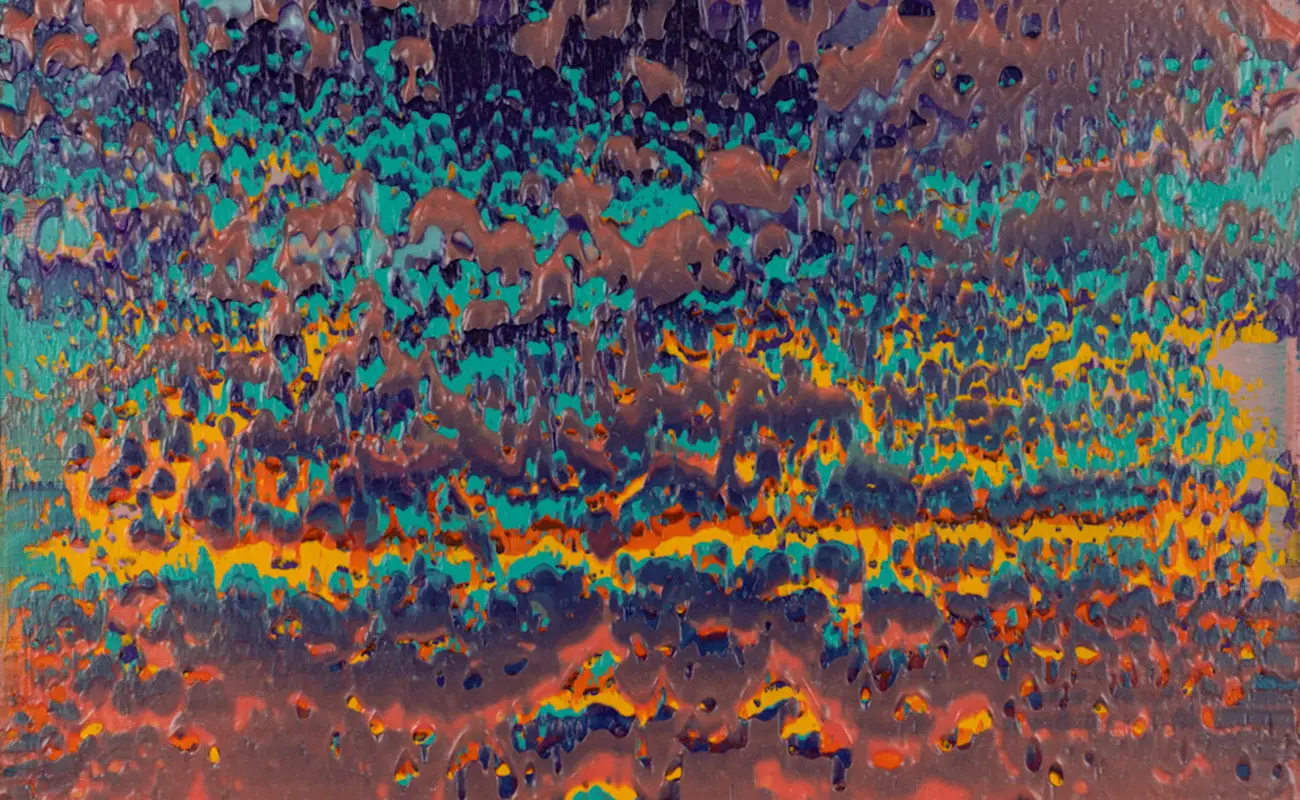
The physical act of painting is equally integral to the meaning of the finished piece. Dunn applies paint using a large sheet of plexiglass attached to a wooden handle, a tool associated with Gerhard Richter but adapted to his own purposes. This method produces a forceful and irregular application, creating fractures, gaps, and abrasions that expose earlier layers beneath. Thin passages gradually give way to thicker accumulations, resulting in surfaces that feel both unstable and intentional. What emerges is not a polished illusion but a record of action, revision, and persistence. The entire evolution of the painting remains legible, offering viewers access to its construction rather than concealing it behind refinement.
Energy functions as the essential element that unifies color and form within Dunn’s work. Rather than pursuing harmony for its own sake, he seeks a dynamic charge that compels sustained attention. This energy may appear aggressive or restrained, but it must be present for the work to succeed. Planning plays a paradoxical role within this framework. While Dunn imagines potential directions before beginning, he resists rigid preconceptions, allowing the painting to assert its own demands as it develops. Practical planning, such as ensuring sufficient materials, supports uninterrupted engagement with the work. The resulting paintings exist as negotiated outcomes between intention and resistance, where difficulty becomes productive and uncertainty generates meaning.

Gregory Logan Dunn: Inner Experience, Philosophy, and Contemporary Relevance
The conceptual foundation of Gregory Logan Dunn’s painting practice is rooted in an examination of the human spirit under pressure. His work addresses states of crisis, grief, and transformation, focusing on the effort to reach self awareness and spiritual clarity within an environment dominated by constant stimulation and consumption. Rather than presenting solutions, the paintings function as spaces of reflection where psychological tension and aspiration coexist. Themes of cosmic space, inner shadow, and the balance between light and darkness recur throughout his work, not as illustrations but as abstract conditions communicated through color, texture, and movement. These concerns extend outward toward collective challenges such as environmental responsibility and humanitarian awareness, while remaining grounded in personal accountability.
Dunn’s philosophy of making art is disarmingly direct yet rigorously demanding. His goal is to create a painting that compels sustained engagement, then to repeat that effort without complacency. Visual appeal alone is insufficient; the work must generate questions and invite contemplation. This requires pushing beyond comfort into zones of resistance, where resolution is uncertain and failure is possible. The paintings that demand the greatest struggle often produce the strongest responses, reinforcing his belief that difficulty is not an obstacle but a necessary condition of meaningful creation. Abstraction becomes the ideal language for this pursuit, allowing emotional and intellectual content to coexist without confinement to literal narratives.
An important dimension of Dunn’s public practice involves transparency around mental health. Diagnosed with Bipolar Disorder 1 in 2010, he chose to make this aspect of his life public in 2023 during Mental Health Awareness Month, framing the disclosure as an act of solidarity rather than self definition. His daily studio life at the Torpedo Factory reflects both discipline and flexibility, shaped by fluctuations in focus, energy, and emotional state. Some days are devoted to painting, others to contemplation, dialogue, or necessary pause. This honesty extends into his engagement with audiences, whether through open studio interactions or social media, where process videos and documentation create context and accessibility. Through this integrated approach, Dunn’s work maintains relevance by acknowledging vulnerability while insisting on rigor, positioning painting as both a personal necessity and a shared cultural inquiry.