
The Collision of Image, Motion, and Meaning
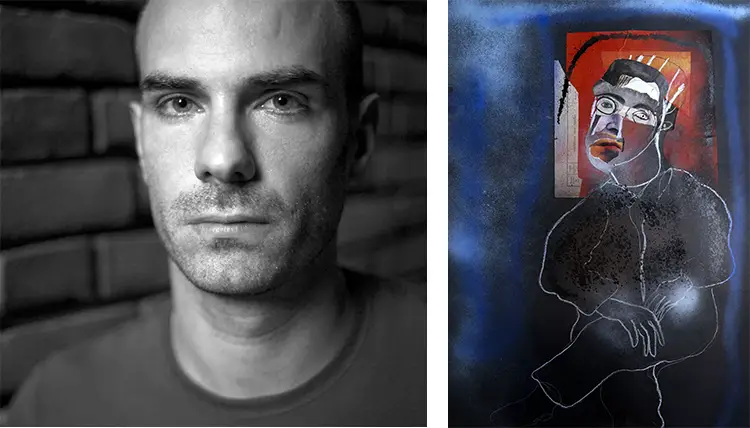
In a world where the digital and the analog frequently collide but rarely cohere, Giuseppe Ragazzini has carved out a singular position. Born in London in 1978 into a family steeped in artistic exploration, Ragazzini has since emerged as one of the most innovative figures bridging traditional painting with new media. His body of work, which spans live visual performances, pictorial animation, and immersive digital scenography, reflects a deep philosophical inquiry and technical fluency. Equally at home with brush and code, Ragazzini offers a compelling answer to the age-old question of whether technology and fine art can truly coexist. Through his lens, they don’t just coexist—they provoke and transform one another.
The artist’s formative years were marked by a rich exposure to artistic experimentation. His father, Enzo Ragazzini, a prominent photographer known for optical and darkroom experiments, immersed Giuseppe in a world of improvised tools and visual curiosity. These early influences laid the groundwork for what would become an unrelenting fascination with image transformation. Inspired by Henri-Georges Clouzot’s documentary Le Mystère Picasso, Ragazzini developed a method for animating his artistic process, translating real-time painting into flowing digital compositions. What began as a fascination with watching a drawing unfold became a life’s work of animating not only images but the very act of creation itself.
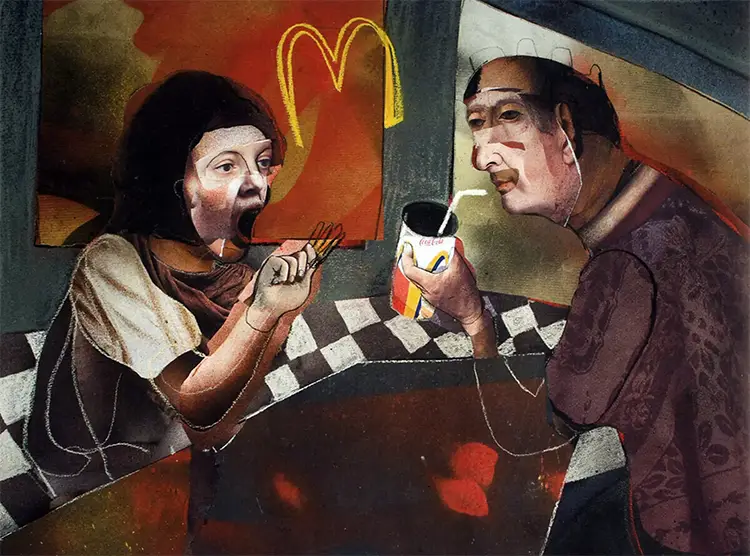
What distinguishes Ragazzini is his refusal to allow images to become static. His visual language thrives on change, layering, and metamorphosis. Whether he is producing video scenographies for globally recognized musicians or presenting pictorial animations at festivals such as Stuttgart’s International Trickfilm Festival or Brazil’s Anima Mundi, his work resists the notion of finality. His video projections have illuminated venues like Venice’s Teatro La Fenice and New York’s Lincoln Center, yet the spectacle is never just technical—it’s experiential. For Ragazzini, technology is not a tool for spectacle but a medium for impermanence, where images breathe, mutate, and mirror the fluidity of human identity and thought.
Giuseppe Ragazzini: Painting with Time and Thought
Ragazzini’s artistic philosophy is rooted in the fusion of three essential threads: philosophy, technology, and visual intuition. Trained academically in philosophy, his understanding of consciousness, identity, and perception is not merely theoretical—it pulses through every work he creates. Rather than pursue conceptual art in the academic sense, he embraces process-based improvisation, treating every frame or canvas as a dialogue between chance and control. He considers each piece an “organism” that evolves through its making, often straddling the delicate space between randomness and rigorous form. His works do not strive to fix meaning, but to let it move freely—like thought, like memory, like life.
The concept of imperfection plays a crucial role in his method. Ragazzini rejects the sterile precision of algorithmic output in favor of what he calls “beautiful imperfection.” This belief formed the core of his TEDx talk, where he explored how randomness not only distinguishes art from artificial intelligence but also defines the human condition itself. Perfection, he argues, is a stasis that opposes growth and transformation. Machines may produce flawless replicas, but they cannot feel the ineffable joy of an idea emerging from chaos. Ragazzini’s work celebrates those unpredictable moments, the ones that might arise from a misplaced stroke or a sudden shift in direction, as the true generators of authenticity.
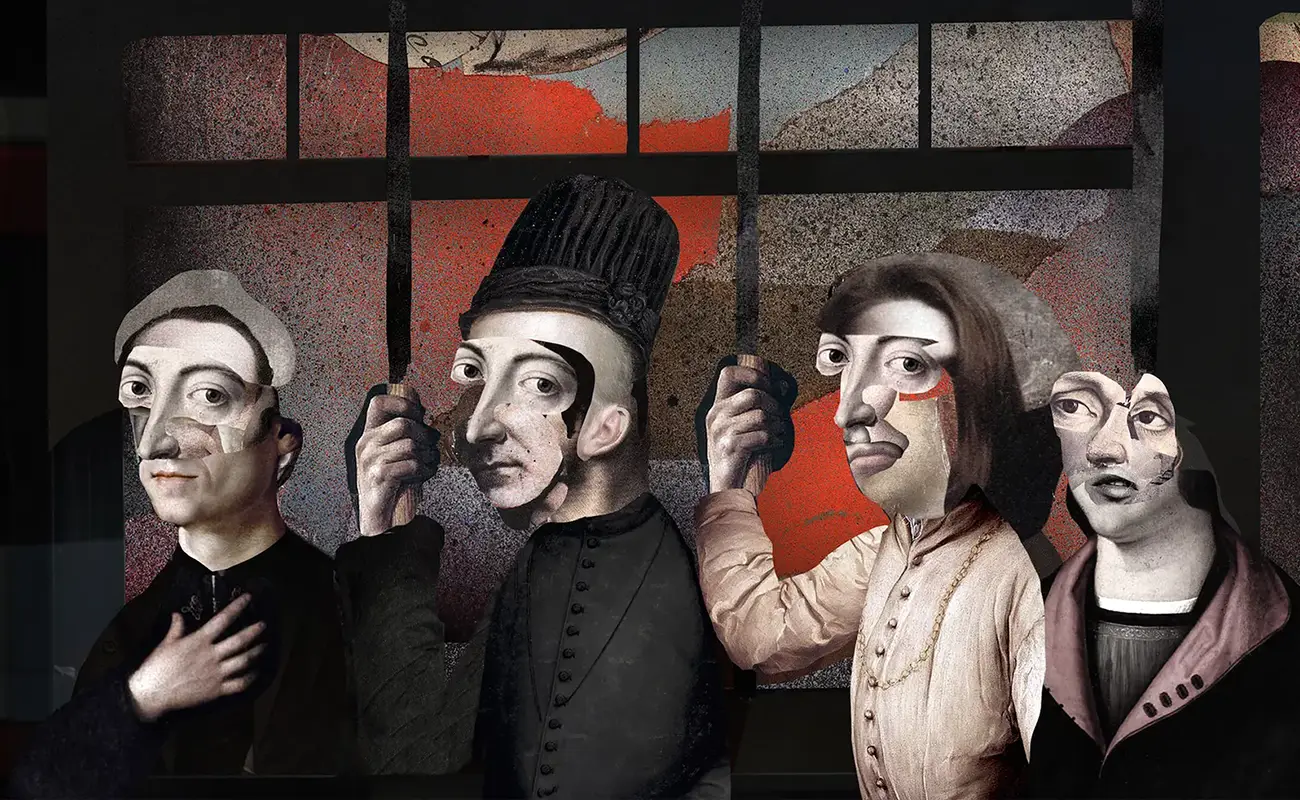
Nowhere is this tension between control and spontaneity more evident than in his animations. Using a combination of frame-by-frame techniques and interpolated transitions, he preserves each step of the painting process by capturing it digitally—often in real time. This is not simply for archival purposes. It allows him to revisit and reinterpret the moment of creation, to use the visual residue of the past as raw material for new motion. In works like The Kiss, a digital animation composed of sixty collages derived from Renaissance paintings, he merges video footage of a real kiss with historical fragments, reassembled and animated using morphing techniques. The result is a poetic meditation on time, intimacy, and memory, where the past and present dance in perfect dissonance.
Craft, Code, and Creative Evolution
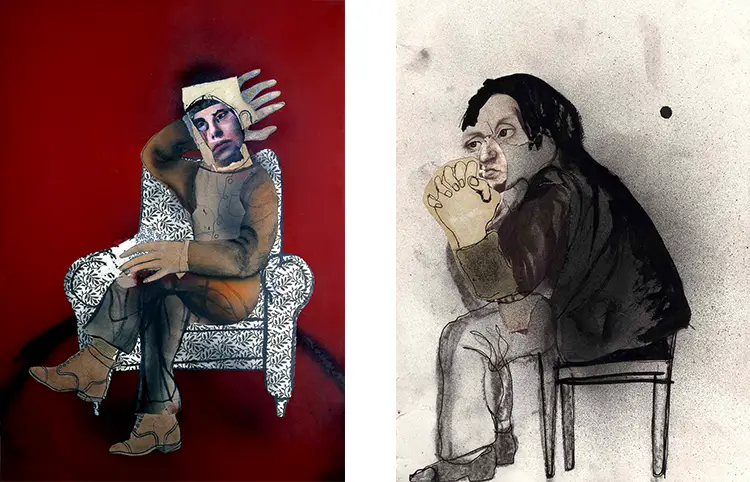
Ragazzini’s practice refuses to acknowledge the usual boundaries between traditional and contemporary art. He sees himself not as a departure from the past, but as a link that ties the thread of classical craft to modern expression. By combining tools like oil paint and ink with iPads, motion sensors, and morphing software, he aligns himself with artists of the past who used whatever means were available to articulate their vision. He draws from the same well as the Old Masters but channels it through the software of today. For Ragazzini, it is not the tool that defines the work, but the energy of transformation that it enables.
His embrace of interactivity is perhaps one of the most forward-thinking aspects of his career. Among his digital experiments, The Interactive Collage Machine stands out as a seminal piece. Using one of the earliest Kinect cameras and built through Quartz Composer, the installation allowed users to animate digital collages with their own body movements. It’s a vivid example of how Ragazzini invites viewers to not only observe but become part of the artwork. This participatory approach also shaped Mixerpiece, his app that democratizes collage-making through a playful, educational interface. Aimed at children yet robust enough for seasoned artists, the app curates public domain elements from centuries of art history and empowers users to remix them into new narratives.
At the core of these projects lies a fascination with identity—not as a fixed entity but as an evolving construct. Much like his art, Ragazzini sees identity as something built through relationships, through difference, and through the continuous encounter with the unknown. His method is improvisational, responding to instinct and to the unexpected. This openness has led him to collaborate with musicians, festivals, and theater companies across Europe and beyond. Whether designing a stage set for Spoleto Festival’s La Dolce Vita tribute or developing AI-powered collage tools for Italian tech companies, Ragazzini always brings the same creative question: how can transformation become visible, and how can art remain alive in the process?
Giuseppe Ragazzini: Future Images in Motion
Ragazzini’s vision for the future of art does not dwell in nostalgia, nor does it fully submit to digital utopianism. Instead, he imagines a hybrid landscape where technological innovation serves a deeper artistic lineage. His enthusiasm for tools like AI, motion capture, and generative design is balanced by a caution against their homogenizing tendencies. For him, mastery over these technologies is essential—not to chase novelty, but to resist the flattening of artistic voice. He often returns to the metaphor of the trimaran, a boat transformed by new engineering but still powered by the wind. In this vision, digital art is not an abandonment of roots, but a reconfiguration of them.
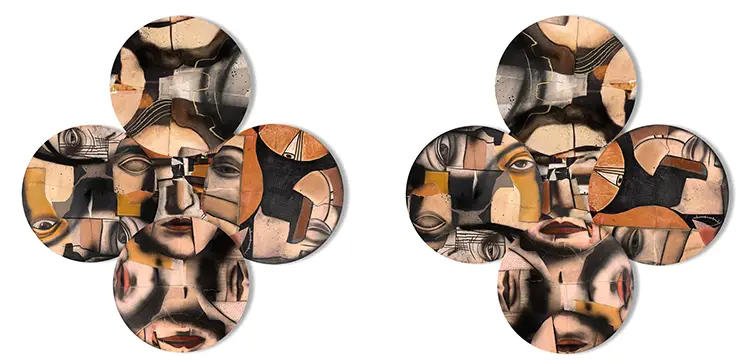
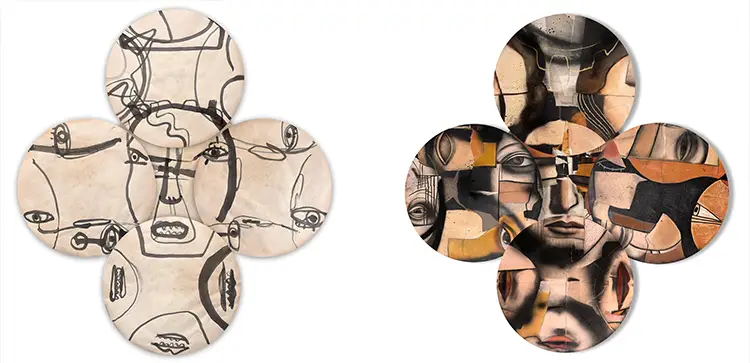
One of his recent projects, The Face Wheel, reflects this integration of technology and tradition. This kinetic sculpture consists of five rotating discs programmed to move at different angles, generating hundreds of possible formal combinations. 1024 combinations are made possible by this kinetic artwork created by Giuseppe Ragazzini, who transformed his series of digital gears into physical objects. Five 80 cm discs are moved by four stepper motors programmed through Arduino. Each of the four discs features four figurative elements arranged at 90° intervals. The possible combinations created by this dynamic collage are therefore five to the power of four, i.e. 1024. The video in which the artist paints live on the first prototype of this sculpture has received millions of views online. The work has been exhibited in several shows, including the group exhibition The Work of Art in the Age of Artificial Intelligence and Art in Motion: AI Creatives at the Singapore Race Night, presented at The Art House in Singapore.
Despite his deep involvement in digital experimentation, Ragazzini remains anchored in the tactile pleasures of traditional artmaking. He frequently expresses a desire to return to painting, though his schedule rarely allows it. His studio, located in Milan, is a space where jazz music plays in the background and ideas gestate without immediate deadlines. Outside the studio, he finds balance in music and the sea, two elements that, like his art, are fluid, rhythmic, and deeply sensory. Even as he continues to explore artificial intelligence, generative storytelling, and NFT platforms, he holds tightly to the intuition that first led him to draw portraits as a child. For Ragazzini, the future of art will not be written only by algorithms, but by those who understand how to make them dance.