
“Every piece I create is a celebration of our natural world and a reminder of our precious interdependency on nature.”
A Practice Rooted in Presence and Interconnection
Emma Lopes introduces herself as an artist, illustrator, and educator working along Portugal’s coastline, a setting that quietly informs the direction and sensitivity of her creative life. Time spent outdoors is not an occasional influence but a defining rhythm that shapes how she observes, interprets, and ultimately creates. The landscapes she inhabits are not treated as distant subjects but as living systems she participates in, and this perspective infuses her work with a sense of closeness and care. Rather than positioning herself apart from nature, she frames her role as one of witness and participant, translating lived encounters into visual language. Her work consistently reflects a belief that all forms of life are interdependent, and this conviction is not presented as an abstract idea but as something tangible and felt within each piece she produces.
That philosophy extends beyond theme and becomes a guiding structure for how her imagery is built. Each artwork functions as both celebration and reminder, emphasizing the fragile balance that sustains ecosystems while encouraging viewers to reconsider their own place within that balance. Her approach does not rely on grand statements or didactic imagery, but instead invites contemplation through detail, rhythm, and layered visual storytelling. Natural forms appear not as static objects but as dynamic systems, suggesting movement, growth, and subtle exchanges of energy. This sense of vitality is central to her work, encouraging a deeper awareness of how interconnected systems operate both visibly and invisibly.
Living near the coast also reinforces her sensitivity to shifting environments, where light, weather, and seasonal change continually reshape perception. These variations become part of her visual vocabulary, influencing both palette and composition. Her work often carries an undercurrent of gratitude, not in a sentimental sense, but as a recognition of the privilege of observing and engaging with these environments. This gratitude translates into careful attention, where even the smallest marks contribute to a larger narrative about coexistence. Through this approach, Emma Lopes establishes a practice that is as much about observation and reflection as it is about image-making, positioning her work within a broader conversation about ecological awareness and human connection to the natural world.

Emma Lopes: The Language of Pattern, Texture, and Reflection
Art has always been central to Emma Lopes’s life, functioning as both a form of exploration and a method of understanding. From an early age, creating images allowed her to engage with color, texture, and imagination in a way that felt both instinctive and grounding. Over time, this intuitive engagement developed into a more defined practice, where art became a bridge between internal reflection and external observation. Her process is not driven by the need to replicate what she sees, but by a desire to interpret and respond to it, capturing both physical structures and emotional impressions. This dual focus allows her work to operate on multiple levels, offering both visual richness and a sense of introspection.
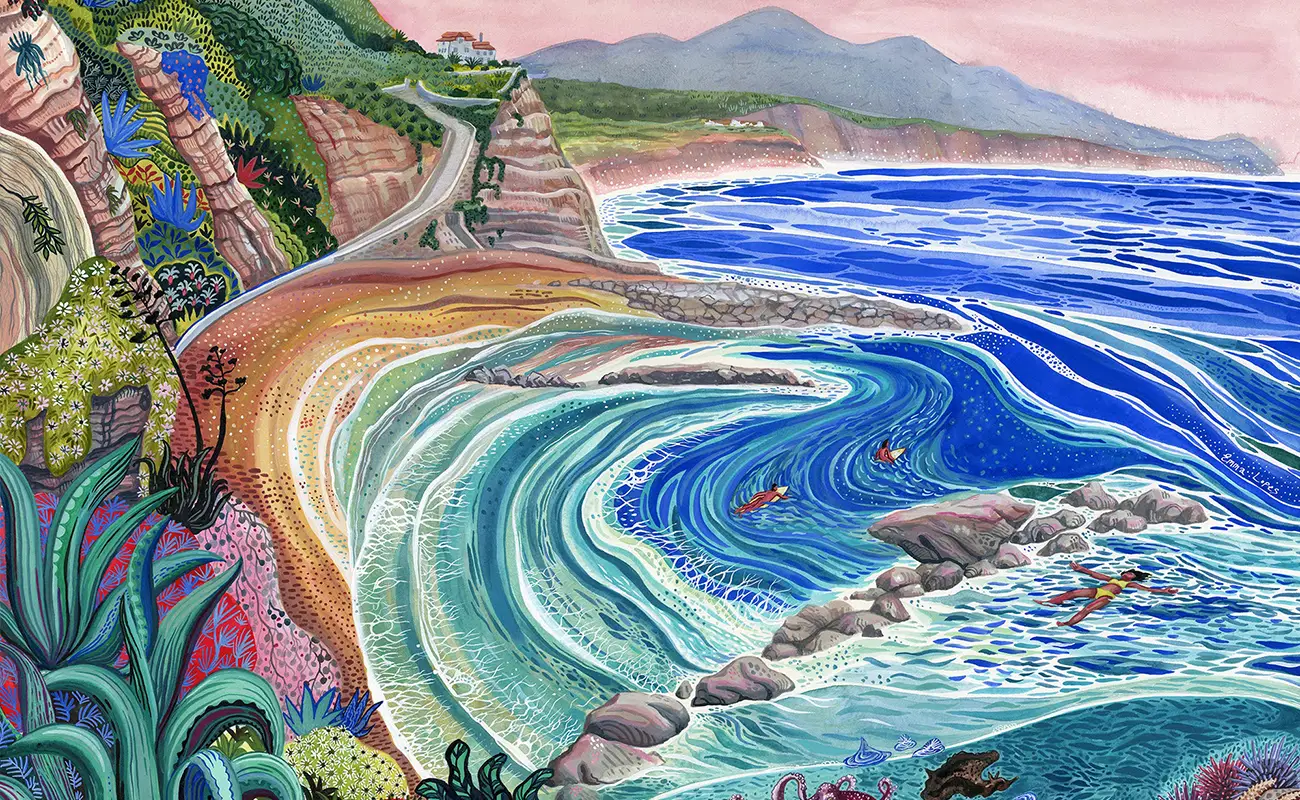
As her artistic voice matured, a clear focus on biodiversity and the complexity of natural systems emerged. She became increasingly drawn to the patterns that exist across different scales, from microscopic structures to expansive landscapes. These patterns are not treated as decorative elements but as fundamental expressions of how life organizes itself. Through repeated mark-making, she constructs intricate surfaces that echo these systems, creating compositions that feel both ordered and organic. This repetition introduces a meditative quality to her work, where the act of drawing becomes a sustained engagement with rhythm and attention.
The emphasis on mark-making also allows her to communicate subtle variations within repetition, reflecting the way natural systems maintain structure while constantly evolving. Each line and form contributes to a larger visual field, creating a sense of movement and continuity. This approach encourages viewers to slow down and engage more closely with the work, discovering layers of detail that reveal themselves gradually. By combining careful observation with a deeply personal process, Emma Lopes creates images that are not only visually compelling but also reflective of a sustained dialogue between the artist and the environments that inspire her.

Influence, Material Sensibility, and the Energy of Living Systems
Emma Lopes’s connection to nature is something she describes as inherent, yet it was also nurtured and encouraged throughout her life. This early support helped shape her enduring sense of curiosity and wonder, which continues to guide her work today. Rather than losing that initial sense of fascination, she has refined it, channeling it into a practice that seeks to communicate the vitality present in all forms of life. Her work often attempts to capture an intangible quality, a sense of energy or vibration that exists within both natural environments and human experience. This focus on energy adds another layer to her imagery, suggesting that what we see is only part of a more complex and interconnected system.
The artists she admires further illuminate her approach, particularly those who engage deeply with material and form. Vanessa Barregão’s textile work and Courtney Mattison’s ceramic sculptures stand out for their ability to translate ecosystems into tactile, immersive experiences. These practices highlight the importance of materiality, showing how texture and physical presence can enhance the communication of natural themes. Emma Lopes draws inspiration from this sensitivity, even when working in different mediums, aiming to evoke a similar sense of depth and engagement within her own work.
Yayoi Kusama’s exploration of repetition and infinity also plays a significant role in shaping her perspective. Kusama’s focus on patterns as a way of understanding both internal and external worlds resonates strongly with Lopes’s own interests. This influence can be seen in her use of repeated marks and structured compositions, which suggest continuity and interconnectedness. By combining these influences with her own experiences, Emma Lopes develops a visual language that feels both personal and expansive, rooted in observation yet open to broader interpretations about existence and connection.

Emma Lopes: Sketchbooks, Process, and Expanding Scale
Among the many elements of her practice, Emma Lopes places particular importance on her sketchbooks, which she considers some of her most meaningful works. These books serve as intimate records of time spent observing and engaging with natural environments, capturing not only visual details but also emotional responses to specific moments. Each page represents an act of presence, where drawing becomes a way of slowing down and fully experiencing a place. Rather than focusing on polished outcomes, these sketches prioritize honesty and immediacy, preserving fleeting impressions that might otherwise be lost. This makes them both deeply personal and foundational to her broader body of work.
Her materials for sketching are intentionally simple and portable, often consisting of watercolor and white gouache, though she remains open to using whatever is available in the moment. This flexibility reinforces the spontaneous nature of her sketchbook practice, allowing her to respond directly to her surroundings without overthinking the process. These sketches function as both memory and research, forming a visual archive that she can return to when developing larger compositions. The emphasis remains on experience rather than perfection, with each page reflecting a genuine interaction with the environment.
In her studio, these collected observations evolve into more developed paintings, shaped by both direct experience and additional research. When working with subjects that are less accessible, such as deep sea life, she supplements her knowledge through books, images, documentaries, and preliminary drawings. Currently, she is preparing to expand her work into larger formats, building on an idea that began during time spent in Lisbon during the pandemic. Limited access to nature led her to reflect on the importance of urban green spaces, both for biodiversity and for human wellbeing. What began as small-scale explorations in sketchbooks is now growing into a larger project, where increased scale allows these environments to be experienced in new and more immersive ways.