
Witnessing Difference and Emotional Extremes
The work of Elinor Shapiro stands at the intersection of vulnerability, perception, and psychological intensity, offering viewers an uncompromising encounter with the inner mechanics of human connection. Her paintings focus on emotional states that are often uncomfortable, unresolved, or in flux, prioritizing authenticity over aesthetic ease. Rooted in personal history yet expansive in its emotional reach, her practice addresses what it means to exist outside standardized frameworks of behavior, learning, and communication. Shapiro’s art does not attempt to simplify the human condition, but instead presents it as layered, contradictory, and deeply felt. Through her use of mixed media and expressive figuration, she creates visual environments where emotion is not illustrated but embodied. The resulting works hold tension between exposure and concealment, asking viewers to engage with what is sensed rather than what is clearly explained.
Born in 1997 in Los Angeles, Shapiro spent her formative years navigating an educational environment designed for students with learning disabilities and exceptional intellectual abilities. The final seven years of her pre university education took place within a specialized academy that profoundly shaped her understanding of human psychology. This period was marked by both intellectual awakening and emotional trauma, as she observed peers oscillate between brilliance and psychological distress. Experiences of depression, instability, and emotional fragmentation were not abstract concepts but daily realities. Witnessing creativity eroded by mental health struggles left a lasting imprint on her perspective. These experiences sharpened her sensitivity to the fragile balance between cognition and emotion, and they continue to inform the psychological depth present in her visual language.
Rather than distancing herself from these memories, Shapiro integrated them into the foundation of her artistic identity. Her work consistently reflects an awareness of difference, not as a limitation but as a defining condition of being human. The figures she creates often appear isolated or disconnected, mirroring the emotional separation she observed during her schooling years. Yet there is also empathy embedded in this distance, an acknowledgment of shared vulnerability. Her paintings operate as spaces where complexity is permitted to exist without resolution. By confronting experiences that are frequently hidden or misunderstood, Shapiro positions her work as both a personal reckoning and a broader reflection on emotional diversity and psychological survival.

Elinor Shapiro: A Studio Practice Driven by Instinct and Physicality
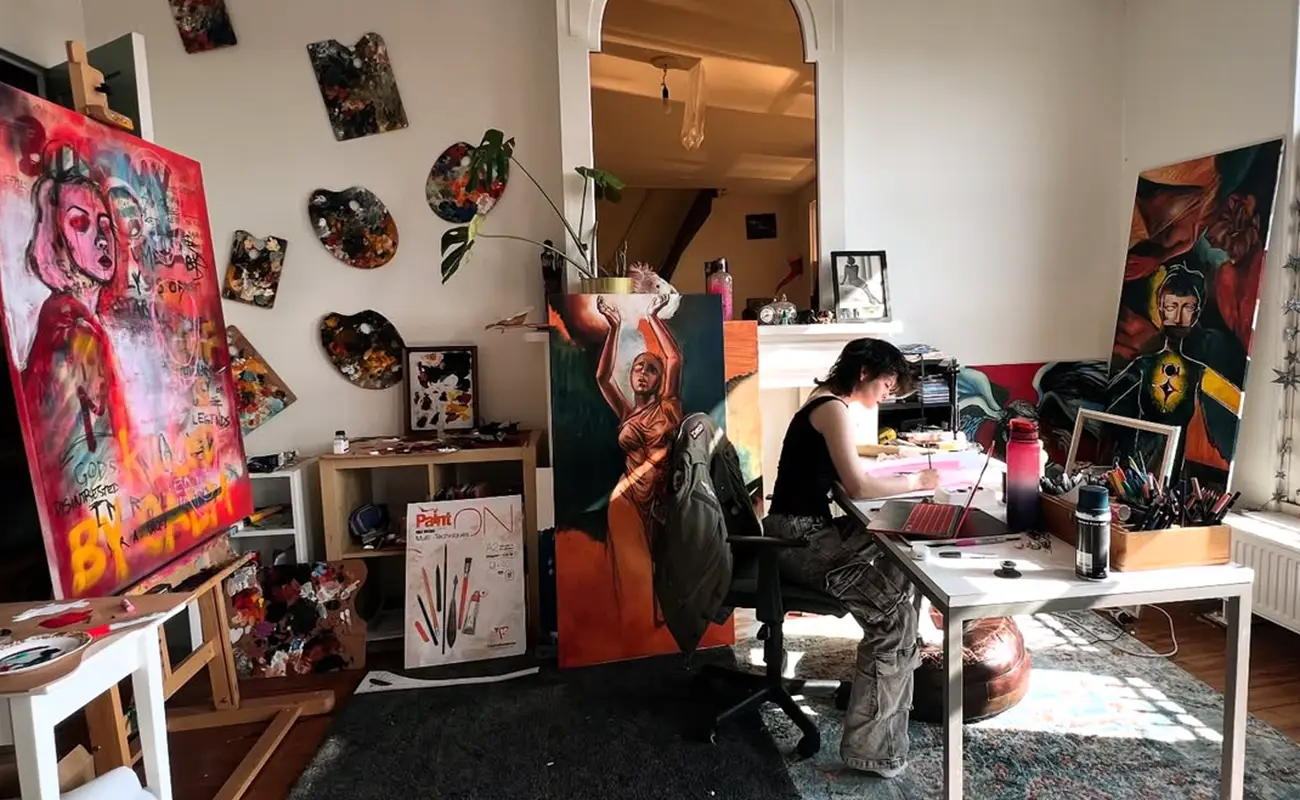
Shapiro’s studio process is marked by speed, force, and an absence of preciousness toward materials. She works primarily on large canvases laid directly on the floor, moving across their surfaces with her entire body engaged in the act of making. Fast paced music fills the space as she walks, scribbles, and strikes the canvas with charcoal before layering additional materials. There is no reverence for the blank surface, no hesitation before the first mark. The canvas is treated as a site of action rather than an object to be preserved. This physical approach allows her to bypass overthinking and access a more immediate emotional register, one that aligns with the urgency present in the themes she explores.
Her paintings are constructed through the accumulation of charcoal, chalk pastel, spray paint, acrylic, ink, and oil paint. This combination gives her the ability to alternate between precision and erosion, rendering a figure with care in one moment and disrupting it the next. Lines may define a face only to dissolve into abstraction, while color can both clarify and obscure form. The figures that emerge are intentionally unstable, reflecting emotional states that resist containment. Shapiro often exaggerates specific body parts such as hands, eyes, or spines, using distortion as a means of translating internal sensation into physical form. These choices are not decorative but psychological, rooted in how emotion reshapes perception.
A recurring element in her portraits is the treatment of the eyes, which are frequently left unpainted or rendered in an abstract manner. This absence shifts attention inward, suggesting introspection rather than outward observation. The viewer is denied direct access to the subject’s gaze, reinforcing a sense of internal focus and emotional withdrawal. This strategy aligns with Shapiro’s broader interest in self reflection and internal dialogue. Her figures do not seek engagement but exist within their own emotional landscapes. Through this impulsive and layered process, Shapiro constructs images that feel lived in, carrying traces of movement, resistance, and release embedded within their surfaces.

Language, Error, and the Emotional Weight of Words
Written language plays a critical role in Shapiro’s visual vocabulary, functioning as both content and structure within her paintings. Words and phrases appear scrawled, embedded, or partially obscured beneath layers of pigment, operating as emotional signals rather than narrative explanations. These textual elements often originate from fragments of conversation or persistent thoughts that linger in her mind at the start of a painting. When their emotional charge is strong enough, they are transferred directly onto the canvas. For Shapiro, words possess a descriptive power distinct from imagery, and their inclusion expands the expressive range of her work. The coexistence of text and figure creates a dialogue between visual and verbal modes of understanding.
Her relationship with language is deeply personal, shaped by lifelong struggles with spelling and writing linked to her learning disability. Rather than concealing these difficulties, Shapiro actively reclaims them by allowing errors and irregularities to remain visible within her work. Misspellings and fragmented phrases are not corrected or refined but presented as integral components of the composition. This decision transforms what might traditionally be viewed as mistakes into markers of authenticity. By foregrounding imperfection, she challenges conventional hierarchies of correctness and fluency. The written word becomes a site of empowerment, reflecting resilience and self acceptance rather than deficiency.
The visibility of text within her paintings varies, sometimes clearly legible and other times buried beneath layers of paint. This fluctuation mirrors the instability of memory and thought, where some ideas surface clearly while others remain obscured. Shapiro has emphasized that these words are not meant to be decoded in a singular way. Their meanings are intentionally open, allowing each viewer to form a personal interpretation. Works such as Eatmyeyes and Stone exemplify this approach, combining expressive figuration with embedded language to create emotionally charged surfaces. In these pieces, words function as emotional residues, inviting feeling rather than explanation and reinforcing the deeply internal nature of her practice.

Elinor Shapiro: Movement, Influence, and an Expanding Artistic Voice
Shapiro’s artistic development has been shaped by geographic movement and sustained exposure to diverse creative communities. After majoring in art at California State University, Northridge, where she focused on figure drawing and printmaking, she relocated to Orquevaux, France. There, she served as Associate Director at the artist residency Chateau Orquevaux from 2019 to 2021. This role immersed her in a constantly shifting environment of international artists working across disciplines. The monthly arrival of new residents created an ongoing exchange of techniques, ideas, and cultural perspectives. This experience offered a sense of freedom that contrasted sharply with her earlier academic training, allowing her work to evolve through dialogue rather than structure.
The influence of art history also runs quietly but persistently through her work. Shapiro grew up frequenting museums, internalizing the presence of artists she considers familiar companions. Figures such as Malevich, Modigliani, Caravaggio, Picasso, Basquiat, Monet, and Kandinsky occupy her subconscious as sources of visual and emotional guidance. Their approaches to form, movement, and expression inform her practice without overt imitation. These influences coexist with her contemporary experiences, contributing to a visual language that feels both historically aware and distinctly personal. Her engagement with mixed media further reflects this synthesis, blending traditional materials with experimental application.
During the pandemic, Shapiro moved to New York City, where the intensity of urban life and prolonged isolation pushed her toward new modes of expression. She continued combining words, figures, and emotional states, producing exhibitions and gaining experience within gallery settings. Her work remained focused on the complexities of human interaction, now filtered through the density and anonymity of the city. With plans to move to Colombia, her trajectory suggests an ongoing commitment to growth through displacement and observation. Each relocation adds another layer to her understanding of communication and emotional expression, ensuring that her artistic voice continues to expand while remaining grounded in lived experience.