“Forms appear without a preconceived idea, unfolding with the energy of the brush as the painting gradually reveals itself.”
Between Improvisation and Testimony
Didier Rouby’s artistic journey reflects a persistent effort to translate the emotional and intellectual turbulence of modern society into visual form. Born on October 17, 1960, in France, Rouby developed an early interest in artistic expression during adolescence, long before publicly presenting his work. His path first unfolded independently, guided by curiosity and experimentation rather than institutional frameworks. Later, formal study at the Municipal School of Fine Arts in Le Puy-en-Velay strengthened his technical understanding and expanded his artistic awareness. This combination of self-directed exploration and academic training shaped a practice that values both freedom and reflection. Today, Rouby lives in French Guiana, where he has continued to share his work through exhibitions. His paintings and mixed media compositions speak not only about personal sensitivity but also about collective concerns. Through layered imagery, expressive gestures, and conceptual references, Rouby transforms contemporary anxieties into visual narratives that invite viewers to reflect on their place within society and history.
Rouby’s career as a retired teacher contributes to the thoughtful nature of his creative output. Years spent in education cultivated a reflective outlook that naturally extends into his visual work. Rather than seeking purely aesthetic solutions, his paintings frequently function as observations or questions addressed to society. Participation in exhibitions such as the Salon de l’Art Français in Hyères in April 2008 placed his work within broader artistic conversations, particularly during the event commemorating the sixtieth anniversary of the Universal Declaration of Human Rights. Such contexts highlight the ethical dimension that runs throughout his production. Later, after relocating to French Guiana in 2012, Rouby renewed his public engagement with art exhibitions. Presentations at Salle Pagaret in Rémire-Montjoly in January 2025 and the collective exhibition Talents d’Armire at the town hall of the same municipality in July 2025 introduced his work to new audiences. These exhibitions reveal an artist motivated by dialogue, where painting becomes a vehicle for reflection on cultural identity, memory, and responsibility.
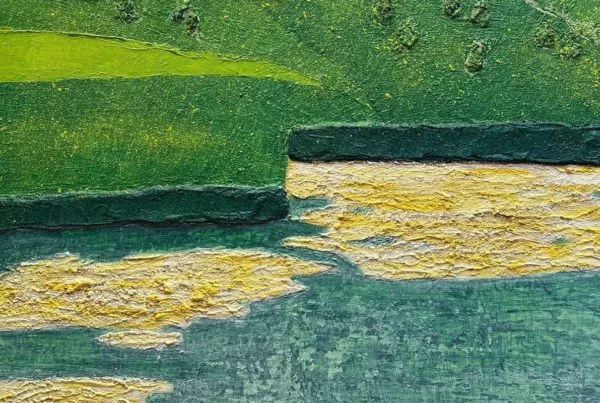
Mixed media techniques play a central role in Rouby’s visual language. Acrylic and oil often coexist within the same composition, allowing him to balance spontaneous gestures with layered textures. The surfaces of his works frequently suggest an evolving process rather than a fixed plan. In certain pieces, ideas appear gradually through the movement of the brush, while in others conceptual intentions guide the composition from the beginning. This dual approach allows Rouby to navigate between improvisation and deliberate commentary. Some paintings arise from free creative flow, where shapes and colors emerge without predetermined structure. Other works respond directly to historical or social realities that deeply affect the artist. Together, these two directions form a cohesive practice in which emotional immediacy meets intellectual inquiry. The result is an artistic language that captures both the unpredictability of creative expression and the urgency of contemporary questions about humanity, culture, and the future.

Didier Rouby: Improvisation as Creative Energy
Improvisation forms one of the most distinctive aspects of Didier Rouby’s artistic approach. In several works, the painter deliberately abandons preconceived ideas, allowing movement, gesture, and intuition to guide the formation of the image. Paint becomes an instrument through which thought unfolds spontaneously. The works titled Impro 1 and Impro 2, both created in 2023 with acrylic on canvas, embody this philosophy. Each composition emerges from energetic brushwork where shapes develop gradually, almost as if discovered rather than constructed. The artist describes this process as a form of creative flow in which the brush becomes the extension of emotion. Rather than pursuing rigid structure, Rouby welcomes the unexpected, allowing visual rhythms to determine the final appearance. These paintings recall elements associated with cubist thinking, where forms evolve through fragmentation and reconstruction. Yet the spirit remains deeply personal, emphasizing the act of painting itself as a living moment of discovery.
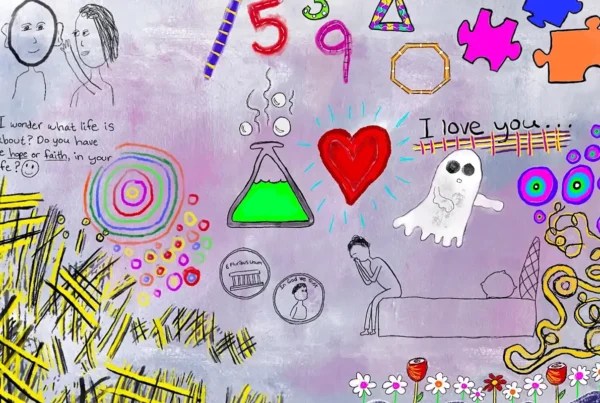
Improvisation also appears in works that relate to music, emotion, and human connection. The piece Lyrique, created in 2005 using gouache on paper mounted onto cardboard, draws inspiration from musical expression. Lines and shapes echo rhythmic movement, suggesting the invisible influence of sound on visual composition. Another earlier work, Toi et Moi from 2000, addresses the intimate themes of love and shared existence. Produced in gouache on paper, this painting focuses on the emotional dialogue between two individuals, transforming personal relationships into symbolic imagery. Within these works, Rouby demonstrates that improvisation does not exclude meaning. Instead, it allows emotional truths to emerge naturally through color and gesture. The absence of strict planning encourages authenticity, enabling the artist to translate inner sensations into visible forms that remain open to interpretation by viewers.
This improvisational dimension also reflects Rouby’s broader philosophy about creativity. Artistic practice becomes a space where intuition interacts with lived experience. Each brushstroke carries traces of the artist’s thoughts, doubts, and hopes. Improvised compositions often produce shapes that seem to appear organically, reinforcing the sense that art is a living process rather than a calculated design. Such an approach aligns with Rouby’s sensitivity to the unpredictability of life itself. Social changes, cultural encounters, and personal reflections all feed into the act of painting. Through improvisation, the artist embraces uncertainty and transformation, allowing visual language to evolve freely. These works therefore stand not only as aesthetic experiments but also as expressions of a mindset that values openness and creative risk.

Images of Society, Memory, and Conflict
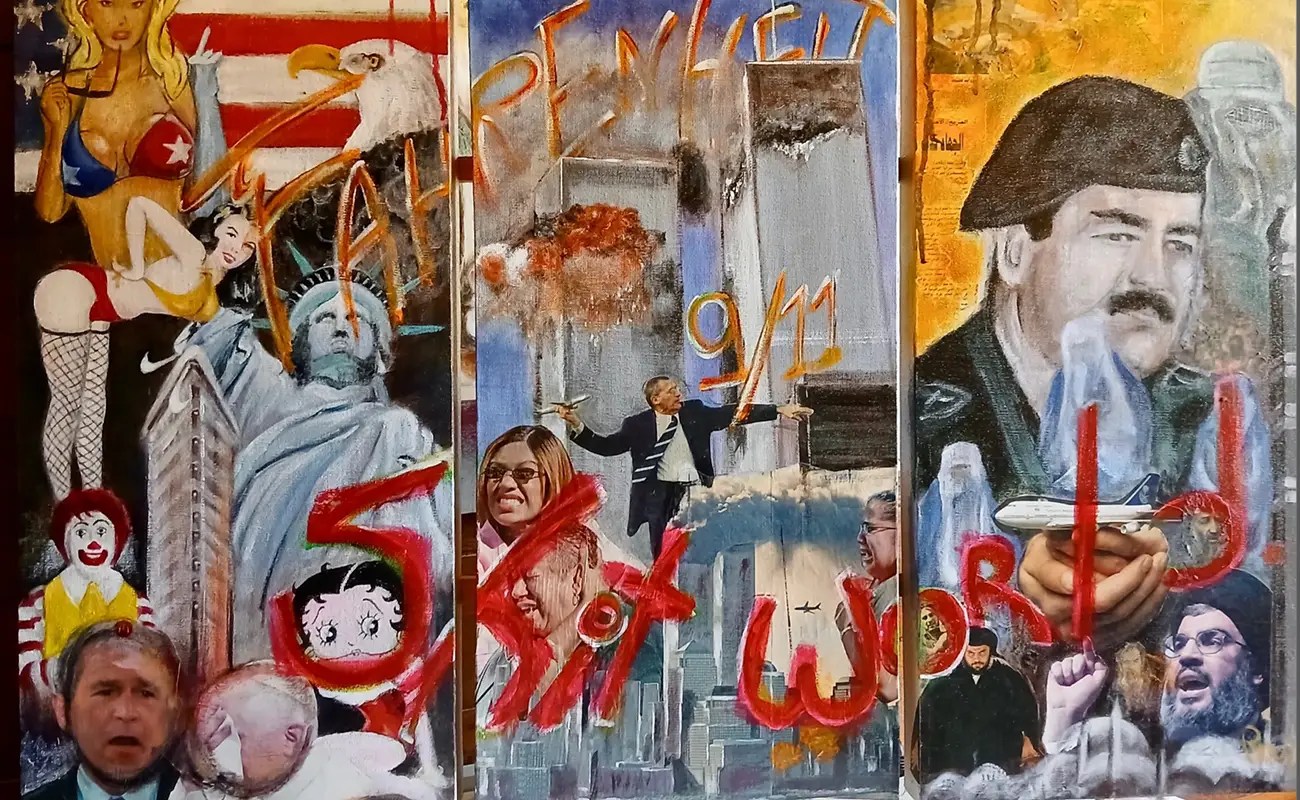
Alongside improvisational works, Didier Rouby creates compositions that directly confront historical and social events. These paintings serve as visual testimonies, inviting reflection on the forces shaping modern societies. One significant example is the triptych September 11, produced in 2006 using photographs and oil on canvas. Measuring 92 by 60 centimeters, this mixed media work addresses the traumatic events surrounding the attacks on the Twin Towers. At the center, the towers themselves stand as symbols of tragedy and loss, representing the thousands of innocent lives sacrificed during that moment of global shock. Rouby describes the piece as a portrayal of horror witnessed in real time, while also acknowledging the pride and determination that emerged in response to extremist violence. By combining photographic material with painted elements, the artist constructs a layered visual statement that reflects both collective grief and the complexity of political reality.
Another powerful example of social commentary appears in the work The Adult War, painted in 2024 with acrylic on canvas. This piece addresses the recurring nature of wars and conflicts that seem specific to human societies. The title introduces a striking contrast between adulthood and childhood, suggesting that violence represents a troubling inheritance passed down through generations. The presence of children in the composition raises an unsettling question about the future of humanity. Will younger generations escape the cycles of conflict that have shaped history, or will they continue to bear the consequences of decisions made by adults? Through this painting, Rouby encourages viewers to consider the moral responsibilities carried by societies that claim to value progress while repeatedly engaging in destructive confrontations.
The work Conflits, created in 2005 using oil on canvas, offers another perspective on violence and psychological distress. The painting presents a face marked by a wandering, almost disoriented gaze. A strong red glow surrounds the figure, evoking the emotional impact of blind terrorism and the chaos it produces. Rather than depicting a specific event, the composition captures the internal turmoil associated with conflict. Rouby’s treatment of the face suggests fear, confusion, and vulnerability. This approach transforms the subject from a political topic into a human experience. Viewers encounter not only the idea of conflict but also the emotional consequences carried by individuals living within unstable environments. Through works such as these, Rouby establishes painting as a space where memory, responsibility, and reflection intersect.

Didier Rouby: Identity, Media, and Cultural Encounters
Questions of identity and cultural perception appear frequently throughout Didier Rouby’s work. Certain paintings examine how individuals understand themselves within complex social environments shaped by media, technology, and cultural diversity. The piece Selfie, originally created in 2005 and revisited in 2025, addresses the transformation of identity in an era dominated by digital communication and social networks. Executed in gouache on paper mounted onto wood, the work reflects the global phenomenon of self representation through images shared online. Rouby interprets the selfie not simply as a casual photograph but as a symbol of how individuals construct and display their identities. Faces from different parts of the world appear within this context, suggesting that digital culture reshapes the ways people see themselves and others.
Media influence also emerges in works such as People 1 and People 2. The first, created in 2006 using mixed media with photographs and acrylic on wood, examines the impact of celebrity journalism and the constant presence of entertainment news. Rouby describes this environment as a system in which the celebrity press survives through continuous exposure, shaping public attention and cultural priorities. People 2, painted in oil on wood in 2005, refers to reality television programs such as Temptation Island, where emotions and relationships become part of a televised spectacle. Through these compositions, Rouby questions how modern media industries manufacture emotional experiences for mass audiences. The paintings encourage viewers to reflect on the boundary between authentic feelings and those constructed by entertainment formats designed to capture attention.
Cultural diversity forms another significant dimension of Rouby’s artistic perspective. The work L’Africaine, produced in 2006 using oil on wood, reflects his admiration for the richness and beauty of different cultures. The painting presents the gaze of a woman who represents the idea of a global citizen, embodying dignity and cultural heritage. Additional conceptual works expand this reflection. Nature/Culture, created in 2024 with acrylic on canvas, explores philosophical questions about identity and belonging, expressed through the imagined voice of a child asking where life leads and who they truly are. Virtual/Reality from the same year continues this inquiry by questioning whether happiness can truly be found within virtual environments such as the metaverse or whether such spaces merely provide escape from everyday life. Together these works illustrate Rouby’s ongoing effort to understand humanity through painting, observing how culture, technology, and personal identity continuously reshape one another.