
“I’m interested in how images function less as representations and more as emotional residues.”
Origins of a Quietly Restless Vision
David Miller’s artistic practice emerges from a life shaped by intellectual openness, cross-cultural movement, and a sustained engagement with visual storytelling. Born in London and now working between the United Kingdom and Finland, he belongs to a generation of artists whose foundations were formed before rigid stylistic labels solidified into movements. His formative years at Goldsmiths College
in the early 1970s placed him inside an environment defined by questioning rather than consensus. This was a period preceding the codification of what would later be termed Britart
, and the absence of that label mattered. Ideas were tested freely, images were treated as propositions rather than declarations, and meaning was understood as fluid. That atmosphere continues to shape how Miller approaches visual construction, not as a final statement but as an open field where interpretation remains active.
Before committing fully to visual art, Miller spent many years working as a filmmaker and scriptwriter. This chapter of his life sharpened his sensitivity to pacing, atmosphere, and the emotional consequences of sequence. Film trained him to think in terms of what remains unseen as much as what appears on screen, an approach that later transferred seamlessly into still imagery. Narrative, in his hands, became less about plot and more about psychological pressure, memory, and suggestion. Each image carries the residue of cinematic thinking, shaped by framing, implied duration, and the sense that something has either just happened or is about to occur.
Together, these experiences formed a practice grounded in memory and identity, yet resistant to explanation. Miller’s images function as constructed spaces where stories hover without resolving. Rather than instructing viewers on what to feel or think, his work creates conditions for contemplation. The influence of education, cinema, and lived experience does not surface as quotation, but as a steady undercurrent guiding how images are built, slowed down, and allowed to hold ambiguity without apology.

David Miller: Dreamlike Realism and the Architecture of Memory
The evolution of Miller’s visual language coincided with the arrival of tools that allowed him to articulate long-held concerns with precision and emotional depth. AI-assisted image making became central to his process, not as a novelty, but as a means of aligning conceptual rigor with intuitive resonance. These tools offered a way to externalize ideas he had been circling for decades, allowing images to surface that felt psychologically accurate rather than illustratively literal. His approach emphasizes careful editing and compositional control, ensuring that technology serves intention rather than spectacle.
Thematically, his work returns repeatedly to memory, identity, ritual, and interior landscapes. Visually, this manifests as a form of dreamlike realism, where scenes appear recognizable at first glance yet gradually reveal instability beneath their surface. Stillness plays a crucial role, not as absence of action, but as a charged state where emotional after-images linger. Figures are often placed in spaces that feel transitional or suspended, encouraging viewers to slow their gaze and remain with uncertainty rather than resolve it quickly.
Stylistically, Miller’s images echo the tonal gravity of nineteenth-century painting and early photography. Muted palettes, softened focus, and painterly textures create a sense of temporal erosion, suggesting how recollection wears down clarity over time. Scratches, patina, and blur are not decorative effects but conceptual devices, signaling how meaning degrades and reforms through repetition. His use of AI feels archaeological rather than futuristic, as if the images were uncovered rather than invented, reinforcing the sense that memory precedes authorship.

Cinematic Influence and the Ethics of Ambiguity
Cinema remains a foundational influence in Miller’s work, particularly films that privilege atmosphere and psychological dislocation over linear storytelling. Works such as Last Year at Marienbad
and Un Chien Andalou
continue to inform his understanding of memory as unstable and emotionally charged. These films offered him models of how repetition, silence, and visual suggestion can communicate more powerfully than exposition. Their influence is evident not through imitation, but through a shared commitment to ambiguity and emotional resonance.
Beyond specific references, Miller draws from literature, silence, and lived experience. Meaning, in his practice, is understood as something that accumulates slowly rather than arriving fully formed. Age and travel have contributed to a measured pace in his work, while meditation has sharpened his attention to interior states. He shows little interest in explaining images, preferring instead to construct spaces that viewers can enter with their own histories. Interpretation becomes a collaborative act, shaped as much by the observer as by the artist.
This ethical stance toward ambiguity defines the emotional tone of his work. Grief, tenderness, and unease coexist without tipping into spectacle. Childhood appears not as innocence, but as vulnerability and symbolic weight, while adulthood carries the burden of memory and protection. Stillness becomes a position of care, an insistence on allowing images to breathe. By resisting narrative closure, Miller invites sustained engagement, encouraging viewers to remain with what feels unresolved and quietly familiar.

David Miller: Stillness Between Rooms and the Weight of What Remains
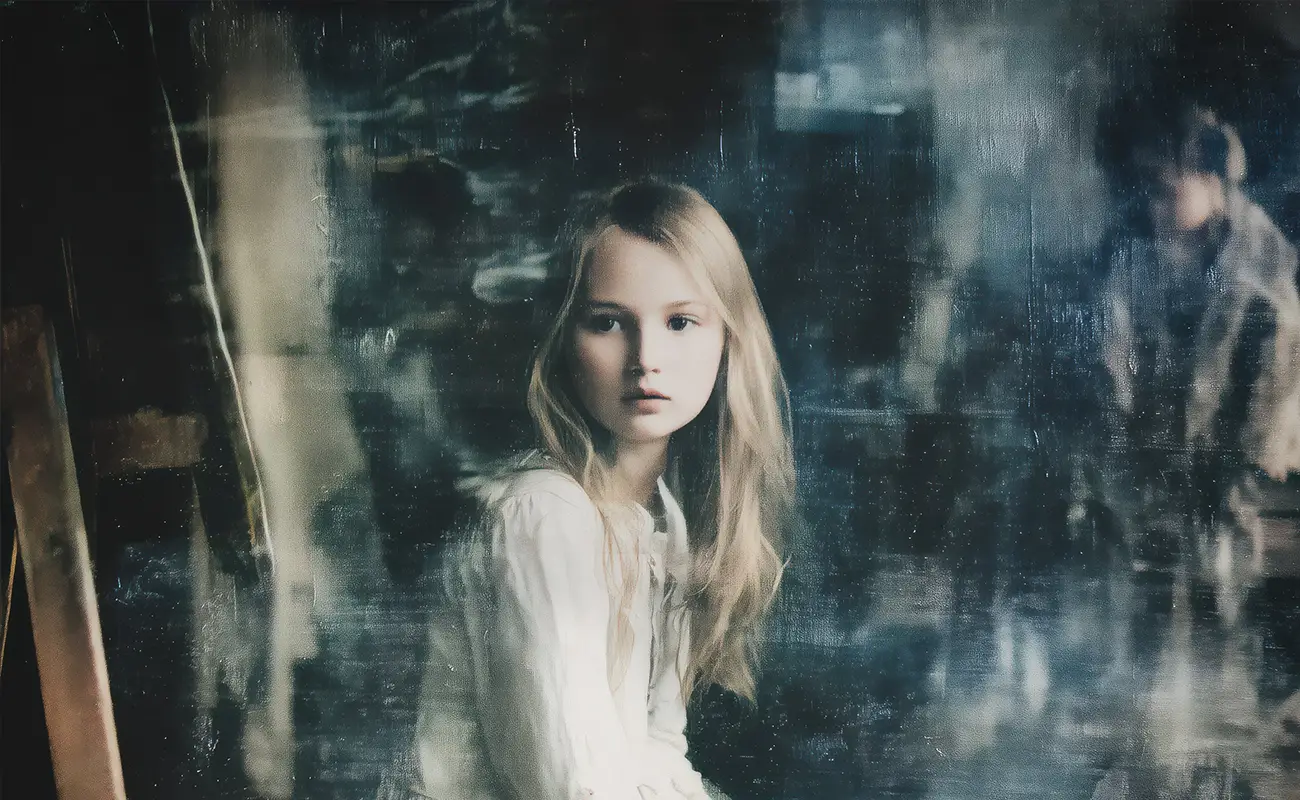
One of the most meaningful works in Miller’s practice is Stillness Between Rooms, an image depicting a solitary young figure within a deteriorating interior. The scene exists between categories, functioning as both portrait and apparition. Presence and disappearance coexist, creating a visual tension that resists resolution. The ambiguity is intentional, allowing the figure to operate less as an individual and more as a psychological vessel. What matters is not who the figure is, but what the image carries emotionally, a sense of memory recalled too late or too often.
The piece was created through an AI-assisted process and then carefully refined through color, texture, and composition. Miller’s editorial control ensures that the final image feels restrained rather than excessive. Its power lies in psychological weight rather than narrative clarity. The figure appears both watched and watching, suspended in a moment that refuses to settle. This duality reinforces themes of inheritance and absence, suggesting how memory can linger long after its original context has faded.
Within the broader scope of his work, Stillness Between Rooms exemplifies how Miller treats images as emotional residues rather than representations. The image does not explain itself, nor does it demand interpretation. Instead, it offers a space where viewers may recognize something indistinct yet familiar. Through such works, Miller constructs an internal mythology composed of recurring motifs and atmospheres, paused mid-scene, inviting contemplation rather than conclusion.