
“My work explores the dichotomy of synthetic and natural forms through painting, drawing, and collage.”
Synthetic Surfaces, Organic Echoes
David D’Andrade stands as a compelling figure within contemporary abstraction, shaping a practice that consistently balances material experimentation with conceptual rigor. Based in South Pasadena, California, he works as both an artist and educator, roles that mutually inform one another through sustained inquiry and critical reflection. His educational path includes formative years at Pratt Institute in New York during the early 1980s, followed by undergraduate and graduate studies at the San Francisco Art Institute, where he completed his BFA in 1994 and MFA in 1996. These academic environments exposed him to shifting dialogues around materiality, image-making, and critical theory, grounding his work in a deep awareness of art history while allowing space for experimentation. From the outset, his work positioned abstraction not as a retreat from meaning but as an active system for examining perception in an increasingly mediated world.
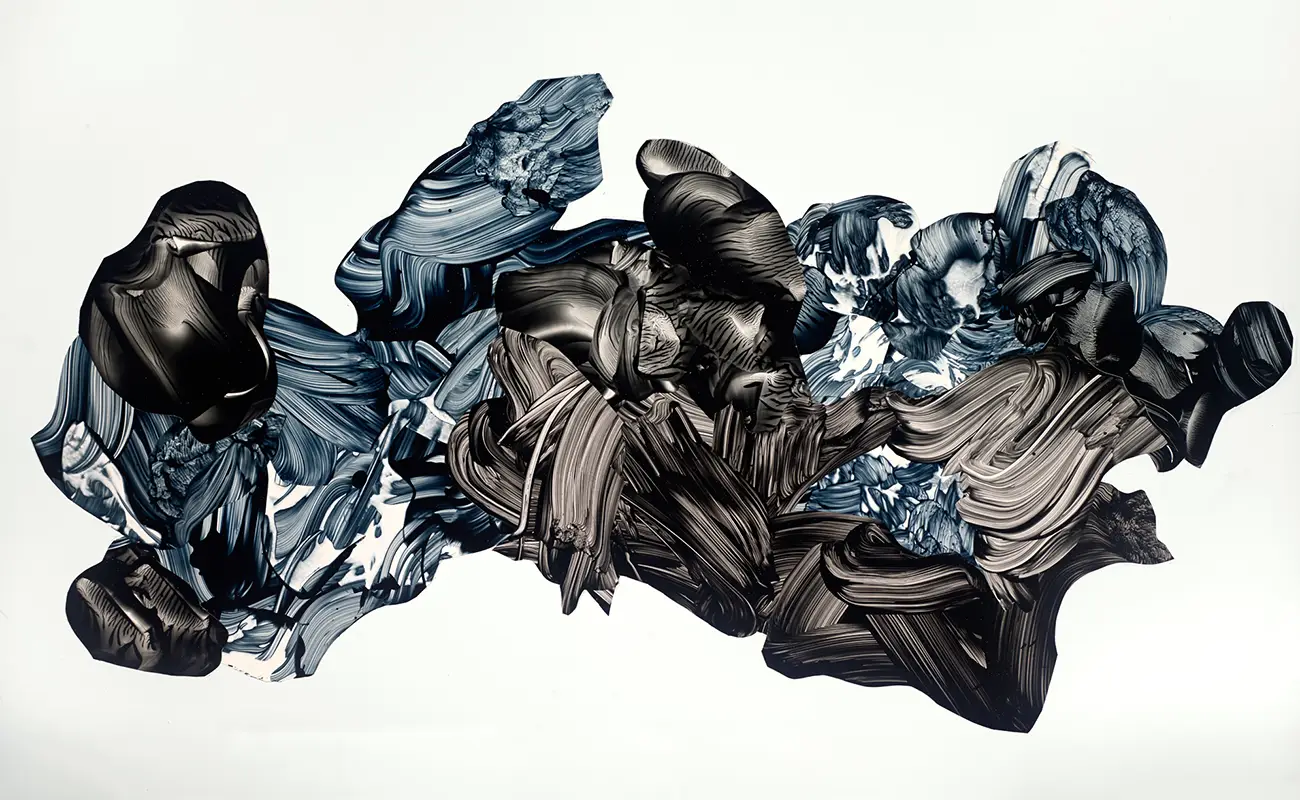
Central to D’Andrade’s work is an investigation of the tension between synthetic surfaces and organic form. His paintings and collages present slick, translucent layers that evoke the glow of pixelated screens while simultaneously referencing bodily structures and biological rhythms. This duality creates a visual language that feels both familiar and unsettled, reflecting contemporary life where digital interfaces shape how images are consumed and understood. Rather than depicting technology directly, he suggests its presence through surface, sheen, and structural repetition. The result is work that feels informed by digital culture yet remains rooted in physical process, resisting full assimilation into virtual aesthetics.
This balancing act extends to the emotional tone of the work, which oscillates between controlled construction and intuitive gesture. Viewers encounter compositions that feel carefully assembled, yet never static or overly resolved. The surfaces invite close inspection, revealing layers that shift depending on light and angle. These qualities establish D’Andrade’s practice as one that values ambiguity and sustained looking, encouraging an experience that unfolds gradually rather than offering immediate resolution. Through this approach, abstraction becomes a means of engaging with contemporary visual conditions without sacrificing material presence.

David D’Andrade: Education, Movement, and Artistic Evolution
D’Andrade’s artistic evolution reflects a series of geographic and conceptual shifts that shaped his approach to making art. His early training at Pratt Institute focused on illustration, immersing him in visual storytelling, graphic clarity, and image-based communication. During this period, he developed an enduring interest in comics, popular imagery, and modern art, influences that later resurfaced in more abstract forms. The move from New York to San Francisco marked a decisive turn, as his focus shifted away from illustrative clarity toward a more exploratory and expressive mode of working. At the San Francisco Art Institute, he encountered an environment that encouraged risk-taking and conceptual depth, leading him toward abstraction during the 1990s.
This period also marked the beginning of his dual identity as artist and educator. Teaching and exhibiting throughout the Bay Area allowed him to remain in active dialogue with peers and students, reinforcing the importance of process and critical exchange. Abstraction became a framework through which he could test ideas about structure, improvisation, and perception. Rather than adopting a single stylistic formula, he treated each body of work as an opportunity to reconsider how materials behave and how images are assembled. This openness remains a defining characteristic of his practice today.
The transition to Los Angeles in the 2000s introduced new visual stimuli and reinforced his engagement with urban environments. The city’s layered textures, signage, and street-level interventions provided an expanded field of reference, subtly informing his use of color and compositional density. Continuing to teach while maintaining a studio practice, D’Andrade cultivated a rhythm that allowed for sustained experimentation. His work from this period onward reflects an artist deeply committed to growth, viewing each shift in location and context as an opportunity to refine rather than redefine his core concerns.

Influences, Materials, and Visual Language
The visual language that defines D’Andrade’s work draws from a wide range of artistic and cultural influences, woven together through a disciplined yet flexible process. Early encounters with the work of Jasper Johns and Robert Rauschenberg offered a model for material hybridity and conceptual openness, demonstrating how everyday imagery and unconventional materials could coexist within a single composition. These influences aligned naturally with his interest in Dada and Surrealism, movements that valued chance, juxtaposition, and the disruption of conventional meaning. Over time, admiration for artists such as Mark Bradford, Bruce Conner, and Sigmar Polke further reinforced his commitment to layered surfaces and experimental construction.
Equally important are sources drawn from outside the traditional canon of fine art. Street graffiti, urban signage, and digitally enhanced scientific imagery have all informed his sense of form and color. These references do not appear as direct quotations but rather as structural echoes within the work. Saturated hues and repeated motifs suggest systems of information, while irregular edges and overlaps maintain a sense of instability. This synthesis allows his work to resonate with contemporary visual culture without becoming illustrative or didactic.
Material choice plays a critical role in sustaining this balance. Acrylic paint and specialized mediums are applied to drafting film and Yupo paper, materials that support translucency and reconfiguration. These surfaces allow paint to remain mobile longer, encouraging manipulation and adjustment. Through layering, cutting, and reassembling, D’Andrade builds compositions that feel assembled rather than painted in a single moment. The process foregrounds decision-making and revision, reinforcing the idea that abstraction can function as a constructed language shaped by both intention and responsiveness.

David D’Andrade: Collage, Process, and Forward Momentum
Among the most meaningful aspects of D’Andrade’s practice is his sustained engagement with collage as both method and philosophy. Rather than adhering to traditional canvas-based painting, he creates pre-cut painted shapes using squeegees and drywall tools, generating a library of forms that can be rotated, layered, and repositioned. This approach allows for continual adjustment, offering flexibility that fixed surfaces cannot provide. The ability to alter orientation and relationships between shapes becomes central to the work’s meaning, emphasizing adaptability and choice over permanence. This method underscores his interest in construction, treating each piece as an evolving configuration rather than a final statement.
The significance of this collage-based approach lies in how it reshapes the act of painting itself. By separating the creation of forms from their final placement, D’Andrade introduces a temporal gap that encourages reflection and experimentation. Decisions are revisited, compositions are tested, and outcomes remain open until the final assembly. This process resists the mythology of spontaneous abstraction, replacing it with a model that values revision and responsiveness. The resulting works maintain a sense of immediacy while revealing the thoughtful structure beneath their surfaces.
Looking ahead, D’Andrade remains focused on expanding the scale and scope of his painting and collage practice. Continued experimentation with larger formats and Yupo paper reflects an ongoing interest in how material behavior shifts with size. This forward momentum signals an artist committed to deepening rather than concluding his inquiry. Each new work builds upon established methods while remaining open to change, ensuring that his practice continues to evolve in dialogue with material, environment, and perception.