
Dream in Suburbia, Dream of Elsewhere
Dana James’s paintings do not simply occupy the gallery wall—they beckon, shimmer, and shift, pulling viewers into an invented nostalgia. A native of Manhattan now based in Brooklyn’s Bushwick neighborhood, James constructs work that references Americana through imagined objects and places she never truly experienced. Swimming pools, flickering televisions, and hammocks surface like distant artifacts from a life lived adjacent to her own. These elements drift in and out of abstraction, emerging as fragmented memories reassembled into compositions that feel simultaneously personal and unfamiliar. Her ability to conjure emotional topographies through color, light, and form has made her one of the most compelling voices in contemporary abstract painting.
Since graduating from the School of Visual Arts in 2008, James’s career has unfolded across major art hubs, with exhibitions in New York, Berlin, and beyond. Her works are housed in notable public and private collections, including the UBS Art Collection and Gibson & Dunn. Represented by Hollis Taggart Contemporary in New York and Bode Projects in Berlin, she continues to garner international recognition. Solo exhibitions such as Pearls & Potions (2023) and Something Meant to Say (2021) in New York, alongside Hushed Neon (2024) and Otherwise All Was Silent (2020) in Berlin, speak to her evolving visual language—one that explores memory, contradiction, and material transformation with unwavering intensity.
Her compositions often evoke the sensation of being on the edge of recall—like trying to remember a dream just after waking. This interplay of clarity and haze stems not only from the imagery but also from her technical approach. By manipulating media such as oil, acrylic, ink, encaustic, fabric, and resin, James constructs layers that hold air, light, and shadow within them. The result is a dreamy, semi-transparent surface that seems to glow from within. Her paintings are not passive objects; they shimmer with latent stories, often navigating the edge between beauty and its undoing.

Dana James: The Pulse of Process and Instinct
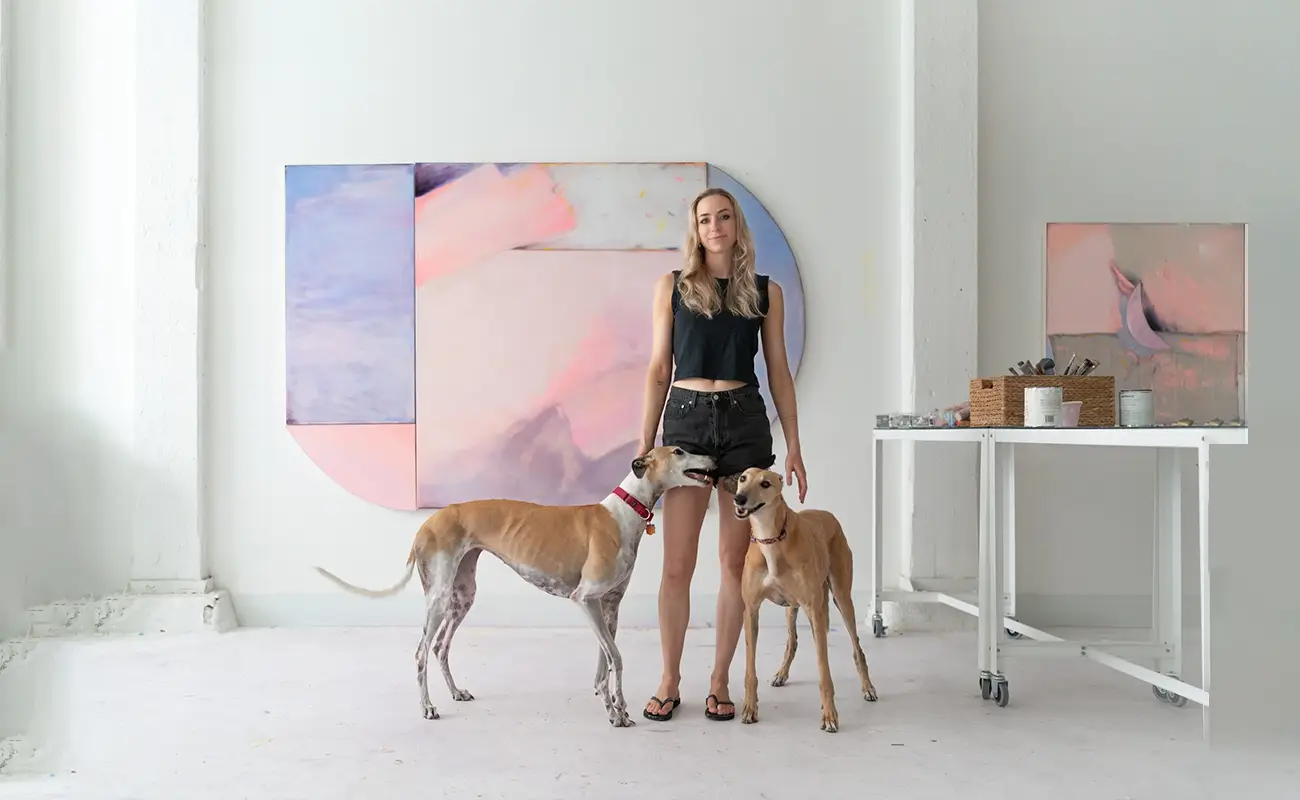
At the heart of Dana James’s studio practice is a deep commitment to exploration and a refusal to over-determine the outcome of her work. In Ridgewood, Queens, where she shares her light-filled studio with her two retired racing greyhounds, James begins her day with routine but leaves room for improvisation. Each painting emerges through instinct rather than rigid planning. She works across multiple canvases simultaneously, allowing the drying time of one layer to inform the rhythm of the next. Her palette is a mixture of delicately diluted pigments, and she speaks of her process as being grounded in both chemistry and spontaneity—a practice where precision and intuition meet.
James often describes her most successful pieces as those that seem to possess their own autonomy. Instead of forcing the composition, she follows it, letting the work dictate its own development. This philosophy reflects a broader ethos that permeates her artistic approach: a trust in the unknown and a reverence for the unexpected. In revisiting old pieces or past ideas, she engages with earlier versions of herself, reshaping what was once finished into something new. It’s a process she refers to as an act of loyalty to prior selves, where memory becomes a medium in itself.
Her technical toolkit includes unconventional materials such as flecks of tin foil and iridescent encaustic that catch the light in unpredictable ways. These choices underscore her fascination with contrast and duality. A work may feature radiant pastel hues that verge on the ethereal, only to be disrupted by raw texture or geometric weight. Her ability to navigate between softness and structural rigor, between luminous elegance and earthy imperfection, gives her compositions an emotional and visual complexity that resists easy classification. This tension is what keeps the work alive, compelling, and continually surprising.

Chromatic Characters and Abstract Personas
A recurring motif in James’s work is her use of titles that evoke human identity, though her pieces are never portraits in the traditional sense. Instead, works like Lady Danger, The Feral Empress, and The Soft Spoken One offer windows into emotional states, atmospheric conditions, or fleeting memories. These titles personify abstract elements, allowing color, shape, and gesture to become stand-ins for moods, identities, or even imagined narratives. Her paintings become more than visual experiences; they are conversations between seen and felt, suggesting that abstraction can be as psychologically charged as figurative representation.
James continually explores the balance between brightness and restraint. She is particularly interested in how a work can embody femininity and vibrancy without being dismissed as decorative. In one painting, she may push the limits of what is considered “beautiful,” only to undercut that sensibility in the next with deliberate disruption. This refusal to stay within a single emotional register mirrors her broader fascination with contradiction. By creating a dynamic interplay of softness and structure, James challenges the viewer to hold multiple truths at once—joy and melancholy, clarity and ambiguity, attraction and discomfort.
Her compositions echo a visual rhythm found not just in painting but also in her lifelong fascination with spectacle and transformation. A devoted wrestling fan since childhood, James sees parallels between the theatrics of wrestling and the performative aspects of abstraction. The over-the-top entrances, costumes, and emotional arcs of wrestling characters resonate with the layered personas in her artwork. Just as wrestlers embody archetypes that evolve over time, her abstract personae inhabit ever-shifting spaces, refusing to be pinned down by a singular interpretation. Each painting becomes its own stage—vivid, unpredictable, and charged with emotional resonance.

Dana James: Capturing Light, Memory, and the Edge of Time
James’s paintings often read as quiet meditations on the passage of time, with surfaces that seem to hold the memory of their own making. Her treatment of light—whether through shimmering encaustic glazes or reflective materials embedded in opaque fields—transforms the static canvas into a dynamic object that shifts with every angle. These surfaces conjure a sensation akin to the glint of ocean water or the flash of light glimpsed just before sleep, offering viewers a momentary escape from linear perception. Her work doesn’t seek to represent time but rather to hold it, as if preserving a fleeting emotion within layers of color and form.
She often references the idea of her paintings as visual diaries, encapsulating contradictions and moments of latency activated by sudden, impulsive gestures. These pieces oscillate between calculated structure and emotive freedom, embodying the unpredictable rhythm of thought itself. Drawing from 20th-century color field painting, James reinvents the genre through a lens that is both contemporary and deeply personal. She uses geometry and fluidity not as opposing forces, but as partners in shaping her visual lexicon—each element in conversation with the other, contributing to a larger story about impermanence and presence.
One of her most resonant concepts is the belief that materials can transcend their origins. Through her intricate layering of media, discarded and recycled supports, and shimmering additives, James elevates what might otherwise be overlooked. A piece like Fiona, composed of oil, acrylic, pigment, and collage, exemplifies this ethos. Similarly, works on paper such as Firefly and The Diver III showcase her sensitivity to scale and form, where even the most intimate compositions hold monumental weight. In every work, James invites the viewer not just to look, but to feel time, memory, and transformation caught mid-breath.